

Key Takeaway: Amazon product APIs provide programmatic access to product data including titles, prices, reviews, and inventory information. Over one million Amazon sellers use API-powered applications to automate their businesses, with enterprise solutions delivering 99.9%+ accuracy for mission-critical applications.
Key Terms:
- Amazon Product API: Software interface for accessing Amazon product information programmatically
- SP-API: Amazon’s Selling Partner API for authorized sellers
- ASIN: Amazon Standard Identification Number for products
- Real-Time Data: Information updated within seconds or minutes of changes
- Product Catalog API: Access to Amazon’s complete product database
- JSON Format: Structured data format for easy integration
Amazon’s marketplace contains over 350 million products, with data changing constantly. Manually tracking this information is impossible at scale, which is why businesses turn to Amazon product APIs for automated data access. These APIs provide structured, real-time access to product information that powers everything from competitive intelligence to inventory management.
In our tests integrating various Amazon product APIs, we found significant differences in data accuracy, update frequency, and coverage. Over one million Amazon sellers worldwide use API-powered applications to automate their operations, demonstrating the critical role these tools play in modern e-commerce.

What is an Amazon Product API?
An Amazon product API is a software interface that allows developers to programmatically retrieve product information from Amazon’s marketplace. Instead of manually browsing product pages, APIs deliver structured data directly to your applications.
Amazon product APIs typically provide access to:
- Product titles, descriptions, and specifications
- Pricing information and availability status
- Customer reviews and ratings
- Product images and media assets
- Seller information and fulfillment details
- Sales ranking and bestseller data
The primary advantage of using APIs over manual data collection is speed and scale. Where manual checking might cover 10-20 products daily, API-powered systems can monitor thousands of products simultaneously with real-time updates.
Why do businesses need Amazon product data?
Access to comprehensive product data enables several business-critical use cases:
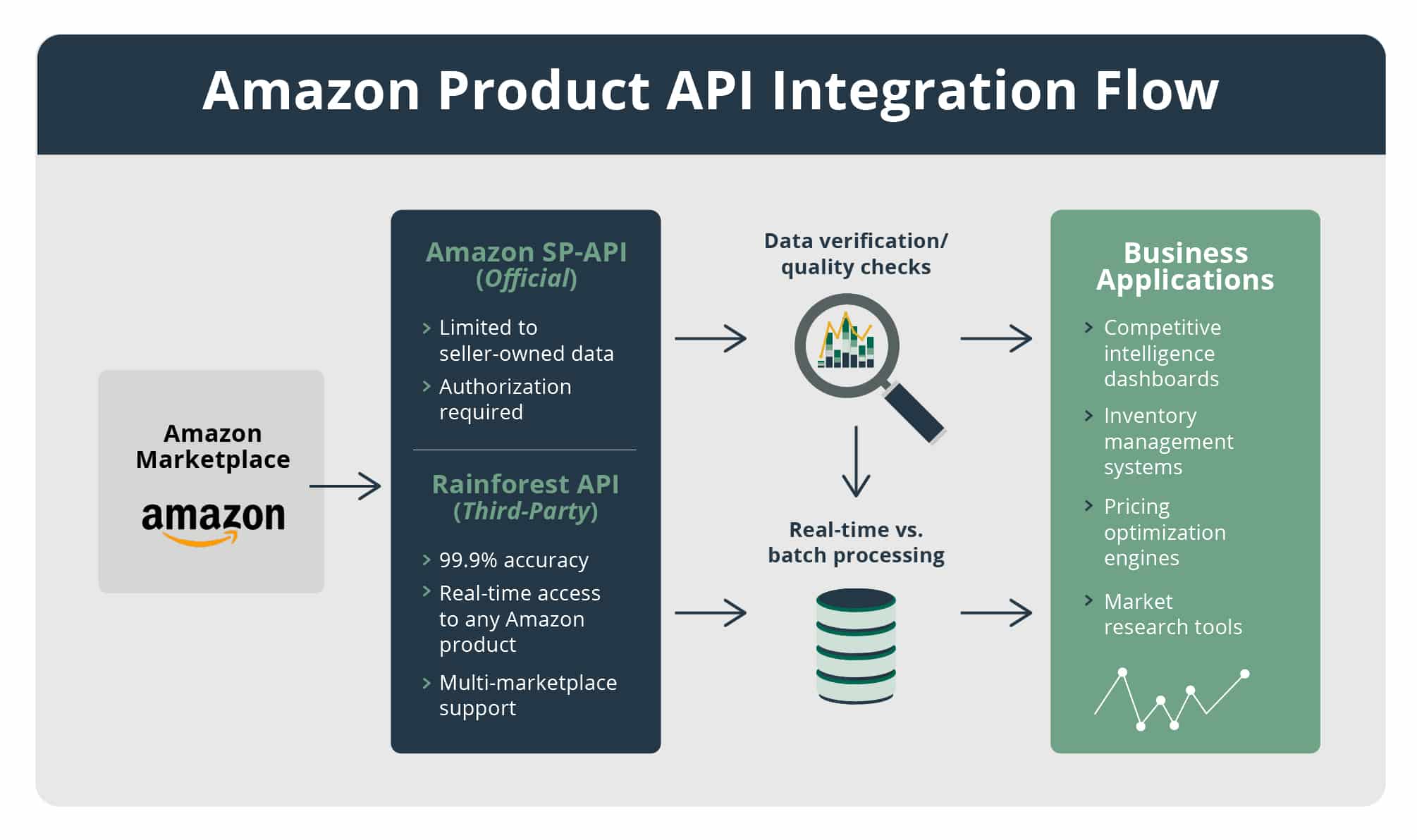
- Competitive Intelligence: Monitor competitor products, pricing, and market positioning
- Inventory Management: Track stock levels and availability across products
- Price Optimization: Implement dynamic pricing based on market conditions
- Content Strategy: Analyze successful product descriptions and optimize listings
- Market Research: Identify trending products and emerging categories
For detailed guidance on implementing these strategies, check our blog articles on e-commerce automation.
Amazon’s Official APIs
What is Amazon’s Selling Partner API (SP-API)?
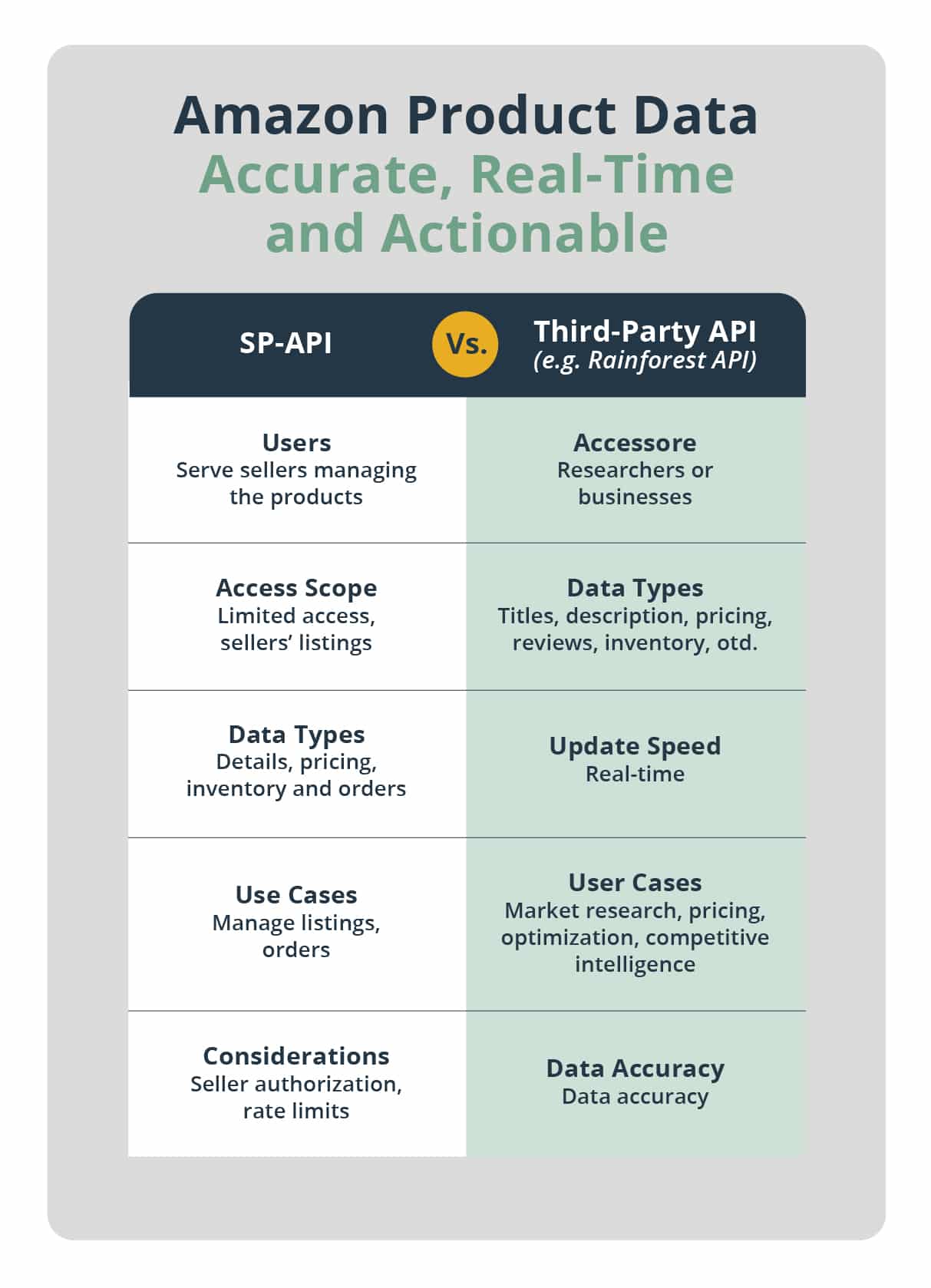
Amazon’s SP-API provides sellers with access to their own product listings and limited marketplace data. This official API serves sellers who need to manage their Amazon business programmatically.
Catalog Items API
Retrieve information about items in Amazon’s catalog, including product details, attributes, and classifications:
- Search by ASIN or keywords
- Product identifiers and dimensions
- Browse classifications
- Sales rankings
Listings Items API
Access and manage your own product listings, including pricing and inventory updates:
- Retrieve listing details
- Update product information
- Manage inventory levels
- JSON schema validation
Product Pricing API
- Featured Offer Expected Price (FOEP)
- Competitive price thresholds
- Buy Box pricing data
- Real-time price updates
What are the limitations of Amazon’s official APIs?
While powerful for sellers managing their own products, Amazon’s official APIs have constraints for broader market intelligence:
- Seller Authorization Required: Access limited to your own products
- Restricted Competitive Data: Limited visibility into competitor information
- Rate Limiting: Request quotas may restrict large-scale monitoring
- Complex Authentication: Requires application approval and ongoing compliance
For comprehensive competitive intelligence and market research, businesses often require additional solutions beyond Amazon’s official offerings. Our case studies show how enterprises overcome these limitations.
Third-Party API Solutions
How do third-party Amazon product APIs work?
Third-party APIs use web scraping technology to access publicly available Amazon product data. These services provide broader coverage than official APIs, enabling monitoring of any Amazon product regardless of ownership.
Enterprise Advantage: Traject Data’s Rainforest API delivers over 99.9% accuracy through automated quality assurance systems, providing enterprise-grade reliability for mission-critical applications.
What are the benefits of third-party solutions?
Third-party Amazon product APIs offer several advantages for businesses requiring comprehensive market data:
- Universal Access: Monitor any Amazon product, not just your own
- No Seller Authorization: Access data without Amazon seller account requirements
- Comprehensive Coverage: Extract all visible product information
- Flexible Integration: Support for various output formats and delivery methods
- Scalable Performance: Handle large-volume requests efficiently
How do you choose the right third-party API?
When evaluating third-party Amazon product APIs, consider these factors:
- Data Accuracy: Look for providers with verification systems and quality assurance
- Update Frequency: Ensure real-time or near real-time data refresh
- Coverage Scope: Verify support for required Amazon marketplaces
- Integration Options: Confirm compatibility with your technical infrastructure
- Reliability: Check uptime guarantees and service level agreements
For technical implementation details, review our comprehensive documentation.
Amazon Product Search API Examples
How do Amazon product search APIs work?
Amazon product search APIs allow you to query Amazon’s catalog using keywords, categories, or product identifiers. Here’s a real example of how these systems work:
GET /catalog/2022-04-01/items/B08N5WRWNW
Host: sellingpartnerapi-na.amazon.com
Authorization: Bearer [access_token]
x-amz-access-token: [access_token]
marketplace-ids: ATVPDKIKX0DER
included-data: attributes,images,productTypes,salesRanks,summaries
{
  "asin": "B08N5WRWNW",
  "attributes": {
    "item_name": [
      {
        "value": "Wireless Bluetooth Headphones",
        "language_tag": "en_US"
      }
    ],
    "brand": [
      {
        "value": "AudioTech",
        "language_tag": "en_US"
      }
    ],
    "list_price": [
      {
        "value": {
          "amount": 129.99,
          "currency": "USD"
        }
      }
    ]
  },
  "images": {
    "primary": {
      "large": {
        "url": "https://m.media-amazon.com/images/I/example.jpg",
        "height": 500,
        "width": 500
      }
    }
  },
  "productTypes": [
    {
      "productType": "HEADPHONES",
      "marketplaceId": "ATVPDKIKX0DER"
    }
  ],
  "salesRanks": [
    {
      "productCategoryId": "electronics",
      "rank": 1547,
      "classificationRanks": [
        {
          "classificationId": "wireless_headphones",
          "title": "Wireless Headphones",
          "rank": 89
        }
      ]
    }
  ]
}
[Code source: Amazon SP-API Catalog Items documentation – https://developer-docs.amazon.com/sp-api/docs/catalog-items-api-v2022-04-01-reference]
What data can you search for?
Amazon’s Catalog Items API supports searches by identifiers or keywords, returning comprehensive product information:
- Product Details: Titles, descriptions, brands, specifications
- Visual Assets: Product images in multiple sizes and variations
- Classification Data: Categories, browse nodes, product types
- Market Performance: Sales rankings across categories
- Pricing Information: List prices and currency details
Ready to try this yourself? Explore our interactive API demo to see real Amazon product data in action.
Amazon Product API Pricing Models
How much do Amazon product APIs cost?
Amazon product API pricing varies significantly between official and third-party solutions:
Amazon SP-API Costs
- New AWS customers receive up to $200 in free tier credits starting in 2025
- One million API calls per month included for 12 months
- Standard pay-as-you-go rates apply after free tier
Third-Party API Pricing
- Consumer Tools: Free to $20/month for basic monitoring
- Business Solutions: $100-500/month for moderate volume
- Enterprise Platforms: Custom pricing for high-volume needs
In our experience implementing these solutions, the total cost depends on several factors:
- Request Volume: Number of API calls per month
- Data Complexity: Types of product information required
- Update Frequency: Real-time vs. batch processing needs
- Integration Support: Technical assistance and documentation
What factors affect API pricing costs?
When evaluating Amazon product API pricing, consider these cost drivers:
- Data Accuracy Requirements: Higher accuracy typically costs more
- Geographic Coverage: Multiple marketplaces increase complexity
- Custom Features: Specialized data processing or delivery
- Support Level: Technical assistance and SLA guarantees
For detailed pricing information tailored to your needs, check our frequently asked questions about API costs.
Real-Time vs. Batch Data
Why is real-time data important for Amazon products?
Amazon’s dynamic marketplace requires current information for effective decision-making. Real-time Amazon data APIs source information directly from Amazon with response times between 1-5 seconds, ensuring you have the most current information available.
Real-time data provides critical advantages:
- Competitive Response: React immediately to competitor price changes
- Inventory Alerts: Know instantly when products go out of stock
- Deal Monitoring: Catch lightning deals and limited-time offers
- Buy Box Changes: Monitor when featured seller positions shift
When is batch data sufficient?
For certain use cases, periodic batch updates may meet requirements while reducing costs:
- Historical analysis and trend identification
- Content optimization and SEO research
- Market research and category analysis
- Long-term competitive intelligence
The choice between real-time and batch data depends on your specific business needs and response time requirements.
Implementation Guide with Code Examples
How do you get started with Amazon product APIs?
Follow these steps to implement Amazon product data collection:
- Define Requirements: Identify what product data you need and update frequency
- Choose Your Solution: Select between official APIs for your own products or third-party solutions for broader coverage
- Plan Integration: Design how data will flow into your existing systems
- Test Implementation: Start with a small dataset to verify accuracy and performance
- Scale Gradually: Increase volume and frequency based on initial results
What does a complete API integration look like?
Here’s a practical example using third-party APIs for comprehensive product monitoring:
import requests
import json

# Search for products by keyword
search_params = {
    'api_key': 'your_api_key',
    'type': 'search',
    'amazon_domain': 'amazon.com',
    'search_term': 'bluetooth headphones',
    'sort_by': 'price_low_to_high'
}

response = requests.get('https://api.rainforestapi.com/request', params=search_params)
search_data = response.json()

print(f"Found {len(search_data['search_results'])} products")
{
  "search_results": [
    {
      "position": 1,
      "title": "Sony WH-1000XM4 Wireless Headphones",
      "asin": "B0863TXGM3",
      "link": "https://www.amazon.com/dp/B0863TXGM3",
      "image": "https://m.media-amazon.com/images/I/example.jpg",
      "rating": 4.4,
      "ratings_total": 73891,
      "price": {
        "symbol": "$",
        "value": 278.00,
        "currency": "USD"
      },
      "is_prime": true,
      "is_amazon_choice": true,
      "availability": {
        "type": "in_stock",
        "raw": "In Stock"
      }
    }
  ],
  "pagination": {
    "current_page": 1,
    "total_pages": 16,
    "results_per_page": 16
  }
}
Want to see this in action? Access our full documentation for complete code examples and integration guides.
What are common implementation challenges?
Based on our experience helping businesses implement Amazon product APIs, common challenges include:
- Data Quality Validation: Ensuring accuracy and consistency of retrieved information
- Rate Limit Management: Optimizing request patterns to avoid throttling
- Error Handling: Building robust systems to handle API failures gracefully
- Data Storage: Designing efficient storage for large volumes of product data
For guidance on overcoming these challenges, explore our case studies featuring successful API implementations.
Frequently Asked Questions
What is an Amazon product API?
An Amazon product API is a software interface that allows developers to programmatically access Amazon product data including titles, descriptions, prices, reviews, availability, and seller information in real-time. It eliminates the need for manual data collection by providing structured access to Amazon’s product database.
What’s the difference between Amazon’s official APIs and third-party solutions?
Amazon’s official APIs like SP-API serve sellers managing their own products with authorized access to specific data. Third-party APIs provide broader access to any Amazon product data for competitive intelligence and market research, without requiring seller authorization or product ownership.
How accurate is Amazon product API data?
Data accuracy varies by provider. Official Amazon APIs provide highly accurate data for authorized products. Quality third-party providers like Traject Data’s Rainforest API deliver over 99.9% accuracy through automated quality assurance systems and real-time data verification.
What types of product data can I access through APIs?
Amazon product APIs provide access to comprehensive data including product titles, descriptions, pricing, availability, customer reviews, ratings, seller information, images, specifications, category data, and sales rankings. The specific data available depends on the API provider and access level.
How fast can I get Amazon product data through APIs?
Real-time APIs typically respond within 1-5 seconds, providing current product information. Batch APIs may have longer processing times but can handle larger data volumes efficiently. Response times depend on the complexity of requests and API provider infrastructure.
Do I need technical expertise to implement Amazon product APIs?
Basic programming knowledge helps, but many API providers offer user-friendly interfaces, documentation, and support. Some solutions provide no-code options or managed services. The complexity depends on your specific integration requirements and chosen solution.
Ready to See What Traject Data Can Help You Do?
We’re your premier partner in web scraping for eCommerce data. Get started with one of our APIs for free and see the data possibilities that you can start to collect.