Skip to content

Decoding the AI Shift: How to Scrape Google AI Overviews and Boost Your Click-Through Rate (CTR)

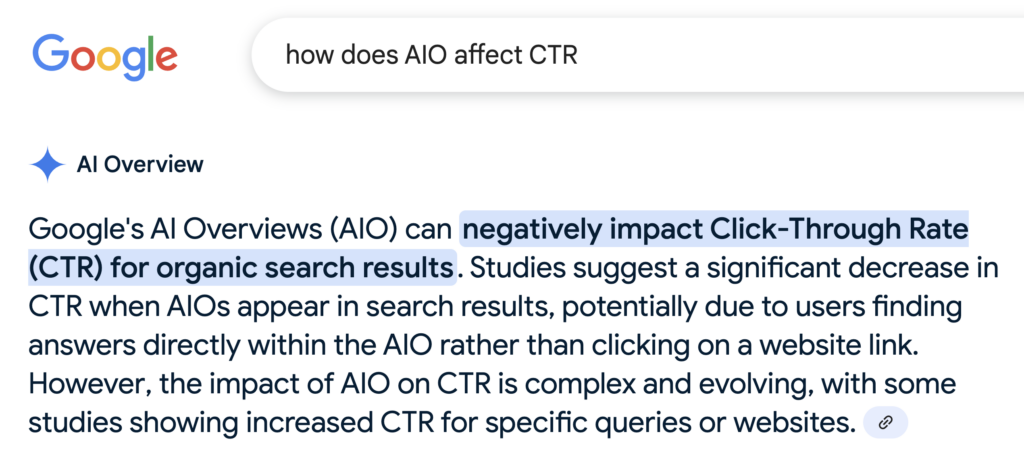
AI is rewriting the rules of Search Engine Optimization (SEO) and reshaping how marketers think about Click-Through Rates (CTR). Traditional SEO strategies are no longer enough. The rise of AI-generated answers—especially Google’s AI Overviews (AIO)—is changing what shows up on the search results page and what actually gets clicked.

In this post, we’ll break down what’s changed, how AI Overviews are impacting CTR, and most importantly—how to scrape Google AI Overviews and CTR data using Traject Data’s SERP API to stay ahead.
AIO and CTR

The AIO Effect: How AI Overviews are Reshaping Google CTR

It used to be simple: rank on page one (ideally in the top three positions), and the clicks would follow. CTR was the go-to metric to measure SEO success. But now, AI is sitting between users and your content.

With Google’s AI Overviews (AIO), along with platforms like ChatGPT and Perplexity, users are getting full answers—often without clicking anything. Instead of ten blue links and a featured snippet, they’re served a complete summary generated by AI.

This shift is having a measurable impact:

  • Ahrefs found that when an AIO appears, the #1 organic result sees a 34.5% drop in CTR.
  • Amsive reported a 15.49% average decline across 700,000 keyword results, with non-branded queries showing nearly 20% drops.
  • Advanced Web Ranking (AWR) revealed that AIOs now appear in 42.5% of search results, an 8.8-point jump in just one quarter. This rise has been directly linked to falling CTRs—especially on desktop.

As Dan Popa from AWR puts it:

“This surge in AI Overviews may be impacting clickthrough rates for organic listings, as informational content is increasingly getting overrun by these AI-generated summaries.”

How AI Overviews Affect Google CTR

Even if you’re still ranking on page one, you could see significant traffic declines if you’re not cited in the AI Overview. Informational content—once a reliable traffic driver—is being displaced.

Some of the hardest-hit industries include:

  • Science: Down 6.03 percentage points in CTR during Q4—the biggest drop tracked (Search Engine Journal).
  • Careers: Despite a 334% rise in demand, top 3 positions lost 4.34 CTR points.
  • Shopping: Even with a 142% increase in holiday search volume, CTR dropped across both mobile and desktop.

Only a few sectors—like business and fashion—saw CTR improvements. For everyone else, the new question is no longer “What’s my rank?” but “Am I in the AI Overview?

How to Rank in AI Overviews to Improve CTR

To stay competitive in this AI-first search environment, here are five practical ways to optimize your content and monitoring strategies:

  1. Identify AIO-Triggered Queries
    Segment your keyword data to isolate searches that consistently trigger AI summaries.
  2. Structure Your Content for AI
    Use clean markup, concise value-driven sections, and trustworthy signals like cited sources.
  3. Optimize for Concepts, Not Just Keywords
    AI prefers broad topical relevance. Link your content to high-level ideas and semantically related terms.
  4. Track New Traffic Sources
    Monitor referrals from tools like Perplexity, Brave, and other AI-driven engines.
  5. Evaluate Your Data Infrastructure
    Make sure your partners and tools can adapt to the fast-evolving landscape of AI-generated search.

How to Scrape Google AI Overviews and CTR with Traject Data’s SERP API

If you’re trying to figure out how to scrape Google AI Overviews and track CTR, Traject Data has you covered.

Our SERP API is built for scale, speed, and resilience—capable of handling billions of monthly requests and delivering millions of high-quality records in just days. Whether you’re tracking visibility across volatile search results or trying to understand where your brand shows up in AI summaries, we provide the infrastructure to support it.

Here’s what makes Traject Data different:

  • Rapid scaling during critical visibility windows
  • High-accuracy scraping of search results, including complex SERP layouts
  • Resilience against anti-scraping protections
  • Customizable data feeds designed for SEO, pricing, and brand monitoring

While we don’t yet offer a dedicated AI citation tracking product, we’re actively collaborating with forward-thinking partners to develop solutions. Our platform is designed to evolve with the search landscape—AI Overviews included.

Key Takeaways

  • AI-generated summaries are cutting into traditional CTR, even for top-ranking content.
  • Being cited in the AI Overview may soon matter more than being #1 in organic results.
  • Studies from Ahrefs, Amsive, and AWR confirm measurable CTR declines linked to AIO growth.
  • Traject Data’s SERP API is ready to help you monitor and adapt to these changes at scale.
  • If you’re serious about protecting your organic visibility, it’s time to measure where you stand in AI-driven search.

Curious about how your brand shows up in AI Overviews—and how to scrape Google AI Overviews and CTR data at scale? Explore Traject Data’s SERP API and start building for an AI-first search world today.

Ready to See What Traject Data Can Help You Do?


We’re your premier partner in web scraping for SERP data. Get started with one of our APIs for free and see the data possibilities that you can start to collect.

Navigating the AI Search Engine Wars: How SERP APIs Keep You Ahead of the Curve

This article explores the current state of the AI search engine wars, the major players involved, and how SERP APIs like Traject Data’s SERPWow can help you stay on top of the game.

The AI Search Engine Wars: What’s Happening?

The “AI search engine wars” refer to the growing competition among tech giants like Google, Microsoft, and Meta—alongside AI pioneers like OpenAI—to develop the most advanced AI-powered search engines. When ChatGPT was released in 2022, many began questioning whether AI could eventually replace traditional search engines. Google’s quick restructuring and aggressive development of AI initiatives show it’s not taking ChatGPT lightly. Other players, both old and new, are also entering the fray, aiming to redefine the search landscape.

 A Timeline of the AI Search Engine Wars

The AI search engine landscape has rapidly evolved, with major tech companies introducing AI-driven features to enhance user experience. Here’s a timeline:

  • November 2022: OpenAI releases ChatGPT, a conversational AI model that brings generative AI to the mainstream. Within five days, it had more than a million users. Users begin turning to ChatGPT for information previously found on Google search. 
  • January 2023: Microsoft invested another $10 billion in OpenAI, bringing its total investment to $13 billion, laying the groundwork for future AI integrations.
  • February 2023: Microsoft integrates OpenAI’s GPT-4 model into Bing, enhancing search functionalities with AI capabilities.
  • March 2023: Google unveiled Bard, its AI chatbot, an open-access tool to rival OpenAI’s ChatGPT, later rebranding the technology as Gemini.
  • December 2023: Google releases Gemini, its latest AI model, claiming to surpass previous state-of-the-art models on most benchmarks.
  • May 2024: Google introduced its Search Generative Experience (SGE) now referred to as AI Overviews at the top of search results, aiming to provide AI-generated summaries to user queries.
  • July 2024: OpenAI launched SearchGPT in phases, starting with a limited release to 10,000 test users on July 25, 2024.
  • October 2024: Meta is pursuing its own AI search engine to put inside its Meta AI tool to replace operations inside Meta that are currently using Google search or Bing.
  • December 2024: OpenAI announces that ChatGPT’s AI search engine is rolling out to all users, both free and paid, expanding access to AI-driven search capabilities.

How AI is Changing Search Engine Optimization (SEO)

These developments underscore the rapid advancements in AI integration within search engines, as companies strive to enhance user experience and redefine search paradigms.

AI is not just changing how search engines function—it’s rewriting the rules of SEO. If AI-powered overviews and chat-style results feel ubiquitous, that’s because they’re reshaping user behavior and, by extension, SEO strategies. AI is transforming search by prioritizing intent and context over traditional keyword-based indexing. Features like conversational queries, personalized results, and AI-generated summaries are becoming the new standard.

Key trends in AI-driven SEO include:

  • Shift to Context and Intent: AI-powered search engines prioritize the user’s intent and context, moving away from a purely keyword-centric approach.
  • Importance of Structured Data: Schema markup and structured data have become essential to helping AI systems understand and surface content effectively.
  • Frequent Algorithm Updates: With AI driving rapid updates, staying current with algorithm changes has become more challenging than ever.

For marketers, this means adapting strategies to align with the evolving landscape, making tools like SERP APIs indispensable.

The Role of SERP APIs in the AI Search Landscape

A SERP API (Search Engine Results Page API) is a tool that provides programmatic access to real-time search engine data. It’s like having a backstage pass to search engine performance, offering invaluable insights for marketers.

Key Benefits of SERP APIs:

  1. Real-Time Data: Access up-to-the-minute ranking data across multiple search engines, including Google, Bing, and Amazon.
  2. Competitive Analysis: Monitor competitors’ rankings and identify trends.
  3. Dynamic Adjustments: Quickly adapt SEO strategies based on algorithm updates and emerging AI-driven features.
  4. Brand management: Track online mentions of your brand and monitor online reviews.  

By leveraging SERP APIs, marketers can stay proactive, ensuring their strategies align with the latest search engine advancements.

Practical Tips for Leveraging SERP APIs

To get the most out of SERP APIs in the AI search era, consider these actionable tips:

  • Monitor Rankings Regularly: Set up automated monitoring to track ranking changes on both traditional and AI-powered search engines.
  • Analyze AI Features: Pay attention to AI-specific elements like rich snippets and conversational search results to identify optimization opportunities.
  • Optimize for Context: Use insights from SERP APIs to fine-tune your content for both intent-based and traditional ranking factors.

How Traject Data’s SERPWow API Can Help

The AI search engine wars are transforming how we think about search and SEO. Staying agile in this rapidly evolving landscape requires the right tools, and SERP APIs like Traject Data’s SERPWow are essential for maintaining a competitive edge.

Ready to future-proof your SEO strategies? Start leveraging Traject Data’s SERPWow API to stay ahead in the AI search engine wars.

Ready to See What Traject Data Can Help You Do?


We’re your premier partner in web scraping for SERP data. Get started with one of our APIs for free and see the data possibilities that you can start to collect.

Capture Google AI Overviews Data with Our SERP APIs

Traject Data is ready to support you as you expand from just traditional SEO strategy into the rapidly developing world of GEO (Generative Engine Optimization) – optimizing for generative AI and answer engines. SerpWow, Scale SERP and VALUE SERP now provide Google AI Overviews data to support your efforts in understanding and growing generative search performance.

As you’re probably already aware, AI-driven search is transforming traditional search and SEO. Generative search results are meant to provide faster and more personalized answers, leading to a drastic change in the traditional SERP. Where there is an AIO result on the Google SERP, there is now even less room for traditional organic results. Brands now have to compete not just for Google ranking, but for visibility i.e with an AIO.

      So what can the AIO data help you to do?

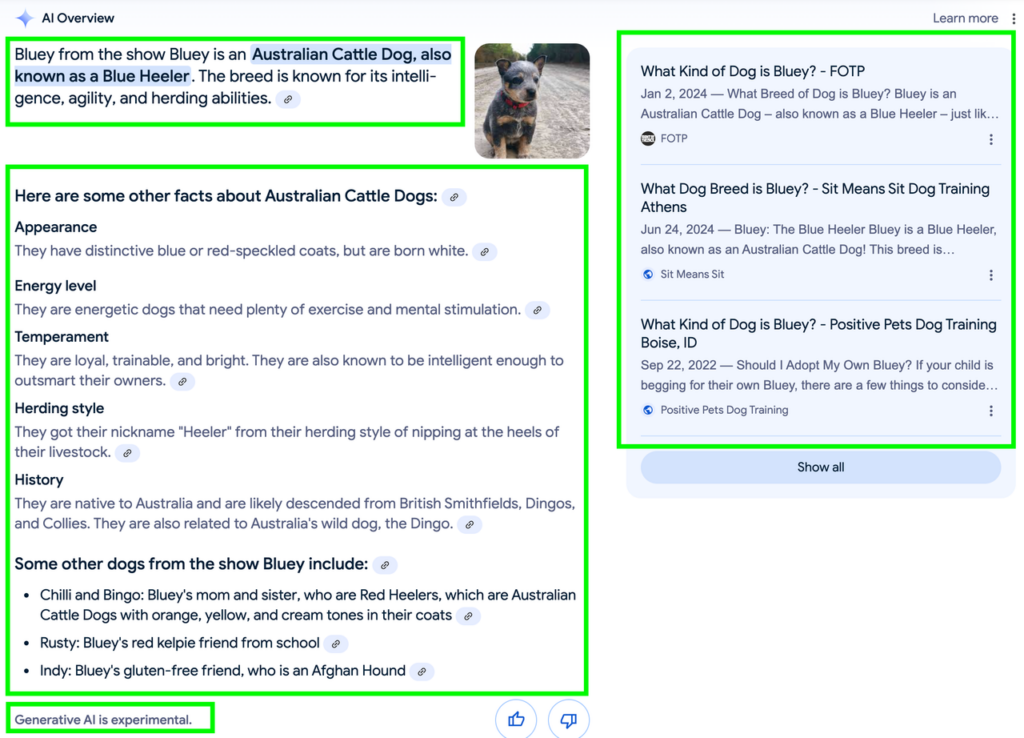
      • Analyze AI-generated content structures, topics, citations and how they are evolving over time
      • Adapt content: The new data can help you understand Search Algorithm changes so you can adjust your keyword strategies
      • Optimize for AI-driven features so you can increase visibility

      Feature Details

      How to Request AI Overview Data

      1. Set engine=google (SerpWow only) and include_ai_overview=true as a parameter in your request
      2. Make sure domain is set to .com (or input a US location)
      3. Make sure you do not make it a mobile search (desktop only!)

      Data Returned

      ai_overview_banner – the banner
      ai_overview_contents

      • type – header or list
      • text – content (of header or list)

      ai_overview_sources

      • source_title
      • source_description
      • source_url
      • source_image
      • source_name

      What’s Next

      Look out for mobile AIO results from our SERP APIs – coming before the end of the year!

      Ready to See What Traject Data Can Help You Do?


      We’re your premier partner in web scraping for SERP data. Get started with one of our APIs for free and see the data possibilities that you can start to collect.

      Traject Data is Your Premier Partner in Web Scraping


      Join thousands of satisfied users worldwide who trust Traject Data for all their eCommerce and SERP data needs. Whether you are a small business or a global enterprise, our entire team is committed to helping you achieve your goals and stay ahead in today's dynamic digital landscape. Unlock your organization's full potential with Traject Data. Get started today.

      Get started today