Skip to content

Amazon Pulls Out of Google Shopping Ads: How Ecommerce APIs Keep PPC Agencies Ahead

AI shopping agents are no longer science fiction. Numerous engines like Google, ChatGPT, and Perplexity are now designed to provide personalized shopping advice, product comparisons, and recommendations. 

That’s great for buyers, but not so great for Amazon. Why? Because Amazon is losing control of the shopper experience.

As Marketplace Pulse founder Juozas Kaziukėnas puts it:

“Shopify and Amazon aren’t afraid of AI shopping in principle. They’re afraid of AI shopping they don’t control. They’re betting they can block the competition’s tools long enough to build their own and make them the standard.”

Welcome to the AI Shopping Wars.

Amazon vs. Google: From Partners to Rivals

For years, Amazon and Google worked together. Amazon spent heavily on Google Shopping ads, and Google benefited from Amazon’s retail dominance. But that partnership has fractured.

In May 2025, Google announced significant advancements in AI-powered shopping, including automated purchases for users. If shoppers rely on AI-shopping agents instead of browsing Amazon, it’s a direct hit to Amazon’s ad revenue and customer loyalty.

Amazon’s response has been swift and aggressive:

  1. Blocking AI crawlers. Amazon cut off Google from crawling its product listings. Earlier in the year, it did the same with ChatGPT, Claude, and Perplexity, making Amazon listings invisible in many AI-driven shopping tools.
  2. Pulling out of Google Shopping ads. Amazon discontinued all of its Google Shopping ads, causing Google to lose one of its biggest retail advertisers.
  3. Launching its own AI agent. Amazon introduced “Buy for Me”, an AI shopping assistant that keeps the shopper fully inside Amazon’s ecosystem.

Amazon isn’t just protecting its ad spend, it’s reclaiming total control over the customer journey.

The Challenge for Digital Marketing Agencies

When Amazon changes the rules, your clients feel it immediately:

  • CPC swings wreck campaign efficiency. Cost-per-click (CPC) rates have dropped by 1–4% on average, with some categories seeing declines as steep as 40%. Others report drops of 7–12% across verticals.
  • Visibility disappears overnight. If Amazon isn’t bidding, the entire ad landscape shifts in unpredictable ways.
  • Competitor pricing volatility. Stockouts, coupon launches, and delivery slowdowns can flip the script with no warning.

For PPC and digital marketing agencies, relying on guesswork isn’t an option.

The Opportunity: Data-Driven Agencies Win

Agencies that can see the shifts in real time will not only protect their clients, they’ll gain trust, renew contracts, and upsell services.

Take the example from Elizabeth Greene’s team at Junglr: they tested a bidding hack in the supplements category (surfaced by Brandon Young) and unlocked impressions without raising bids. That’s not just a clever hack, it’s proof that when you have the right data inputs, you can turn volatility into opportunity.

That’s where Traject Data’s SERP and ecommerce APIs come in.

The Ecommerce Web Scraping API Advantage

Two APIs in the Traject Data suite, SERPWOW and Rainforest, give agencies the visibility they need:

  • SERPWOW: Track who is winning or losing placements for any keyword in real time. Capture both ad slots and organic rankings.
  • Rainforest: Enrich those ASINs with pricing, stock, delivery speed, and coupon data.

Together, they give you the competitive intelligence Amazon doesn’t want you to see.

Workflow for PPC Agencies

Here’s how digital marketing agencies can put Traject Data’s ecommerce APIs to work:

Step 1: See who’s on the page (SERPWOW)

  • Run keyword SERPs and capture ad placements.
  • Show clients exactly how visibility shifts when Amazon pulls out of auctions.

Step 2: Pull competitive product details (Rainforest)

  • Feed ASINs from SERPWOW into Rainforest’s Product Details endpoint.
  • Track pricing moves, coupon launches, and stock levels.

Step 3: Compare over time 

  • Run API calls hourly, daily, or in sync with campaigns.
  • Spot volatility like stockouts, delivery delays, or aggressive price cuts.

Step 4: Trigger smarter bidding

  • Ramp bids when rivals run out of stock.
  • Shift spend when delivery slows.
  • Decide when to defend against price cuts, and when to let competitors bleed margin.

Example API Calls

  • SERPWOW Search Endpoint → Capture ASINs and placements for a keyword in real time.
  • Rainforest Product Details Endpoint → Enrich those ASINs with pricing, stock, and delivery data.

Combine the two data sets for insights you can turn into action for clients immediately.

Putting It All Together

The AI Shopping Wars are here, and Amazon pulling out of Google Shopping ads is just the beginning. Who knows what will be next. The only way agencies can stay ahead is with real-time ecommerce data.

With Traject Data’s APIs, you can:

  • Retention → Answer tough client questions with hard evidence.
  • Upsell → Turn sharper insights into premium services.
  • Scale → Apply one proven workflow across your entire client portfolio.

In a market where Amazon is rewriting the rules daily, ecommerce APIs give PPC agencies the edge they need to keep clients confident and campaigns profitable.

The Anti-Bot Arms Race Is Here – Part 2

Part 2 of 2: Build vs. Buy in 2025

Let’s not overcomplicate this. We’re not talking about scraping Google or launching a full-blown marketplace monitoring operation. This is basic. One site. A few thousand pages. No logins. No personalization. Just a straightforward scrape.

And even that is falling apart faster than most teams can keep up with.

DIY Always Starts Easy

It starts with a script. Add some proxies. Maybe a CAPTCHA solver. Schedule it to run at night.

Feels like it’s working—until:

  • The site layout changes and your selectors stop working
  • CAPTCHAs trigger every fifth request
  • Your proxies get flagged and traffic slows to a crawl
  • The script still runs, but it’s quietly collecting junk

No alerts. No stack trace. Just broken data that looks fine—until someone actually reads it.

What It Really Takes to Keep a Scraper Alive

Even at small scale—one or two ecommerce sites, a few thousand pages a day—here’s what it actually takes to keep that setup running:

Task DIY Cost
Proxy/IP rotation $1,000–$2,500/month
CAPTCHA solving $250–$750/month
Engineering time 5–10 hours/week
Monitoring & alerts Often skipped

That adds up to $75K–$100K per year. And that’s just to stay functional. No load balancing. No redundancy. Just holding things together with duct tape and hope.

Quiet Failures Are the Most Dangerous

Most scrapers don’t fail loudly. They fail silently.

We’ve seen teams scrape a product page for weeks before realizing a key field was returning an empty string. The job ran. The logs were clean. The data was useless.

In one case, a pricing team missed a competitor’s discount campaign for nearly two weeks. Their scraper had been flagged and was only returning cached content. The reports looked fine. Until they weren’t.

The Real Cost Isn’t Tools—It’s Time

Sure, proxies and CAPTCHA solvers cost money. But the real drain is your team’s time.

Every hour spent chasing 403s and tweaking selectors is time not spent on product, customers, or shipping real features. And usually, scraping isn’t anyone’s actual job. It’s just something someone agreed to “get working.”

Now you’re maintaining infrastructure you never meant to build.

Specialization Wins in 2025

In 2025, scraping isn’t just a technical task. It’s an operational discipline.

And that changes the conversation. The question is no longer “what will it cost to build?” It’s “what else will we not be doing because we’re choosing to build this?”

Hardly anyone builds their own payment stack or email system anymore. Scraping is heading in the same direction. Not because it’s impossible, but because it no longer makes sense to compete with specialists when your edge lies somewhere else.

A good scraping partner doesn’t just write code. They’ve already built the browser behavior, detection evasion, fallback logic, and monitoring you’ll wish you had when your script quietly breaks on a holiday weekend.

You’re not outsourcing scraping because it’s hard. You’re outsourcing it because your team has more important problems to solve.

Final Word: Can You Carry It?

If you’re just testing the waters or pulling a few pages, go for it. No judgment.

But if scraped data is powering decisions, reports, or products, then it’s not a script anymore. It’s a system.

And systems need owners. They need monitoring. They need attention.

So the real question isn’t “Can we build this?”
It’s “Do we want to carry it?”

If the answer’s yes, build it and build it right.
If not, find a partner who treats it like the critical infrastructure it is.

Traject Data eCommerce APIs

Complete real-time ecommerce product information scraper APIs for product development, price strategy and market research.

Explore the APIs

The Anti-Bot Arms Race Is Here…and It’s Killing DIY Scraping

Part 1 of 2: Why brand protection teams can’t afford to go it alone anymore

Scraping Ain’t What It Used to Be

If I had a dollar for every customer who thought they could spin up a few scripts and scale overnight, I’d be somewhere sunny, pretending I didn’t even know what a 429 error was.

We’ve seen teams buy scraping vendors thinking they were getting a well-oiled machine. What they got was fragile scripts and burned IPs. Others try to bolt scraping onto their existing roadmap. “We’ll just run it in the background,” they say. But scraping never stays in the background for long.

Now we’re in the age of AI, and everyone thinks they’ve found a shortcut. Just ask a natural language agent to spit out some code and voilà, instant scraper. Sorry to break it to you, but AI recognizes AI. That’s one of the fastest ways to get detected and blocked. Static, auto-generated code isn’t fooling anyone.

If your brand protection work depends on web data, you’re probably keeping tabs on rogue sellers, pricing violations, or fake reviews. And yeah, it’s tempting to build your own setup. Grab a few proxies, fire up a headless browser, toss in some error handling, and call it a day. How hard could it be?

Reality Check: Scraping Is Now Infrastructure

Here’s the reality. Scraping isn’t what it used to be, and in 2025, it’s not something you can just spin up and forget. That’s not because you’ve done anything wrong. It’s because the internet itself got smarter. Web defenses are now built with machine learning, dynamic challenges, and AI-level fingerprinting. Scraping today isn’t a side project or a clever workaround. It’s infrastructure. And if you don’t have people who know exactly what breaks first and why, you’re going to spend more time firefighting than getting data.

At Traject Data, we’ve seen what happens when teams try to patch things together mid-flight. It’s rarely about effort. It’s about keeping up with a moving target. So instead of trying to outsmart every platform update, we work with customers to navigate around the noise, clean, consistent data that actually shows up when and where they need it.

AI Is the New Gatekeeper

Modern anti-bot systems do more than block IPs. They use AI to analyze how you scroll, click, and interact. They evaluate your browser fingerprint, flag anything suspicious, and dynamically escalate defenses. Static tools won’t hack it anymore.

Common detection methods include:

  • Behavioral detection: Move too fast or too smooth? You’re out.
  • Fingerprinting: Headless browsers are easy prey.
  • Dynamic challenges: Rotating CAPTCHAs, JavaScript traps, hidden fields.

Even seasoned in-house teams get blindsided. We’ve seen proxy bans, silent failures, and delayed data tank entire quarters. One customer paused their roadmap for three months to fix their scraping pipeline. That’s not scaling, that’s survival mode.

Unless you’re treating web scraping as a full-time mission, you’re just buying time. And eventually, you’ll run out.

Google’s January 2025 Update: A Turning Point

In January, Google quietly made JavaScript rendering mandatory for accessing search results. If your scrapers still relied on static HTML, they broke, instantly.

“Google is blocking search result scraping, causing global outages at many popular rank tracking tools like Semrush.”

Search Engine Journal

SE Ranking confirmed delays. Semrush downplayed the issue. But SEOs on the ground told a different story:

“Definitely affecting my tools as well — we use a 3rd party data supplier and ALL the major ones were blocked yesterday.”

@RyanJones

By March, Semrush reported that AI Overviews, Google’s generative AI answers, were showing up in 13.14% of desktop queries in the U.S., up from 6.49% in January. That’s a massive shift in just two months.

So not only did the gates get harder to bypass, the content behind them started changing faster, too.

Cloudflare Joins the Fight

In July 2025, Cloudflare added fuel to the fire. They started blocking AI crawlers by default and launched a beta pay-per-crawl model, letting sites charge bots for access.

While marketed as AI policy, it affects anyone scraping behind Cloudflare, including ecommerce, review, and marketplace sites. These systems use machine learning, not static rules, so a tiny tweak in their detection logic could silently disable your scrapers overnight.

The teams that survive have invested in:

  • Advanced browser session simulation
  • Fingerprint spoofing with built-in randomness
  • Real-time challenge detection and solving
  • Continuous monitoring and fast human response

You’re Scraping Platforms, Not Just Sites

This is the real shift. his isn’t about bypassing one website. It’s about constantly adapting to platform-wide defenses from Google and Cloudflare. When they change the rules, your whole category of traffic can vanish.

In brand protection, missing even a single day of coverage is risky. Fake sellers, bad pricing, counterfeit products, all slip through during downtime.

That’s why scraping can’t be a side hustle anymore.

Part 2, Build vs. Buy in 2025

In part two, we dive into:

  • The real cost of DIY scraping: engineering, ops, downtime
  • Infrastructure complexity and hidden risk
  • Why partners like Traject Data offer scalable, reliable solutions
  • What real ROI looks like when you offload the heavy lifting

Read Part 2 here. Or if you’re already trying to hold a fragile pipeline together, talk to us. Let’s skip the wild goose chase and get reliable data.

Traject Data eCommerce APIs

Complete real-time ecommerce product information scraper APIs for product development, price strategy and market research.

Explore the APIs

Nintendo Pulled the Plug on Amazon Listings. Here’s What It Teaches Us About Brand Protection

While I was technically on vacation—beach chair, drink in hand—I couldn’t resist diving into Nintendo’s latest plot twist. (No surprise. My brain doesn’t do “off.”)

The short version?

Nintendo launched the Switch 2 in early June. Fans were ready. Listings popped up on Walmart, Target, and other major retailers. But on Amazon U.S.? Crickets. No official listing—just a flood of third-party sellers flipping consoles at inflated prices.

What happened?

According to Bloomberg (June 30, 2025), Nintendo pulled official Switch 2 listings from Amazon after discovering that unauthorized sellers were importing the console from Southeast Asia and undercutting U.S. pricing strategies. Amazon had essentially become a back door for grey-market units—something Nintendo couldn’t allow during a high-stakes product launch.

Both companies denied any rift. But as The Verge reported (July 7, 2025), the Switch 2 eventually reappeared on Amazon—this time with an invite-only purchase option. It’s still there… just behind a velvet rope.

Why this matters beyond gaming

This isn’t just about Nintendo. It’s a wake-up call for every brand selling online. Even iconic companies can lose control of how their products are listed, priced, and sold on platforms like Amazon.

From MAP (Minimum Advertised Price) violations and grey-market leakage to rogue sellers and skewed search results, these disruptions aren’t just annoying. They erode revenue, reputation, and customer trust.

If Nintendo had to pull its listings to regain control, how are you staying ahead of this?

Brand Protection in the Age of Amazon

This is exactly the kind of challenge we solve at Traject Data.

Our Rainforest API is built for brand protection on Amazon and other major ecommerce platforms. We don’t rely on marketplace APIs that limit your view to curated data. Instead, we scrape live listings—what your customers actually see—and deliver clean, structured data that helps you take fast, decisive action.

Traject Data enables you to:

That’s the visibility our brand protection API provides. Fast. Flexible. No velvet rope required.

The Bigger Picture

Nintendo’s “Amazon pause” wasn’t a glitch—it was a calculated reset. They pulled listings in late June and didn’t return until mid-July, well after launch day. That may work when you’re Nintendo. But for most brands, disappearing from the world’s largest online marketplace isn’t an option.

This is the new reality: listing chaos, grey-market back doors, and third parties playing by their own rules.

The question isn’t if this will happen to your brand.

It’s when—and whether you’ll have the data to respond.

Stay in Control with Traject Data

We provide ecommerce APIs for Amazon, Walmart, Target, and Google Shopping so you can monitor your brand across the platforms that matter most. Whether you’re tracking unauthorized sellers, pricing violations, or SKU mismatches, we give you the data to act fast.

Want to protect your brand online? Reach out to Traject Data and get started today.

Web Scraping for Healthcare: How SERP Data Gives You a 3-Week Head Start

Traditional health surveillance systems—reliant on hospital reports, lab results, and manual reporting cycles—often react too late. By the time those signals appear, emergency rooms are packed, supplies are stretched thin, and staffing shortages are critical. But what if you could get ahead of the crisis? Web scraping for healthcare using a SERP API offers exactly that: a faster, smarter, real-time signal pulled straight from the search bar.

Why Health Teams Should Pay Attention to Search Behavior

Before patients ever step into a clinic, they’re asking questions:

  • “COVID sore throat vs cold”
  • “Urgent care near me”
  • “Walk-in flu test”

And they’re asking these questions days or even weeks before they become official statistics. A 2021 study in NPJ Digital Medicine confirmed that Google search data predicted COVID-19 trends 2–3 weeks before traditional reporting systems. This kind of insight lets healthcare systems act early—before case counts spike or hospital capacity is maxed out.

From Digital Clues to Real-Time Health Intelligence

Early search behavior reveals valuable health signals. With the right tools, you can:

  • Identify geographic hotspots before cases rise
  • Reallocate staff and PPE to where they’ll be needed
  • Fuel forecasting models and improve surge readiness
  • Fine-tune pharmacy inventory and campaigns
  • Send location-specific alerts and messaging

All of this is made possible through web scraping for healthcare using a real-time SERP API like Traject Data’s.

Meet the Tool: Traject Data’s SERP API (SerpWow)

SerpWow is Traject Data’s real-time search scraping API that captures location-specific keyword trends directly from Google. It’s designed for healthcare professionals, public health officials, and data scientists who need timely, high-signal data for early response.
Here’s what you get:

  • Keyword tracking at scale. Monitor thousands of health-related terms—from “fever and chills” to “flu shot near me”.
  • Hyperlocal insights. Break down search behavior by city or zip code.
  • Early trend detection. Set custom thresholds and get alerted to abnormal search spikes.
  • Raw, flexible data. Plug the results into Tableau, Snowflake, or your own ML models. 

Unlike Google Trends, which offers delayed and aggregated summaries, SerpWow delivers raw search data in real time—with full control and precision.

Use Case: Getting Ahead of Flu Season

Let’s say your team wants to prepare for the upcoming flu season. With SerpWow, you can:

  • Monitor keywords like “flu symptoms,” “flu test near me,” or “urgent care [city name]”
  • Run API checks every 6 hours across 10 metro areas. Flag cities with sudden spikes in flu-related search activity

When one city sees a 30% surge in flu-related searches—even before official case data spikes—you:

  • Adjust staffing at local clinics
  • Send PPE and supplies ahead of demand
  • Trigger targeted public health messaging

This proactive approach gives your team a real lead—not just a reaction.

Other Use Cases for Web Scraping in Healthcare

Web scraping for healthcare isn’t just for infectious disease monitoring. Other applications include:

  • Public health surveillance. Track early indicators of outbreaks or seasonal illness trends.
  • Drug pricing analysis. Monitor how consumers search for prescription medications and compare pricing.
  • Insurance research. Scrape data on plan availability, coverage questions, or competitive offerings.
  • Competitive analysis. See how patients search for services across hospitals, telehealth, and urgent care centers.

Why Traject Data Outperforms Traditional Sources

🚫 Traditional Source ✅ Traject Data’s SerpWow
Google Trends: Aggregated, no local granularity Real-time SERP data, down to zip code
CDC/Lab Data: Reactive and delayed Search behavior shows symptoms and concern before diagnosis
Dashboards from other vendors: Limited summaries Raw data, customizable and ready for modeling

Who Benefits From Healthcare Search Scraping?

This strategy is built for:

  • Hospital operations teams managing surge capacity
  • Public health departments overseeing preparedness efforts
  • Retail pharmacies optimizing campaigns and logistics
  • Epidemiologists and data scientists modeling spread and risk

Want a 2–3 Week Advantage?

Search behavior is already telling the story—you just need the right tools to listen. With Traject Data’s SERPWow API, you get the raw, real-time insights you need to get ahead.

Talk to an expert today 👉 Book a Demo

Ready to See What Traject Data Can Help You Do?


We’re your premier partner in web scraping for SERP data. Get started with one of our APIs for free and see the data possibilities that you can start to collect.

Google I/O 2025 SEO Changes: Navigating the New SERP with Traject Data

The biggest announcements at Google I/O 2025 hit the SEO world like a rocket. This isn’t the death of SEO—but it’s definitely the end of SEO as we knew it.

AI Overviews are now front and center in search. Ads are seamlessly integrated into AI-generated answers. And with a new Chrome-based Marketing Advisor, brands can launch entire campaigns directly within the browser. It’s fast, sleek, and aligned with everything modern users expect from the internet in 2025.

But what does all of this mean for your SEO strategy?

Google I/O 2025: What Changed in SEO

Here’s a breakdown of the key SEO changes from Google I/O 2025:

  • AI Mode in Search: Search results are now curated by AI. Ads are fully embedded into AI responses, reshaping how visibility and traffic work.
  • Gemini Agent Mode: Google’s AI can now take actions—clicking buttons, filling forms, and interacting with websites on your behalf.
  • Visual Search Upgrades: “Search Live” lets users point their cameras at objects and ask questions in real-time, powered by AI interpretation.
  • AI-Powered Shopping: Personalized, visual, and predictive. Google can now curate products based on user behavior, enable virtual try-ons, track prices, and even auto-purchase.
  • In-SERP Charts and Visual Answers: Google generates charts and visual data directly in the search results.
  • AI Answers Instead of Listings: The traditional list of links is replaced with one polished, AI-authored summary—often embedded with monetized content.
AI Mode in Search

Instant Answers vs. Lasting Trust

If you love efficiency, this is your golden age.

But if you care about trust and transparency, now’s the time to ask serious questions.

Google has created an experience where one search gets you everything: a summary, product suggestions, action plans, and a direct path to purchase. For a generation raised on instant answers, this is perfection.

But here’s the problem: convenience is easy—trust is earned.

When the AI interprets your query, rewrites the answers, and decides what appears—all while selling ads within that response—you’re not really searching anymore. You’re being told what to think.

That’s not a critique of AI. It’s a call for transparency in a system we can no longer see into.

The Hidden Risk for Brands

The new AI-first search experience prioritizes speed, not depth. And while users may initially love the streamlined experience, they’ll eventually notice what’s missing, what’s biased, or what’s just wrong.

That’s when trust begins to erode.

So what can’t brands rely on anymore?

  • You can’t assume SEO best practices will get you visibility.
  • You can’t trust platform analytics as your only data source.
  • You can’t use traffic alone as proof of performance.

This isn’t traditional search. It’s a model deciding what’s relevant—and if your brand isn’t part of that dataset, you simply don’t exist in that moment.

You can’t optimize your way around that. But you can monitor, measure, and challenge it—with the right tools.

What You Can Control

This is where independent data becomes your most powerful asset. If Google controls the interface, you need to control the insight.

That means:

  • Monitoring SERPs to see how and where your brand is showing up
  • Tracking share of voice across platforms that still value organic discovery
  • Auditing your presence with verifiable, transparent performance data
  • Identifying citations in AI-generated answers to see which brands are getting visibility

Independent data gives you leverage. It tells the truth when platform metrics become a closed loop.

Most importantly, it gives you an answer when a customer asks, “Why didn’t I see you there?”

How to Respond to Google I/O 2025 SEO Changes

Here’s how to adapt your strategy for this AI-first world:

  • Be Multichannel-Native
    Google isn’t the only sandbox. Retail search, TikTok, Reddit, YouTube, influencer SEO, and community-driven reviews still rely on your input signals. If you’re only optimizing for Google, you’re feeding the beast and hoping it doesn’t eat you next.
  • Own Your Data
    First-party data, customer journey mapping, SERP snapshots, and pricing deltas are now strategic assets. If you can’t control the data inputs, you’re just reacting to a black box.
  • Compete on Context, Not Clicks
    Google’s AI doesn’t rank based on great content alone. It favors responses that fit the narrative it’s building. Structured data, third-party mentions, and machine-readable authority are what get you included.
  • Own the Relationship
    Search might be shrinking, but your audience isn’t. Email lists, direct visits, private communities—these are now your power channels. If AI stops linking out, the only thing that matters is the audience you’ve built.
  • Optimize for the AI Layer
    You’re no longer just writing for people. You’re writing for the model. Your product descriptions, brand footprint, and structured data all need to be readable and relevant to the AI systems deciding what to show.

The Solution: Traject Data’s SERP APIs

The Google I/O 2025 SEO changes mark another fundamental shift in how brands win (or lose) in search.

We’ve moved from “How do I rank?” to “How do I become the AI answer?”

To stay agile in this fast-changing landscape, you need tools that can keep up. Traject Data’s SERP API helps you monitor, measure, and adapt in real time.

With full visibility into SERPs across channels, you’ll be able to:

  • Track changes as AI Overviews evolve
  • Identify which brands are cited in AI responses
  • Benchmark performance across competitors and platforms
  • Respond quickly to shifts in what Google chooses to show

Future-Proof Your Strategy

The SEO landscape is evolving fast. AI isn’t going away. But neither is your need for visibility, credibility, and trust.

Traject Data’s SERP API puts the power back in your hands—with independent data, flexible tracking, and actionable insights.

Ready to future-proof your SEO? Start using Traject Data’s SERP API today and stay ahead of Google I/O 2025 SEO changes.

Ready to See What Traject Data Can Help You Do?


We’re your premier partner in web scraping for SERP data. Get started with one of our APIs for free and see the data possibilities that you can start to collect.

Decoding the AI Shift: How to Scrape Google AI Overviews and Boost Your Click-Through Rate (CTR)

AI is rewriting the rules of Search Engine Optimization (SEO) and reshaping how marketers think about Click-Through Rates (CTR). Traditional SEO strategies are no longer enough. The rise of AI-generated answers—especially Google’s AI Overviews (AIO)—is changing what shows up on the search results page and what actually gets clicked.

In this post, we’ll break down what’s changed, how AI Overviews are impacting CTR, and most importantly—how to scrape Google AI Overviews and CTR data using Traject Data’s SERP API to stay ahead.

AIO and CTR

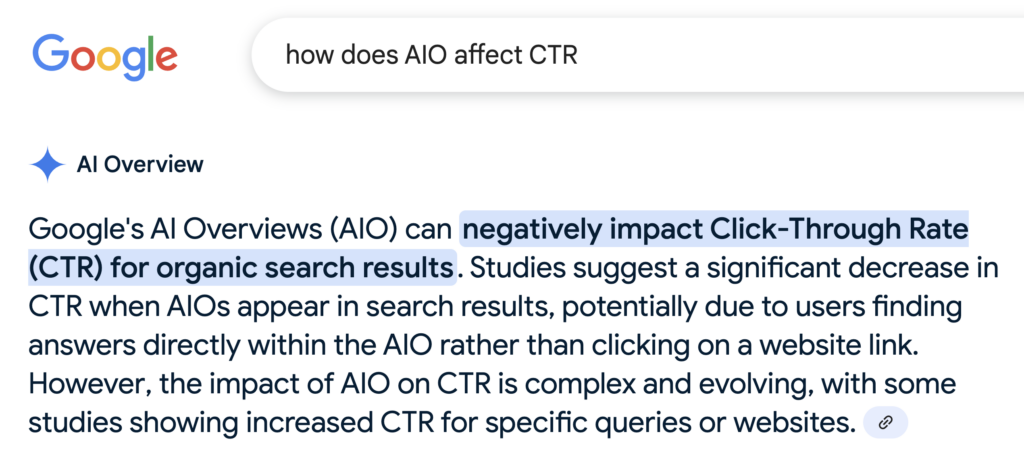
The AIO Effect: How AI Overviews are Reshaping Google CTR

It used to be simple: rank on page one (ideally in the top three positions), and the clicks would follow. CTR was the go-to metric to measure SEO success. But now, AI is sitting between users and your content.

With Google’s AI Overviews (AIO), along with platforms like ChatGPT and Perplexity, users are getting full answers—often without clicking anything. Instead of ten blue links and a featured snippet, they’re served a complete summary generated by AI.

This shift is having a measurable impact:

  • Ahrefs found that when an AIO appears, the #1 organic result sees a 34.5% drop in CTR.
  • Amsive reported a 15.49% average decline across 700,000 keyword results, with non-branded queries showing nearly 20% drops.
  • Advanced Web Ranking (AWR) revealed that AIOs now appear in 42.5% of search results, an 8.8-point jump in just one quarter. This rise has been directly linked to falling CTRs—especially on desktop.

As Dan Popa from AWR puts it:

“This surge in AI Overviews may be impacting clickthrough rates for organic listings, as informational content is increasingly getting overrun by these AI-generated summaries.”

How AI Overviews Affect Google CTR

Even if you’re still ranking on page one, you could see significant traffic declines if you’re not cited in the AI Overview. Informational content—once a reliable traffic driver—is being displaced.

Some of the hardest-hit industries include:

  • Science: Down 6.03 percentage points in CTR during Q4—the biggest drop tracked (Search Engine Journal).
  • Careers: Despite a 334% rise in demand, top 3 positions lost 4.34 CTR points.
  • Shopping: Even with a 142% increase in holiday search volume, CTR dropped across both mobile and desktop.

Only a few sectors—like business and fashion—saw CTR improvements. For everyone else, the new question is no longer “What’s my rank?” but “Am I in the AI Overview?

How to Rank in AI Overviews to Improve CTR

To stay competitive in this AI-first search environment, here are five practical ways to optimize your content and monitoring strategies:

  1. Identify AIO-Triggered Queries
    Segment your keyword data to isolate searches that consistently trigger AI summaries.
  2. Structure Your Content for AI
    Use clean markup, concise value-driven sections, and trustworthy signals like cited sources.
  3. Optimize for Concepts, Not Just Keywords
    AI prefers broad topical relevance. Link your content to high-level ideas and semantically related terms.
  4. Track New Traffic Sources
    Monitor referrals from tools like Perplexity, Brave, and other AI-driven engines.
  5. Evaluate Your Data Infrastructure
    Make sure your partners and tools can adapt to the fast-evolving landscape of AI-generated search.

How to Scrape Google AI Overviews and CTR with Traject Data’s SERP API

If you’re trying to figure out how to scrape Google AI Overviews and track CTR, Traject Data has you covered.

Our SERP API is built for scale, speed, and resilience—capable of handling billions of monthly requests and delivering millions of high-quality records in just days. Whether you’re tracking visibility across volatile search results or trying to understand where your brand shows up in AI summaries, we provide the infrastructure to support it.

Here’s what makes Traject Data different:

  • Rapid scaling during critical visibility windows
  • High-accuracy scraping of search results, including complex SERP layouts
  • Resilience against anti-scraping protections
  • Customizable data feeds designed for SEO, pricing, and brand monitoring

While we don’t yet offer a dedicated AI citation tracking product, we’re actively collaborating with forward-thinking partners to develop solutions. Our platform is designed to evolve with the search landscape—AI Overviews included.

Key Takeaways

  • AI-generated summaries are cutting into traditional CTR, even for top-ranking content.
  • Being cited in the AI Overview may soon matter more than being #1 in organic results.
  • Studies from Ahrefs, Amsive, and AWR confirm measurable CTR declines linked to AIO growth.
  • Traject Data’s SERP API is ready to help you monitor and adapt to these changes at scale.
  • If you’re serious about protecting your organic visibility, it’s time to measure where you stand in AI-driven search.

Curious about how your brand shows up in AI Overviews—and how to scrape Google AI Overviews and CTR data at scale? Explore Traject Data’s SERP API and start building for an AI-first search world today.

Ready to See What Traject Data Can Help You Do?


We’re your premier partner in web scraping for SERP data. Get started with one of our APIs for free and see the data possibilities that you can start to collect.

Unlocking Real Estate Insights with SERP API: A New Frontier in Market Intelligence

In today’s dynamic real estate landscape, traditional data sources often lag behind the rapid shifts in buyer behavior and market trends. Enter the power of real estate data with SERP API—a transformative approach that leverages real-time search engine insights to stay ahead of the curve.​

The Current Challenge: Navigating a Frozen Market

With many homeowners locked into sub-3% mortgages, inventory remains tight, and affordability is a pressing concern. Conventional reports frequently arrive too late to inform timely decisions. Real estate professionals require proactive tools to anticipate demand and adapt strategies accordingly.​

Harnessing SERP Data for Real Estate Intelligence

Traject Data offers access to raw, real-time SERP (Search Engine Results Page) data, unveiling what potential buyers are searching for and where market shifts are emerging. Here’s how this data can be utilized:​

1. Market Analysis

  • Detect spikes in searches like “townhouses in Tempe” or “condos in Jersey City,” signaling rising interest before listings catch up.
  • Monitor demographic trends, such as the growing popularity of “single-level homes near parks” among baby boomers.
  • Track evolving preferences, with queries shifting from “homes with home office” to “homes near transit” as remote work dynamics change.​

2. Competitor Intelligence

  • Identify which brokerages consistently rank high in target neighborhoods.
  • Observe how competitors adapt listings with affordability-focused language like “low down payment” or “first-time buyer eligible.”​

3. SEO Optimization

  • Incorporate trending descriptors such as “walkable,” “starter home,” or “ADU-ready” based on rising search interest.
  • Adjust strategies as attention shifts between urban, suburban, and exurban areas.​

4. Investment Opportunities

  • Use rising search interest in overlooked suburbs or fast-growing secondary cities to guide acquisitions.
  • Monitor demand for models like build-to-rent, co-living, and rent-to-own, especially in price-sensitive regions.​

Real-World Applications

Brokerages utilize SERP API to pinpoint underserved markets and enhance local SEO. Investment firms track demand signals to inform land or portfolio decisions. Marketing agencies craft campaigns aligned with trending keywords and consumer intent.​

Stay Ahead with Real-Time Insights

By integrating real estate data with SERP API, professionals can uncover early buyer interest, identify emerging neighborhoods, and act before the competition. Embrace this innovative approach to transform challenges into opportunities in the ever-evolving real estate market.​

For more information on leveraging SERP data for real estate intelligence, consider exploring Traject Data’s offerings.​

Ready to See What Traject Data Can Help You Do?


We’re your premier partner in web scraping for SERP data. Get started with one of our APIs for free and see the data possibilities that you can start to collect.

How to Identify and Stop Rogue Resellers from Undermining Your Brand

Rogue sellers don’t just hurt your margins—they erode customer trust, violate your pricing policies, and undermine your brand’s reputation across marketplaces. In this post, we’ll explore how an unauthorized seller scraping API can help you automate detection and take back control.

Why Unauthorized Seller Monitoring Matters More Than Ever

When unauthorized sellers undercut your pricing, the damage ripples outward:

  • Customers lose trust when they receive products that are misrepresented or poorly packaged.
  • Your legitimate partners are frustrated, asking why they’re upholding Minimum Advertised Price (MAP) guidelines while others aren’t.
  • Your brand reputation suffers.
  • You face legal and compliance headaches from policy violations.

Manual monitoring simply can’t keep up. Unauthorized sellers change tactics constantly—switching listings, altering prices in-cart, or using bundles to disguise violations.

Brands that effectively fight back don’t wait to react. They implement scalable, proactive monitoring strategies across all sales channels—turning unauthorized seller monitoring into a competitive advantage.

The High Cost of Doing Nothing

By the time you detect rogue sellers manually, the damage may already be done. Here’s how these unauthorized listings hurt your business:

  • Price undercutting that devalues your product in the eyes of consumers.
  • Misinformation that leads to customer confusion or negative reviews.
  • Exploited policy gaps that create compliance risk and revenue loss.
  • Marketplace chaos, with thousands of listings appearing (and reappearing) in real time.

If you’re still relying on spreadsheets and manual checks, it’s time to upgrade. There are low cost, automated solutions that can do the heavy lifting for you. 

Why You Need an Unauthorized Seller Monitoring Scraping API

An unauthorized seller monitoring scraping API enables automated, real-time detection of rogue resellers across ecommerce marketplaces like Google Shopping, Amazon, Walmart, Target, and eBay.

Here’s how it works:

  • The API continuously scans listings to identify unauthorized sellers offering your products.
  • It extracts key data—seller info, pricing, product titles, and URLs.
  • This data powers your MAP (Minimum Advertised Price) detection, compliance efforts, and enforcement workflows.

Instead of reacting days later, you can act the moment a policy violation appears.

How Traject Data Helps You Stop Rogue Resellers

Traject Data gives you clean, fast, reliable data to power your unauthorized seller monitoring scraping API strategy. We provide the raw intelligence your compliance or brand protection team needs to stay one step ahead.

Monitor Sellers Across Every Major Marketplace

We cover the platforms that matter most:

  • Amazon
  • Walmart
  • eBay
  • Google Shopping
  • Target
  • And many other third-party marketplaces

This broad visibility helps ensure no unauthorized listing goes unnoticed.

Power Your MAP Strategy with Real-Time Raw Data

We don’t identify violations for you—we give you the raw data to identify them yourself:

  • Product prices
  • Seller names
  • Listing URLs
  • In-cart pricing details
  • Secondary buy box monitoring

You get the insights to detect shady tactics like pricing games or misrepresented bundles—fast.

Lightning-Fast Data Delivery

Speed matters. Traject Data delivers real-time scraping results in under 6 seconds on average, with a P90 of 10 seconds. That means your enforcement team can respond to violations before they cause harm.

Flexible, Developer-Friendly API Integrations

Our APIs fit into your existing systems and workflows—whether you’re feeding data into a MAP dashboard, building alerts, or automating takedown notices. Traject Data helps you move fast, without having to manage scraping infrastructure yourself.

Deep Product and Seller Insights

With Traject Data, your team gets granular, real-time visibility:

  • Product and pricing info
  • Seller listings
  • SKU-level detail
  • Secondary buy box pricing

All the raw data you need to investigate and act.

Why the Amazon Secondary Buy Box Matters

Did you know that rogue sellers often avoid MAP enforcement by targeting the secondary buy box?

Traject Data’s unauthorized seller monitoring scraping API gives you visibility into both the primary and secondary buy boxes—critical for true pricing enforcement.

Here’s why it matters:

  • Pricing integrity: Secondary buy box listings often appear cheaper, hurting your brand value.
  • Customer influence: Buyers still consider these listings—sometimes preferring them over the primary.
  • Faster enforcement: With real-time data, you can take swift action to protect your margins and reputation.

Proven ROI: A Case Study with Sigil

Sigil, a leading brand protection company, used Traject Data to dramatically improve enforcement efficiency and ROI:

  • $4M in revenue recovered by identifying violations faster on Amazon
  • 2+ engineers freed up by eliminating the need to maintain their own scraping tools
  • Effortless expansion into new marketplaces—without additional overhead

With Traject Data, Sigil scaled their enforcement without scaling their headcount.

Ready to Stop the Race to the Bottom?

If you’re still relying on spreadsheets and manual checks, you’re already behind. Traject Data gives you the speed, scale, and insight you need to stop rogue resellers in their tracks.

How Traject Data Powers Your Unauthorized Seller Monitoring Scraping API

Here’s what it looks like in action:

1. Track Core SKUs and Marketplaces

Monitor your most critical product listings across Amazon, Google Shopping, Walmart, and more.

2. Set Violation Thresholds

Define your own MAP enforcement rules—by product, price delta, or seller behavior.

3. Get Real-Time Pricing and Seller Data

Use our fast, flexible APIs to ingest pricing and seller data in real time.

4. Automate Alerts and Enforcement

Trigger alerts and actions automatically—whether you’re reporting sellers or issuing takedowns.

Want help configuring your unauthorized seller monitoring strategy?
Book a demo with our team today and learn how Traject Data can power your enforcement efforts—at scale.

Ready to See What Traject Data Can Help You Do?


We’re your premier partner in web scraping for SERP data. Get started with one of our APIs for free and see the data possibilities that you can start to collect.

How to Master Amazon’s Buy Box (Featured Offer) in 2025

If you sell on Amazon, you’ve probably wondered how to win the Amazon Buy Box (now called the Featured Offer). Approximately 82% of all Amazon sales come through the Buy Box, making it a crucial factor for success. Losing Buy Box eligibility can cause a dramatic drop in sales. In this article, we’ll provide a step-by-step guide on how to master the Amazon Buy Box in 2025.

How Does the Amazon Buy Box Work?

The Amazon Buy Box (now Featured Offer) determines which seller gets the sale when multiple sellers list the same product. When a customer clicks “Add to Cart” or “Buy Now,” the seller chosen by Amazon’s algorithm gets the order\sell.

With over 9.7 million sellers on Amazon, competition is fierce. Amazon rotates the Buy Box among eligible sellers, but some sellers get more turns in the rotation than others based on performance. If you lose eligibility due to poor seller metrics, low sales volume, or inventory issues, your sales can suffer significantly.

How to win the Amazon Buy Box

How Does Amazon Decide Who Wins the Buy Box?

Amazon uses a machine learning algorithm to determine the Buy Box winner. While the exact details of the algorithm are not disclosed, Amazon provides guidance on key factors influencing Buy Box success.

Factors Influencing Buy Box Eligibility and Success

Traject Data Table
Factor Definition How to Win
Type of Seller Account Individual vs. Professional seller accounts Only Professional Sellers are eligible to win the Buy Box
Condition of Product New vs. Used products Only new products qualify for the Buy Box
Price Total cost (product price + shipping) Competitive pricing increases chances of winning
Shipping Speed How fast the item ships Faster shipping improves Buy Box chances
Shipping Price Cost of shipping Free or low-cost shipping is preferred
Fulfillment Method Either FBA, FBM, or SFP FBA and SFP sellers have an advantage over standard FBM
Stock Availability How often a seller runs out of stock Having the product in stock is required.
Order Defect Rate (ODR) % of defective orders in a 60-day period Must be under 1%
Valid Tracking Rate (VTR) % of seller-fulfilled packages with tracking Aim for 95%+
Late Shipment Rate (LSR) Orders shipped late (10- & 30-day period) Keep below 4%
Pre-Fulfillment Cancellation Rate (CR) % of seller-canceled orders in 7 days Aim for under 2.5%
Feedback Score Average of customer ratings Higher ratings improve chances
Response Time How quickly the seller replies to customers Aim for under 12 hours
Refund Rate How often customers request refunds Lower is better

How the Amazon Buy Box Algorithm Evolves

Amazon’s Buy Box algorithm constantly changes, leaving sellers struggling to adapt. Here are some recent trends:

  • Faster shipping and competitive pricing matter more than just using FBA or Prime.
  • Buy Box rotation frequency varies, shifting multiple times per hour for some products but staying static for others.
  • Amazon enforces price consistency across marketplaces, suppressing the Buy Box if prices are lower on external sites.
  • Regional differences impact strategy — in Europe, some categories display multiple Buy Box winners.

To stay competitive, sellers must track Buy Box win rates, analyze historical trends, and make real-time strategy adjustments.

Tools to Facilitate Your Amazon Buy Box Strategy

To improve Buy Box performance, sellers can use tools to track pricing, shipping speeds, and competitor behavior. While Amazon offers its own API, third-party APIs like Traject Data’s Rainforest API provide deeper insights and better tracking.

Why Amazon’s API Alone Isn’t Enough

Amazon’s API provides only a limited snapshot of Buy Box data, leaving sellers with gaps in historical trends, competitor movements, and fulfillment insights. Relying solely on Amazon’s API makes it harder to react to Buy Box changes effectively.

Traject Data Table
Amazon’s API Traject Data Logo
Buy Box Tracking Only current winner Full historical trend analysis
Competitor Monitoring No visibility into competitors Tracks all competing offers over time
Fulfillment Insights Limited shipping data Stock levels & delivery speed tracking
Sales Velocity No tracking Identifies patterns & demand shifts
Actionability One-by-one ASIN lookups, slowing large-scale analysis Batch processing enables large-scale ASIN data retrieval for comprehensive trend tracking

Traject Data fills these gaps, giving sellers real-time and historical data to make smarter decisions before competitors do.

How to Use Traject Data to Win the Amazon Buy Box

1. Track Buy Box Trends & Adjust Strategy

  • Use Traject Data’s Rainforest API to monitor Buy Box winners, pricing, shipping costs, and stock levels.
  • Identify shifts in Buy Box winners and adjust fulfillment strategies accordingly.

Action: Adapt inventory allocation based on real Buy Box trends.

2. Analyze Pricing Strategies of Buy Box Winners

  • Compare real-time pricing across sellers.
  • Avoid Buy Box suppression due to external price mismatches.

Action: Keep pricing competitive while maintaining profit margins.

3. Optimize Fulfillment Strategy

  • Assess how shipping speed and cost impact Buy Box prioritization.
  • Retrieve estimated delivery times and compare winners vs. non-winners.

Action: Invest in faster logistics or cost-efficient shipping.

4. Monitor Competitor Stock Levels

  • Use stock estimation to track competitor inventory.
  • Adjust pricing when competitors are low on stock.

Action: Take advantage of stock shortages by adjusting pricing accordingly.

5. Use Sales Velocity as a Competitive Edge

  • Retrieve detailed pricing, fulfillment, and sales data.
  • Analyze which sellers consistently win the Buy Box despite price differences.

Action: Increase sales momentum by offering discounts, bundling products, or optimizing fulfillment speed.

6. Adapt to Regional Buy Box Trends

  • In Europe, track multiple Buy Box winners per product.
  • In North America, monitor real-time Buy Box rotation.
  • In Asia, focus on Prime eligibility and localized fulfillment solutions.

Action: Align strategies with marketplace-specific rules and trends.

Take Control of Your Amazon Buy Box Strategy

✅ Pull Buy Box data daily for high-competition categories and weekly for lower-volume products.

✅ Analyze pricing and shipping trends to determine key Buy Box factors.

✅ Monitor competitor behavior to adapt before they do.

✅ Use historical trends to predict future Buy Box patterns and adjust fulfillment accordingly.

✅ Compare non-Buy Box offers to identify pricing opportunities.

✅ Track regional Buy Box trends to stay compliant with country-specific rules.

Get Ahead, Stay Ahead

Waiting to see how Amazon Buy Box changes affect your business means losing to competitors who are already adapting. Success requires constant monitoring, strategic agility, and real-time insights.

With Traject Data’s Rainforest API, businesses can adjust pricing, fulfillment, and inventory strategies proactively. Unlike Amazon’s API, which only provides real-time snapshots, Traject Data enables historical tracking, competitor insights, and fulfillment impact analysis.

Don’t let Amazon’s shifting rules dictate your success. Contact us today to see how Traject Data can transform your Buy Box strategy.

Ready to See What Traject Data Can Help You Do?


We’re your premier partner in web scraping for SERP data. Get started with one of our APIs for free and see the data possibilities that you can start to collect.

Traject Data is Your Premier Partner in Web Scraping


Join thousands of satisfied users worldwide who trust Traject Data for all their eCommerce and SERP data needs. Whether you are a small business or a global enterprise, our entire team is committed to helping you achieve your goals and stay ahead in today's dynamic digital landscape. Unlock your organization's full potential with Traject Data. Get started today.

Get started today