Skip to content

How to Scrape Google Maps with a SERP API

Over 1 billion people use Google Maps every month, making it the world’s most popular digital mapping service. The scale, reach, and richness of data on Google Maps make it a goldmine for businesses looking to analyze competitors, optimize logistics, or build detailed local business directories.

But here’s the thing: getting that data manually is slow, inconsistent, and incredibly tedious. That’s why many companies turn to a Google Maps scraper API—a tool that lets you automate the process and pull large volumes of structured data in minutes.

If you’re wondering how to scrape Google Maps with an API, or whether it’s even legal, this post breaks it all down. We’ll also show you how Traject Data’s SerpScale API makes it easy and scalable.

What Is a Scraper API?

A scraper API is a tool that sends automated requests to a platform—like Google Maps—and returns data in a structured format like JSON or CSV. Instead of clicking through results and copying details manually, you can use an API to extract business names, addresses, ratings, reviews, and more—all programmatically.

Why Scrape Google Maps?

Google Maps isn’t just for finding the closest coffee shop. For businesses, it’s a powerful source of real-time local data. Here’s why scraping it makes sense:

1. Market Research and Competitor Analysis

By analyzing business density, categories, ratings, and reviews in specific locations, companies can identify saturated markets, spot gaps, and benchmark competitors.

  • A coffee chain might target areas with few competitors.
  • A digital agency might look for businesses with poor reviews to pitch their services.

2. Supply Chain and Logistics Optimization

Scraping location data helps companies optimize delivery routes, identify ideal spots for new warehouses or storefronts, and streamline operations.

3. Large-Scale, Accurate Data Collection

Manually copying business data from Google Maps is time-consuming and error-prone. Scraping automates the process—giving you high-volume, up-to-date info in minutes.

What Data Can You Scrape from Google Maps?

With the right API, you can collect a wide range of data points from business listings on Google Maps, including:

  • Business name
  • Address
  • Latitude & longitude
  • Phone number
  • Website URL
  • Business hours
  • Ratings & number of reviews
  • Photos
  • Categories
  • Popular times (in some cases)

This structured data can power everything from lead generation tools to territory planning dashboards.

Is It Legal to Scrape Google Maps?

This is a common question. Google’s terms of service generally prohibit scraping their content directly. However, scraper APIs like SerpScale operate in a legally compliant way, respecting rate limits, avoiding bot detection, and sourcing publicly available data.

As always, it’s best to consult with legal counsel if you plan to use scraped data for commercial purposes—but with a reputable API provider, you’re operating in safer territory.

What’s the Best Google Maps Scraper API?

There are several scraping tools on the market, but many fall short when it comes to scale, reliability, and support. That’s where Traject Data’s SerpScale API stands out.

  • High success rates
  • Advanced rendering and parsing
  • Industry Leading Support
  • Low maintenance
  • Support for thousands of queries per minute
  • Seamless integration with BI tools

Whether you’re monitoring local competitors, building lead lists, or analyzing store footprints, SerpScale makes it fast and easy.

How to Scrape Google Maps in 4 Simple Steps

Getting started with Google Maps scraping doesn’t require a developer team or weeks of setup. Here’s how to do it in four easy steps using SerpScale:

1. Sign Up for an API Key

Head over to SerpScale and signup for an API key to get access.

2. Explore the API Documentation

Read through the documentation to understand how to format your requests, what parameters to use (like location or keywords), and how to handle responses.

3. Make Your First API Request

Example: Scraping Google Maps Using Latitude, Longitude, and Zoom

If the location parameter is set to a latitude, longitude, and zoom value—like in the example below—results will be returned from a Google Maps page:

https://api.serpwow.com/live/search?api_key=demo&search_type=places&q=pizza&location=lat:43.437677,lon:-3.8392765,zoom:15

When search_type=places and you provide location as a combination of lat/lon/zoom, the API scrapes results directly from Google Maps.

Google Maps Request Parameters

Parameter Required Description
q Required The keyword used to perform the Google Maps search.
location Optional Sets the geographic focus of the query.
Format: location=lat:43.437677,lon:-3.8392765,zoom:15
Zoom values range from 3 (zoomed out) to 21 (zoomed in).
google_domain Optional Specifies the Google domain (e.g., google.com, google.co.uk). Defaults to google.com.
hl Optional Sets the UI language of the search results. Defaults to en.
page Optional Returns the specified page of results (defaults to 1). Each page contains 20 results.
max_page Optional Automatically paginates and concatenates results across multiple pages in a single response.
Note: The num parameter is ignored in Google Maps searches. To fetch results based on coordinates, use the lat, lon, and zoom values as shown above.

4. Send the Data to Your Favorite BI Tool

SerpScale integrates easily with platforms like Looker, Tableau, and Power BI. You can filter, sort, and analyze data to fit your specific goals.

Start Scraping Google Maps Today

If you’re looking for a scalable, compliant way to access business data from Google Maps, a scraper API like SerpScale is the best way to go.

👉 Sign up for SerpScale

👉 Watch a High Level Overview Video

 👉Explore the API documentation for Google Maps

Have questions or need a custom solution? Contact us—we’d love to help you scale your local data intelligence.

Ready to See What Traject Data Can Help You Do?


We’re your premier partner in web scraping for SERP data. Get started with one of our APIs for free and see the data possibilities that you can start to collect.

Google I/O 2025 SEO Changes: Navigating the New SERP with Traject Data

The biggest announcements at Google I/O 2025 hit the SEO world like a rocket. This isn’t the death of SEO—but it’s definitely the end of SEO as we knew it.

AI Overviews are now front and center in search. Ads are seamlessly integrated into AI-generated answers. And with a new Chrome-based Marketing Advisor, brands can launch entire campaigns directly within the browser. It’s fast, sleek, and aligned with everything modern users expect from the internet in 2025.

But what does all of this mean for your SEO strategy?

Google I/O 2025: What Changed in SEO

Here’s a breakdown of the key SEO changes from Google I/O 2025:

  • AI Mode in Search: Search results are now curated by AI. Ads are fully embedded into AI responses, reshaping how visibility and traffic work.
  • Gemini Agent Mode: Google’s AI can now take actions—clicking buttons, filling forms, and interacting with websites on your behalf.
  • Visual Search Upgrades: “Search Live” lets users point their cameras at objects and ask questions in real-time, powered by AI interpretation.
  • AI-Powered Shopping: Personalized, visual, and predictive. Google can now curate products based on user behavior, enable virtual try-ons, track prices, and even auto-purchase.
  • In-SERP Charts and Visual Answers: Google generates charts and visual data directly in the search results.
  • AI Answers Instead of Listings: The traditional list of links is replaced with one polished, AI-authored summary—often embedded with monetized content.
AI Mode in Search

Instant Answers vs. Lasting Trust

If you love efficiency, this is your golden age.

But if you care about trust and transparency, now’s the time to ask serious questions.

Google has created an experience where one search gets you everything: a summary, product suggestions, action plans, and a direct path to purchase. For a generation raised on instant answers, this is perfection.

But here’s the problem: convenience is easy—trust is earned.

When the AI interprets your query, rewrites the answers, and decides what appears—all while selling ads within that response—you’re not really searching anymore. You’re being told what to think.

That’s not a critique of AI. It’s a call for transparency in a system we can no longer see into.

The Hidden Risk for Brands

The new AI-first search experience prioritizes speed, not depth. And while users may initially love the streamlined experience, they’ll eventually notice what’s missing, what’s biased, or what’s just wrong.

That’s when trust begins to erode.

So what can’t brands rely on anymore?

  • You can’t assume SEO best practices will get you visibility.
  • You can’t trust platform analytics as your only data source.
  • You can’t use traffic alone as proof of performance.

This isn’t traditional search. It’s a model deciding what’s relevant—and if your brand isn’t part of that dataset, you simply don’t exist in that moment.

You can’t optimize your way around that. But you can monitor, measure, and challenge it—with the right tools.

What You Can Control

This is where independent data becomes your most powerful asset. If Google controls the interface, you need to control the insight.

That means:

  • Monitoring SERPs to see how and where your brand is showing up
  • Tracking share of voice across platforms that still value organic discovery
  • Auditing your presence with verifiable, transparent performance data
  • Identifying citations in AI-generated answers to see which brands are getting visibility

Independent data gives you leverage. It tells the truth when platform metrics become a closed loop.

Most importantly, it gives you an answer when a customer asks, “Why didn’t I see you there?”

How to Respond to Google I/O 2025 SEO Changes

Here’s how to adapt your strategy for this AI-first world:

  • Be Multichannel-Native
    Google isn’t the only sandbox. Retail search, TikTok, Reddit, YouTube, influencer SEO, and community-driven reviews still rely on your input signals. If you’re only optimizing for Google, you’re feeding the beast and hoping it doesn’t eat you next.
  • Own Your Data
    First-party data, customer journey mapping, SERP snapshots, and pricing deltas are now strategic assets. If you can’t control the data inputs, you’re just reacting to a black box.
  • Compete on Context, Not Clicks
    Google’s AI doesn’t rank based on great content alone. It favors responses that fit the narrative it’s building. Structured data, third-party mentions, and machine-readable authority are what get you included.
  • Own the Relationship
    Search might be shrinking, but your audience isn’t. Email lists, direct visits, private communities—these are now your power channels. If AI stops linking out, the only thing that matters is the audience you’ve built.
  • Optimize for the AI Layer
    You’re no longer just writing for people. You’re writing for the model. Your product descriptions, brand footprint, and structured data all need to be readable and relevant to the AI systems deciding what to show.

The Solution: Traject Data’s SERP APIs

The Google I/O 2025 SEO changes mark another fundamental shift in how brands win (or lose) in search.

We’ve moved from “How do I rank?” to “How do I become the AI answer?”

To stay agile in this fast-changing landscape, you need tools that can keep up. Traject Data’s SERP API helps you monitor, measure, and adapt in real time.

With full visibility into SERPs across channels, you’ll be able to:

  • Track changes as AI Overviews evolve
  • Identify which brands are cited in AI responses
  • Benchmark performance across competitors and platforms
  • Respond quickly to shifts in what Google chooses to show

Future-Proof Your Strategy

The SEO landscape is evolving fast. AI isn’t going away. But neither is your need for visibility, credibility, and trust.

Traject Data’s SERP API puts the power back in your hands—with independent data, flexible tracking, and actionable insights.

Ready to future-proof your SEO? Start using Traject Data’s SERP API today and stay ahead of Google I/O 2025 SEO changes.

Ready to See What Traject Data Can Help You Do?


We’re your premier partner in web scraping for SERP data. Get started with one of our APIs for free and see the data possibilities that you can start to collect.
Decoding the AI Shift: How to Scrape Google AI Overviews and Boost Your Click-Through Rate (CTR)

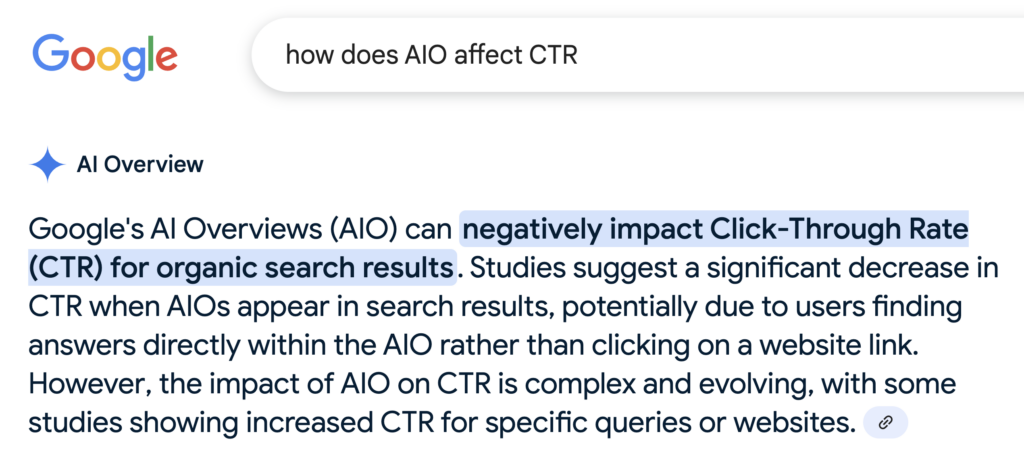
AI is rewriting the rules of Search Engine Optimization (SEO) and reshaping how marketers think about Click-Through Rates (CTR). Traditional SEO strategies are no longer enough. The rise of AI-generated answers—especially Google’s AI Overviews (AIO)—is changing what shows up on the search results page and what actually gets clicked.

In this post, we’ll break down what’s changed, how AI Overviews are impacting CTR, and most importantly—how to scrape Google AI Overviews and CTR data using Traject Data’s SERP API to stay ahead.

AIO and CTR

The AIO Effect: How AI Overviews are Reshaping Google CTR

It used to be simple: rank on page one (ideally in the top three positions), and the clicks would follow. CTR was the go-to metric to measure SEO success. But now, AI is sitting between users and your content.

With Google’s AI Overviews (AIO), along with platforms like ChatGPT and Perplexity, users are getting full answers—often without clicking anything. Instead of ten blue links and a featured snippet, they’re served a complete summary generated by AI.

This shift is having a measurable impact:

  • Ahrefs found that when an AIO appears, the #1 organic result sees a 34.5% drop in CTR.
  • Amsive reported a 15.49% average decline across 700,000 keyword results, with non-branded queries showing nearly 20% drops.
  • Advanced Web Ranking (AWR) revealed that AIOs now appear in 42.5% of search results, an 8.8-point jump in just one quarter. This rise has been directly linked to falling CTRs—especially on desktop.

As Dan Popa from AWR puts it:

“This surge in AI Overviews may be impacting clickthrough rates for organic listings, as informational content is increasingly getting overrun by these AI-generated summaries.”

How AI Overviews Affect Google CTR

Even if you’re still ranking on page one, you could see significant traffic declines if you’re not cited in the AI Overview. Informational content—once a reliable traffic driver—is being displaced.

Some of the hardest-hit industries include:

  • Science: Down 6.03 percentage points in CTR during Q4—the biggest drop tracked (Search Engine Journal).
  • Careers: Despite a 334% rise in demand, top 3 positions lost 4.34 CTR points.
  • Shopping: Even with a 142% increase in holiday search volume, CTR dropped across both mobile and desktop.

Only a few sectors—like business and fashion—saw CTR improvements. For everyone else, the new question is no longer “What’s my rank?” but “Am I in the AI Overview?

How to Rank in AI Overviews to Improve CTR

To stay competitive in this AI-first search environment, here are five practical ways to optimize your content and monitoring strategies:

  1. Identify AIO-Triggered Queries
    Segment your keyword data to isolate searches that consistently trigger AI summaries.
  2. Structure Your Content for AI
    Use clean markup, concise value-driven sections, and trustworthy signals like cited sources.
  3. Optimize for Concepts, Not Just Keywords
    AI prefers broad topical relevance. Link your content to high-level ideas and semantically related terms.
  4. Track New Traffic Sources
    Monitor referrals from tools like Perplexity, Brave, and other AI-driven engines.
  5. Evaluate Your Data Infrastructure
    Make sure your partners and tools can adapt to the fast-evolving landscape of AI-generated search.

How to Scrape Google AI Overviews and CTR with Traject Data’s SERP API

If you’re trying to figure out how to scrape Google AI Overviews and track CTR, Traject Data has you covered.

Our SERP API is built for scale, speed, and resilience—capable of handling billions of monthly requests and delivering millions of high-quality records in just days. Whether you’re tracking visibility across volatile search results or trying to understand where your brand shows up in AI summaries, we provide the infrastructure to support it.

Here’s what makes Traject Data different:

  • Rapid scaling during critical visibility windows
  • High-accuracy scraping of search results, including complex SERP layouts
  • Resilience against anti-scraping protections
  • Customizable data feeds designed for SEO, pricing, and brand monitoring

While we don’t yet offer a dedicated AI citation tracking product, we’re actively collaborating with forward-thinking partners to develop solutions. Our platform is designed to evolve with the search landscape—AI Overviews included.

Key Takeaways

  • AI-generated summaries are cutting into traditional CTR, even for top-ranking content.
  • Being cited in the AI Overview may soon matter more than being #1 in organic results.
  • Studies from Ahrefs, Amsive, and AWR confirm measurable CTR declines linked to AIO growth.
  • Traject Data’s SERP API is ready to help you monitor and adapt to these changes at scale.
  • If you’re serious about protecting your organic visibility, it’s time to measure where you stand in AI-driven search.

Curious about how your brand shows up in AI Overviews—and how to scrape Google AI Overviews and CTR data at scale? Explore Traject Data’s SERP API and start building for an AI-first search world today.

Ready to See What Traject Data Can Help You Do?


We’re your premier partner in web scraping for SERP data. Get started with one of our APIs for free and see the data possibilities that you can start to collect.

How to Scrape Google Shopping Results with a SERP API

Google Shopping receives around 1.2 billion searches every month, making it one of the most powerful platforms for product discovery and ecommerce intelligence. Whether you’re a marketer, data analyst, or product manager, learning how to scrape Google Shopping data can unlock massive insights into trends, pricing, and competitors.

In this post, we’ll show you how to scrape Google Shopping results using a SERP API—specifically, how Traject Data’s SERP API makes this process efficient, scalable, and compliant.

Why Scrape Google Shopping?

Scraping Google Shopping results gives businesses access to a treasure trove of data that can support smarter decisions, better SEO strategies, and sharper competitive analysis. Here’s what you can do with the data:

🔍 SEO Strategy Optimization

Monitor your website’s rankings, analyze competitor placements, and find the keywords that drive traffic in your industry.

🏆 Competitive Analysis

See how your competitors price their products, where they rank in organic and paid listings, and what kind of messaging they use.

📈 Market and Consumer Insights

Discover trending products, customer search behavior, and emerging needs—insights that can shape product development and marketing campaigns.

👥 Lead Generation

Extract contact details and business information from listings to fuel sales outreach.

✍️ Content Creation & Ideation

Analyze top-ranking pages and product descriptions to generate new content ideas or improve existing ones.

📣 Brand Monitoring

Track how your brand shows up on Google, monitor sentiment, and stay ahead of potential reputation issues.

💰 Advertising & Pricing Intelligence

Keep tabs on competitors’ ad placements, promotions, and pricing strategies in real time.

⚙️ Efficient & Scalable Data Collection

Automated scraping beats manual research in speed, accuracy, and cost-effectiveness—especially at scale.

Benefit Description
SEO Optimization Track rankings, discover keywords, and refine strategies
Competitive Analysis Monitor competitor pricing, positions, and campaigns
Market Insights Spot trends and consumer demands early
Lead Generation Gather contact details for outreach
Content Ideation Create content based on search behavior and top pages
Brand Monitoring Track mentions and manage reputation
Ad & Pricing Intelligence Monitor ads, adjust pricing strategies
Scalable Data Collection Automate data collection to save time and reduce errors

Best Practices: How to Scrape Google Shopping Responsibly

Scraping can be incredibly valuable, but it must be done thoughtfully and ethically. Here are best practices to follow when scraping Google Shopping results:

  • Scrape Only Public Data: Focus on publicly visible information like product titles, prices, ads, and retailers—not personal or sensitive data.
  • Use Rate Limiting: Avoid sending too many requests too quickly to prevent getting blocked.
  • Respect Google’s Terms of Service: While viewing data is legal, scraping can violate Google’s TOS—so proceed carefully.
  • Follow Privacy Laws: Be aware of data protection regulations like GDPR and CCPA.
  • Use a Reliable SERP API: Google employs strong anti-scraping technology. To avoid issues, it’s best to use a professional scraping service like Traject Data.

How to Scrape Google Shopping Results with Traject Data

If you’re wondering how to scrape Google Shopping without getting blocked or bogged down by code, Traject Data makes it simple.

Here’s how it works:

🔑 Step 1: Get API Access

Sign up for a Traject Data account and receive your SERP API key.

🔍 Step 2: Configure Your Query

Set up your request with parameters like:

  • Product search term
  • Location targeting
  • Filters like price range or condition

🧾 Step 3: Retrieve Structured Data

Your request returns structured data (typically in JSON format) with details like:

You can then integrate this data into your dashboards, analytics tools, or pricing engines.

Additional Resources to Get Started

Why Use Traject Data’s SERP API?

Here’s why Traject Data stands out for scraping Google Shopping results:

  • Scalable Performance: Handle thousands of requests daily without throttling or downtime.
  • Accurate Results: Get fresh, reliable data from real-time scraping technology.
  • Localized Insights: Pull results based on specific geographic locations or user preferences.
  • Developer-Friendly: JSON responses are easy to work with, and the API is built for flexibility and speed.
  • Cost-Effective: Avoid the overhead of building and maintaining your own scraping tools.

Make Smarter Ecommerce Decisions with Traject Data

When you know how to scrape Google Shopping the right way, you can tap into powerful insights that help you optimize campaigns, adjust pricing, and outmaneuver your competition. Traject Data’s SERP API is designed to make that easy—with accurate, scalable access to the data you need.

Ready to start scraping Google Shopping like a pro?
Explore Traject Data’s SERP API today and take your data strategy to the next level.

Ready to See What Traject Data Can Help You Do?


We’re your premier partner in web scraping for SERP data. Get started with one of our APIs for free and see the data possibilities that you can start to collect.

Unlocking Real Estate Insights with SERP API: A New Frontier in Market Intelligence

In today’s dynamic real estate landscape, traditional data sources often lag behind the rapid shifts in buyer behavior and market trends. Enter the power of real estate data with SERP API—a transformative approach that leverages real-time search engine insights to stay ahead of the curve.​

The Current Challenge: Navigating a Frozen Market

With many homeowners locked into sub-3% mortgages, inventory remains tight, and affordability is a pressing concern. Conventional reports frequently arrive too late to inform timely decisions. Real estate professionals require proactive tools to anticipate demand and adapt strategies accordingly.​

Harnessing SERP Data for Real Estate Intelligence

Traject Data offers access to raw, real-time SERP (Search Engine Results Page) data, unveiling what potential buyers are searching for and where market shifts are emerging. Here’s how this data can be utilized:​

1. Market Analysis

  • Detect spikes in searches like “townhouses in Tempe” or “condos in Jersey City,” signaling rising interest before listings catch up.
  • Monitor demographic trends, such as the growing popularity of “single-level homes near parks” among baby boomers.
  • Track evolving preferences, with queries shifting from “homes with home office” to “homes near transit” as remote work dynamics change.​

2. Competitor Intelligence

  • Identify which brokerages consistently rank high in target neighborhoods.
  • Observe how competitors adapt listings with affordability-focused language like “low down payment” or “first-time buyer eligible.”​

3. SEO Optimization

  • Incorporate trending descriptors such as “walkable,” “starter home,” or “ADU-ready” based on rising search interest.
  • Adjust strategies as attention shifts between urban, suburban, and exurban areas.​

4. Investment Opportunities

  • Use rising search interest in overlooked suburbs or fast-growing secondary cities to guide acquisitions.
  • Monitor demand for models like build-to-rent, co-living, and rent-to-own, especially in price-sensitive regions.​

Real-World Applications

Brokerages utilize SERP API to pinpoint underserved markets and enhance local SEO. Investment firms track demand signals to inform land or portfolio decisions. Marketing agencies craft campaigns aligned with trending keywords and consumer intent.​

Stay Ahead with Real-Time Insights

By integrating real estate data with SERP API, professionals can uncover early buyer interest, identify emerging neighborhoods, and act before the competition. Embrace this innovative approach to transform challenges into opportunities in the ever-evolving real estate market.​

For more information on leveraging SERP data for real estate intelligence, consider exploring Traject Data’s offerings.​

Ready to See What Traject Data Can Help You Do?


We’re your premier partner in web scraping for SERP data. Get started with one of our APIs for free and see the data possibilities that you can start to collect.

Top 5 SERP APIs

If you’re searching for the best SERP APIs, you already know how valuable real-time search engine data is for SEO, competitive analysis, and market insights. But with so many SERP API providers on the market, how do you choose the right one?

In this post, we’ll break down what makes a SERP API great, explore the top five SERP APIs available today, and explain why Traject Data stands out as the best option for businesses looking for scalable, reliable, and future-ready SERP data solutions.

What Is a SERP API?

A SERP API (Search Engine Results Page API) allows developers and marketers to programmatically collect data from search engine results pages—like Google, Bing, Yahoo, and others. Whether you’re tracking keywords, monitoring competitors, or analyzing trends, a SERP API gives you the data you need without manual scraping or unreliable tools.

Why You Need a SERP API

Automating your SERP tracking can drive up to 3x better results compared to manual methods by:

  • Offering a comprehensive view of your market and competitors
  • Enabling faster pattern recognition
  • Providing real-time data for agile decision-making
  • Supporting data-driven SEO and marketing strategies

How to Choose the Best SERP API

Not all SERP APIs are built the same. When evaluating your options, keep these critical factors in mind:

1. Search Engine Coverage

You need an API that covers more than just Google. Look for one that supports Bing, Yahoo, Amazon, eBay, and even regional search engines like Baidu, Yandex, and Naver—especially if you’re targeting international markets.

2. Speed and Reliability

Timely, structured data is non-negotiable. The best SERP APIs deliver accurate, structured results consistently—no matter how frequently you make requests.

3. Structured Output

Some APIs require extensive post-processing. Opt for providers that give you ready-to-analyze, structured outputs, saving your team hours of manual work.

4. Integration & Automation

Your SERP API should integrate easily into your current tools or workflow. Bonus points if it supports automation, batch requests, and flexible data delivery options.

5. Scalability

As your data needs grow, your SERP provider must scale with you. Make sure your API can handle thousands (or millions) of requests without breaking a sweat.

6. Documentation & Support

Great documentation means your dev team spends less time troubleshooting. Responsive support is a must when you need quick answers.

7. Resilience

Google and other engines update their algorithms constantly. Choose an API provider that can adapt quickly to changes and minimize downtime.

8. Free Trial

Test before you commit. A free trial lets you evaluate performance, integration ease, and data quality firsthand.

9. AI Search Support

AI is revolutionizing search, so you need a SERP provider capable of supporting AI Overviews and staying current with evolving AI search updates.

The Best SERP APIs: Top 5 Providers Compared

Here’s a head-to-head comparison of the top 5 SERP APIs, including key features, supported locations, uptime, pricing, and more:

Feature / Provider Traject Data SerpAPI Oxylabs Bright Data DataForSEO
Key Features Real-time, pre-configured for e-commerce Real-time results, customizable location queries Advanced proxy management, headless browsing Real-time, structured search data, city-level targeting Affordable, real-time SEO data, pay-as-you-go
Supported Locations Global Global 200+ countries 195 countries Global
Output Formats JSON, CSV JSON JSON JSON, HTML JSON
Trial Availability Free trial Free plan 3-week trial Pay-per-use $1 in credits
Up-Time High reliability High High 99.9% Not specified
Speed Real-time Fast Fast Real-time Fast
IPs and Proxies Managed internally Managed internally Advanced proxy network 72M+ residential proxies Managed internally
Best For E-commerce and omnichannel retailers Keyword tracking & SEO analysis Large-scale scraping Real-time SEO insights SEO and Amazon data
Ease of Use Easy integration Developer-friendly Requires expertise Requires expertise User-friendly
Integration Seamless with analytics tools Multi-language support Python, Java Wide language support RESTful API
Docs & Support Robust docs, dedicated support 24/7 support 24/7 support 24/7 support Well-documented
Data Parsing Fully structured Structured JSON Structured extraction Structured HTML/JSON Structured SEO insights

Why Traject Data Is the Best SERP API

When it comes to the best SERP APIs, Traject Data leads the way for reliability, performance, and ease of use. Here’s why:

✅ Automated Data Collection

Gather Google organic SERP data at scale—no manual scraping, no downtime. Monitor your competitors and SERP placements in real time.

✅ Comprehensive Search Engine Coverage

Whether you’re targeting global audiences or specific regional markets, Traject Data provides coverage across all major engines, including Google, Bing, Yahoo, Amazon, Baidu, and more.

✅ Ready-to-Use Structured Data

Our API returns structured, clean, real-time data that integrates seamlessly into your SEO tools, dashboards, and analytics systems.

✅ Built to Withstand Industry Shifts

Google’s updates have caused outages across the industry—but not here. Traject Data is built to adapt. With advanced anti-blocking technology, IP rotation, and dynamic behavioral systems, we ensure your data pipeline stays open—even as algorithms change.

✅ Scalable & Developer-Friendly

From startups to enterprise-grade applications, Traject Data’s infrastructure is built for scale. Easily track millions of keywords and rankings with a flexible pricing model and robust documentation.

✅ Success Stories That Speak for Themselves

One of our e-commerce clients used Traject Data to maintain real-time SERP visibility during a major Google update—while competitors scrambled to restore service. With uninterrupted access to accurate data, they optimized their SEO strategy and maintained their market lead.

Getting Started with Traject Data’s SERP API

Ready to experience the best SERP API for yourself?

  1. Sign up for your API key: app.serpwow.com
  2. Read the full documentation: docs.trajectdata.com
  3. Watch our quick-start video: welcome to serpwow

Whether you’re a retailer, marketer, or SEO analyst, Traject Data gives you the real-time SERP visibility you need to win. When you’re choosing among the best SERP APIs, go with the one that’s built for performance, resilience, and growth.

Unlock the Power of Search Data: Your Guide to SERP Scraper APIs

Ever wondered how businesses effortlessly gather all that search engine data? Well, a big part of that comes down to SERP scraper APIs. If you’re looking to dive into the world of data-driven decision-making, understanding how to use these APIs is a great starting point.

In this blog post, we’ll break down how to get started with SERP scraper APIs. We’ll cover everything from the basics to practical steps, empowering you to harness the power of search engine results page (SERP) data.

What is a SERP Scraper API?

Before we get into the “how-to,” let’s define our terms. A SERP scraper API is a tool that allows you to automatically extract data from search engine results pages.

SERP: The Search Engine Results Page, which is the page displayed by a search engine (like Google, Bing, etc.) in response to a user’s search query.

Whenever you search for something on Google, Bing, or any other search engine, you get a page full of results. This page contains a treasure trove of information, including:

  • Organic search results
  • Paid advertisements
  • Featured snippets
  • Local packs
  • And much more

A SERP scraper API is designed to grab this data and deliver it to you in a structured, easy-to-use format (like JSON). This automation is a game-changer because it eliminates the need for manual data collection, saving you time and resources.

Why Use a SERP Scraper API?

You might be wondering, “Why should I bother with a SERP scraper API?” Here are a few compelling reasons:

  • SEO Analysis: Track keyword rankings, monitor competitor strategies, and identify opportunities to improve your search engine optimization efforts.
  • Competitor Analysis: Keep an eye on your competitors’ online presence, ads, pricing, inventory, and marketing tactics.
  • Omnichannel eCommerce Monitoring: Collect data from multiple sources to build comprehensive databases and reports across all channels.
  • Pricing Strategies: Make informed decisions based on real-time data and gain a competitive edge.
  • Brand Protection: Identify unauthorized use of your brand name or logo, allowing you to take swift action against infringement.
  • Review Monitoring: Gather reviews from various platforms to understand customer sentiment, identify areas for improvement, and manage your online reputation.

Are SERP Scraping APIs legal?

Scraping publicly available data is legal. However, users must comply with a website’s terms of service or risk being blocked. Scraper APIs must follow these guidelines:

  • Scrape Only Publicly Available Data
  • Respect a Site’s Terms of Service
  • Ensure Compliance with Data Privacy Laws

How to Get Started with SERP Scraper APIs

Let’s get to the heart of the matter: how to get started with SERP scraper APIs. Here’s a step-by-step guide to help you navigate this process:

1. Choose the Right SERP Scraper API Provider

The first and most crucial step is selecting a reliable SERP scraper API provider. With so many options available, it’s essential to choose one that meets your specific needs. Here are some factors to consider:

  • Data Accuracy and Reliability: Ensure the provider delivers accurate and up-to-date data.
  • Coverage: Check if the API supports the search engines and locations you need.
  • Scalability: Consider whether the API can handle your current and future data needs.
  • Ease of Use: Look for a provider with clear documentation and a user-friendly interface.
  • Pricing: Evaluate the pricing structure and choose a plan that fits your budget. Many SERP providers also provide a free trial.
  • Customer Support: Good customer support is essential in case you run into any issues.
  • Integration Abilities: Whether you’re integrating the SERP API into an existing tool or analytics platform, seamless integration is vital. Evaluate the SERP API vendor’s batch automation and delivery options. Can the API provider deliver the required data to your specified destination frequently enough to keep you updated on search results?
  • Resilience and Reliability: As search engines make frequent updates, Google’s recent updates caused major outages for SERP providers. Choose a platform designed for adaptability to reduce downtime.

2. Sign Up and Get Your API Key

Once you’ve chosen a provider, the next step is to sign up for an account. Most providers offer free trials or starter plans that allow you to test their services before committing to a paid subscription.

After signing up, you’ll typically receive an API key. This unique key is your credential for accessing the API. Treat it like a password and keep it secure.

3. Read the Documentation

Before you start making API requests, it’s crucial to familiarize yourself with the provider’s documentation. The documentation will provide you with essential information, such as:

  • API endpoints
  • Request parameters
  • Authentication methods
  • Response formats
  • Error codes
  • Usage limits

4. Make Your First API Request

Now that you have your API key and understand the documentation, it’s time to make your first API request. The specific request will depend on the provider and the type of data you want to extract.

Here’s a general example of how an API request might look (using a Traject Data’s SerpWOW API):

GET /search

Performing a search is as simple as making a GET HTTP request to the SerpWow /search endpoint. The only required parameters are:

  • api_key – Sign up for free to get an API key.
  • q – Your search query.

For example, to search for the phrase pizza, the SerpWow search request would be:

https://api.serpwow.com/search?api_key=demo&q=pizza

To view SerpWow JSON results clearly in your browser, we recommend these extensions for Chrome and Firefox.

For more documentation, visit: docs.trajectdata.com

7. Store and Analyze the Data

Once you’ve extracted the data, you’ll likely want to store it in a database or file for further analysis. You can then use various tools and techniques to gain insights from the data, such as:

  • Spreadsheets (e.g., Google Sheets, Microsoft Excel)
  • Databases (e.g., MySQL, PostgreSQL)
  • Data visualization tools (e.g., Tableau, Power BI)

Benefits of Using Traject Data’s SERP API:

  • Comprehensive Coverage: Traject Data collects data across all major search engines, Google, Bing, Amazon, Walmart, and more.
  • User-Friendly API: Easily integrate SERP scraping into your existing marketing tools.
  • Built for the Future: At Traject Data, we’ve designed our scraping solutions with adaptability in mind, enabling us to respond quickly to industry shifts like Google’s latest updates.
  • Client Success Stories: We’ve helped numerous businesses navigate these challenges and come out stronger on the other side.

If you’re ready to gain a competitive edge with real-time insights, explore Traject Data’s APIs today and start optimizing your SEO strategy.

Ready to See What Traject Data Can Help You Do?


We’re your premier partner in web scraping for SERP data. Get started with one of our APIs for free and see the data possibilities that you can start to collect.

How to Scrape Google Ads for Competitive Insights

In the world of digital marketing, data is everything. Understanding your competitors’ Google Ads strategies can help you refine your own approach, optimize ad copy, and identify valuable keywords. But how can you gather this data efficiently? Scraping Google Ads is a powerful way to collect insights on competitor campaigns, ad placements, and keyword trends. 

In this article, we’ll explore why scraping Google Ads is useful, the best methods to do it, the legal considerations, and how Traject Data can help automate the process.

Why Scrape Google Ads?

The average business wastes 76% of their PPC budget on ineffective strategies, largely due to not tracking competitors’ activities. Scraping Google Ads can unlock valuable data that helps businesses refine their pay-per-click (PPC) strategies. Here’s what you can gain:

  • Competitive Intelligence. By analyzing Google Ads results, you can uncover which keywords your competitors are targeting, how frequently their ads appear, and what messaging they use. This information allows you to refine your bidding strategy and gain an edge in the market. 
  • Monitor Brand Bidding. A common practice today is “brand bidding”, where competitors bid on your brand terms. A customer searches for your company, but your competitor’s site appears first in the search results. You could be losing customers to this practice, making it essential to monitor.
  • Ad Copy Optimization. Seeing how competitors craft their ad copy provides insight into what works and what doesn’t. You can analyze calls to action, headline structures, and descriptions to improve your own ad performance.
  • PPC Strategy Enhancement. Scraping Google Ads data helps you identify which keywords are being heavily contested and which might present opportunities for lower-cost, high-converting traffic.
  • Market Trends & Insights. By tracking ad placements over time, businesses can spot seasonal trends, shifts in competitor focus, and emerging industry keywords.

Best Methods to Scrape Google Ads

There are several ways to collect Google Ads data, some free and some paid, each with its own advantages and limitations.

1. Manual Data Collection

The simplest method is to conduct Google searches and document the ads manually. Type in the search term, and see what appears. While this is effective for small-scale research, it’s time-consuming and doesn’t scale well.

2. Google Transparency Center 

The Google Ads Transparency Center provides useful tools to monitor ads. Visit the Google Ad Transparency Center, search for the competitor’s domain or name, and explore their active and past ads, filtering by ad type, location, or date range. This tool is useful but limited and requires manual effort.

3. Google Ads API

Google provides an official Ads API, but it’s primarily designed for advertisers managing their own campaigns. It doesn’t provide competitive data unless you have direct access to an advertiser’s account.

4. Third-Party Analytics Tools

Platforms like Semrush and SpyFu can monitor competitor ads for you. However, these services can be expensive and limit the number of competitors you can track.

5. SERP APIs (Search Engine Results Page APIs)

SERP APIs automate the collection of ad data from search engine results. A SERP API like Traject Data’s SERPWow allows you to scrape thousands of result pages across all major search engines—including Google, Bing, Yahoo, Baidu, Yandex, Naver, Amazon, and eBay. By using a SERP API, you can automate data collection, gain real-time insights, and get a comprehensive view of different markets and channels.

Challenges of Scraping Google Ads

Scraping Google Ads comes with some challenges, including:

  • Google’s Anti-Scraping Measures: Google employs CAPTCHAs, IP blocking, and JavaScript-based rendering to prevent automated scraping. Creating manual scraping scripts requires excessive maintenance, as Google frequently updates its anti-scraping tactics.
  • Evolving Ad Formats: Google Ads frequently change, making it difficult to consistently extract and structure data across different ad types and formats.
  • Geotargeting and Personalization: Ads can change based on user behavior, location, and other factors, making it difficult to capture consistent data.

Best Practices for Scraping Google Ads

While it is legal to view public ad data, scraping Google Ads requires a careful and ethical approach to ensure compliance with legal and technical restrictions. Follow these best practices:

  • Use APIs for Reliable Data Extraction: Instead of manually scraping Google search results, use a SERP API to obtain structured ad data efficiently without violating Google’s terms of services and risking an IP block.
  • Scrape Only Publicly Available Data: Avoid scraping personal or sensitive information. Focus on ad placements, copy, and keyword usage.
  • Implement Rate Limiting: Sending too many requests in a short period can trigger Google’s anti-scraping defenses. Implement rate limits to avoid detection.
  • Respect Google’s Terms of Service: Google actively discourages web scraping, so ensure your methods align with legal guidelines.
  • Ensure Compliance with Data Privacy Laws: Follow regulations like GDPR and CCPA when handling scraped data.

How Traject Data Can Help

Traject Data offers a reliable SERP API that allows businesses to collect Google Ads data without dealing with the complexities of manual scraping. With real-time data extraction and structured results, Traject Data simplifies competitor ad monitoring.

Benefits of Using Traject Data’s SERP API:

  • Automated Data Collection: Gather Google Ads data at scale without manual work. Monitor competitor ads as they appear in search results.
  • Comprehensive Coverage: Traject Data collects data across all major search engines. 
  • User-Friendly API: Easily integrate ad scraping into your existing marketing tools.

Scraping Google Ads provides businesses with critical insights to optimize their PPC strategies and stay ahead of the competition. While there are challenges and legal considerations, using a SERP API like Traject Data’s can streamline the process and ensure compliance.

Want to start leveraging Google Ads data for better marketing decisions? Explore Traject Data’s SERP API today.

Ready to See What Traject Data Can Help You Do?


We’re your premier partner in web scraping for SERP data. Get started with one of our APIs for free and see the data possibilities that you can start to collect.

SERP Fundamentals for B2B Marketers: What Are You Missing?

In the dynamic realm of B2B marketing, a deep understanding of the Search Engine Results Page (SERP) is paramount for gaining a competitive edge. To truly maximize your online visibility and drive relevant traffic, leveraging a SERP API for B2B is essential. This powerful tool allows you to go beyond basic SEO, providing critical insights into search results that you might otherwise be missing.

What is B2B SERP? 

B2B SERP (Business-to-Business Search Engine Results Page) refers to the set of webpages that appear on a search engine, like Google or Bing, when business professionals search for industry-related information. Unlike B2C searches, B2B SERP is focused on connecting businesses looking for products or services from other businesses.

Why SERP Matters for B2B Marketers

B2B SERP and SEO is a strategy designed to increase organic search traffic and keyword rankings for business websites. A successful B2B SEO strategy puts a company’s website in front of decision-makers actively searching for solutions. Research shows that 72% of B2B buyers begin their research on a search engine, highlighting the importance of SERP visibility.

B2B vs B2C SERP: What’s the Same

SERP Basics remain the same whether you’re targeting business or consumers. While B2B and B2C SEO strategies have distinct differences, several key elements are important for both approaches:

  • Keyword research and optimization: Both B2B and B2C SEO require thorough keyword research to target relevant terms that align with user search intent.
  • Quality content creation: Producing valuable, engaging content is crucial for both B2B and B2C SEO to attract and retain visitors.
  • On-page optimization: Proper optimization of meta tags, headers, and internal linking structures is essential for both types of SEO.
  • Technical SEO: Both B2B and B2C require strong technical SEO, including mobile optimization and fast page load speeds. However, B2B SEO may involve more complex site structures due to the need for detailed product or service information.
  • Link building: Acquiring high-quality backlinks remains a crucial aspect of SEO for both B2B and B2C strategies.
  • Schema markup: Implementing structured data can enhance search visibility for both B2B and B2C websites.
  • Performance metrics tracking: Both approaches require monitoring and analysis of relevant SEO metrics to measure success and make data-driven decisions.

B2B vs. B2C SERP: Key Differences 

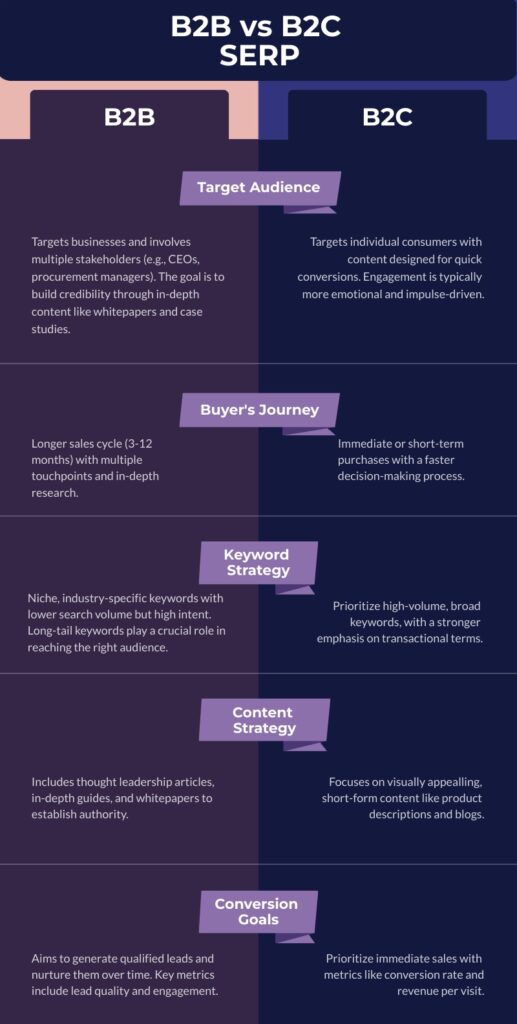
While the fundamentals of SEO apply to both B2B and B2C, the execution differs significantly due to audience, sales cycle, and intent. Here’s what sets them apart:

Target Audience and Decision-Making

  • B2B SERP: Targets businesses and involves multiple stakeholders (e.g., CEOs, procurement managers). The goal is to build credibility through in-depth content like whitepapers and case studies.
  • B2C SERP: Targets individual consumers with content designed for quick conversions. Engagement is typically more emotional and impulse-driven.

Buyer’s Journey and Sales Cycle

  • B2B SERP: Features a longer sales cycle (3-12 months) with multiple touchpoints and in-depth research.
  • B2C SERP: Often involves immediate or short-term purchases with a faster decision-making process.

Keyword Strategy

  • B2B SERP: Prioritizes niche, industry-specific keywords with lower search volume but high intent. Long-tail keywords play a crucial role in reaching the right audience. While niche keywords may drive less traffic, their high relevance ensures you attract engaged users who are more likely to convert.
  • B2C SERP: Prioritizes high-volume, broad keywords with a stronger emphasis on transactional terms.

Content Strategy

  • B2B SERP: Includes thought leadership articles, in-depth guides, and whitepapers to establish authority.
  • B2C SERP: Focuses on visually appealing, short-form content like product descriptions and blogs.

Conversion Goals and Metrics

  • B2B SERP: Aims to generate qualified leads and nurture them over time. Key metrics include lead quality and engagement metrics.
  • B2C SERP: Prioritizes immediate sales with metrics like conversion rate and revenue per visit.

Steps to Enhance Your B2B SERP Strategy

  1. Create Buyer Personas: Tailor content and keywords to the search behavior of key decision-makers.
  2. Conduct Niche Keyword Research: Focus on specific industry terms and long-tail keywords that signal purchase intent.
  3. Develop a Topic Cluster Strategy: Use pillar pages linking to related content to improve site structure and SEO authority.
  4. Optimize Product & Service Pages: Enhance metadata, title tags, internal linking, and structured data.
  5. Create High-Value Content: Publish expert guides, case studies, and whitepapers to establish authority.
  6. Implement Technical SEO Best Practices: Ensure fast page speeds, mobile optimization, and proper schema markup.
  7. Build a Strong Backlink Profile: Gain high-quality backlinks through guest posting and industry collaborations.
  8. Monitor & Adjust Strategy Regularly: SEO evolves constantly; track SERP trends and competitor movements.
  9. Utilize a SERP API: Automate competitive analysis and market insights with real-time SERP data.

By implementing these steps, B2B companies can improve their SEO performance, increase organic traffic, and drive more qualified leads to their website. Don’t expect immediate results. SERP rankings and SEO is a long-term game, so it’s important to take your time, run experiments, and implement best practices.  

Why Use a SERP API for B2B SEO?

SERP APIs provide real-time search data, helping marketers analyze keyword rankings, competitor performance, and search trends at scale. Leveraging a SERP API saves time and reduces errors while offering a comprehensive view of the market landscape. You’re able to customize your data analysis by selecting the most relevant fields for your business while obtaining a complete picture of the results. Search engines are constantly updating their algorithms and site structure which makes manual tracking costly. Using a SERP API to scrape publicly available data from search engine results pages (SERPs) is legal as long as you adhere to the search engine’s terms of service and do not violate them. Leveraging a reputable SERP API provider reduces your risk of non-compliance.

How to use a B2B SERP API:

  1. Choose a Provider: Select an API that meets your data needs and budget.
  2. Get an API Key: Sign up and obtain authentication for access.
  3. Build Search Queries: Target relevant industry keywords.
  4. Send API Requests: Retrieve live SERP data for analysis.
  5. Analyze & Optimize: Use the data to refine your SEO strategy and outperform competitors.

Try Traject Data’s SERP API Today

Traject Data offers industry-leading SERP and eCommerce APIs, providing granular localization, deep data sources, and high-speed performance. Our APIs help businesses optimize pricing, track competitors, and gain actionable market insights.
Try Traject Data’s SERP API for free and take your B2B SEO strategy to the next level.

Ready to See What Traject Data Can Help You Do?


We’re your premier partner in web scraping for SERP data. Get started with one of our APIs for free and see the data possibilities that you can start to collect.

Harness the Power of APIs to Optimize Your Pricing Strategy

Digital technology has transformed consumer purchasing power. We can buy anything, anywhere, anytime, and the market is flooded with competition. As of 2025, there are approximately 30.7 million e-commerce stores worldwide. In the crazy world of ecommerce, your pricing strategy can make or break your business.

Companies that implement a structured pricing strategy can see a 40% increase in revenue year-over-year. But how do you implement an effective pricing strategy? A successful pricing strategy must be data-driven. Web scraping APIs for price tracking and competitive pricing provide real-time insights to help businesses make data-driven decisions and stay ahead of the competition.

The Role of Web Scraping APIs in Pricing Strategy

The beauty of online retail means that adjusting your prices based on market conditions is easy. The days of brick-and-mortar fixed pricing are gone. One in five ecommerce businesses now use dynamic pricing, automatically adjusting prices based on demand and inventory. Amazon, in particular, is known for its sophisticated dynamic pricing algorithms which update prices every few minutes based on demand, stock levels, and competitor pricing. Walmart is close behind, changing prices daily

The ability to track and analyze competitor pricing trends across multiple channels gives businesses an advantage. However, dynamic pricing makes it nearly impossible to manually stay on top of industry pricing trends. This is where price monitoring scraper APIs come in—they automate pricing intelligence, allowing businesses to track prices in real-time.

Major E-Commerce Platforms for Price Scraping

E-commerce giants like Amazon and Walmart dominate the online marketplace and set industry-wide pricing standards. Extracting pricing data from these platforms provides valuable insights into competitive pricing trends. Monitoring these marketplaces helps businesses react quickly to pricing shifts and implement strategic adjustments to stay ahead. 

Challenges in Price Scraping

While price scraping offers undeniable benefits, it also comes with challenges. Amazon and Walmart use sophisticated anti-scraping measures, including:

  • Bot detection
  • Rate limiting
  • IP blocking
  • CAPTCHAs

This results in frequent outages for homegrown and popular web scraping tools. The best price monitoring API for e-commerce must include advanced technology to handle frequent data updates, maintain accuracy, and avoid detection. 

Why Your Business Needs a Pricing API

A pricing API improves reliability and reduces downtime, ensuring uninterrupted access to real-time pricing data. Unlike traditional scraping methods, it’s faster, more efficient, and requires minimal maintenance.

A robust price monitoring API includes:

  • Built-in proxy management and anti-scraping defenses to bypass bot detection.
  • Automated updates that adapt to website changes without breaking.
  • Faster insights than manual scraping, keeping you ahead of competitors.

Use Cases for a Pricing Monitoring API

  • Competitive Pricing Analysis – Compare competitor pricing and adjust your strategy accordingly.
  • Identify Market Trends – Understand shifts in consumer demand and pricing fluctuations.
  • Price Matching Made Easy – Match or beat competitor prices to attract more customers.
  • Optimized Promotions – Plan strategic discounts using real-time pricing data.
  • Validate Supplier & Distributor Contracts – Ensure pricing agreements are being upheld across all sales channels.

Introducing Traject Data’s New Pricing Solution

At Traject Data, we know how important real-time pricing data is to your strategy. That’s why we’re excited to introduce our latest feature:

🚀 Amazon List Price Data 🚀

This powerful tool is designed to supercharge your pricing strategy by providing seamless access to real-time list prices.

Key Benefits of Traject Data’s APIs

  • Wide Coverage –Monitor pricing from Amazon, Walmart, Google, Target, Home Depot and Ebay.
  • Reliable Infrastructure – Get real-time data with minimal latency and downtime.
  • Seamless Integrations – Schedule automated data pushes to your preferred destination.
  • Scalability – Handle tens of millions of requests daily as your business grows.
  • Comprehensive Documentation & Support – Get expert guidance and fast issue resolution.
  • Flexible Pricing – Scale costs based on your needs with a free trial before committing.
  • Clean, Structured Data – We handle data parsing, so you get accurate results without extra processing.

Ready to Optimize Your Pricing Strategy?

The best way to automate price monitoring with an API is to leverage a trusted pricing intelligence solution like Traject Data. Contact us today to learn how our pricing monitoring APIs can help you gain a competitive edge!

Ready to See What Traject Data Can Help You Do?


We’re your premier partner in web scraping for SERP data. Get started with one of our APIs for free and see the data possibilities that you can start to collect.

Traject Data is Your Premier Partner in Web Scraping


Join thousands of satisfied users worldwide who trust Traject Data for all their eCommerce and SERP data needs. Whether you are a small business or a global enterprise, our entire team is committed to helping you achieve your goals and stay ahead in today's dynamic digital landscape. Unlock your organization's full potential with Traject Data. Get started today.

Get started today