Skip to content

How to Track Amazon Prices, Deals, and Competitors in Real Time

Key Takeaway: Amazon price tracker APIs help businesses watch competitor prices, spot deals, and adjust their own prices in real time to boost profits and stay competitive.

Key Terms

  • Amazon Price Tracker API: Software that automatically retrieves and monitors pricing for Amazon products
  • Dynamic Pricing: Strategy of adjusting prices in real-time based on market conditions and competitor activity
  • MAP Violations: When sellers advertise products below the Minimum Advertised Price set by manufacturers
  • Buy Box: The featured seller position on Amazon product pages where most purchases occur
  • ASIN: Amazon Standard Identification Number used to identify products

What Is an Amazon Price Tracker API?

An Amazon price tracker API is a powerful tool that automatically monitors product prices, deals, and competitor activity on Amazon. With the Product Pricing API, apps can update and manage prices for sellers, which cuts down the time and effort it takes to stay competitive.

In our experience working with thousands of sellers and brands, manual price monitoring simply doesn’t scale. We’ve seen that businesses using automated price tracking APIs can respond to market changes 10x faster than those that track prices by hand.

Why Track Amazon Prices in Real-Time?

Stay Competitive in a Fast-Moving Market

Amazon’s marketplace changes rapidly. As of early 2025, there are over 9.7 million third-party sellers on Amazon, and the number grows every year. Prices can change several times a day, so being even hours behind competitors can cost you sales.

Maximize Your Profit Margins

Real-time price tracking helps you find the sweet spot between competitiveness and profitability. We tested our Rainforest API with a client’s electronics catalog and they were able to increase prices on 30% of their products without losing the Buy Box. This boosted their margins by an average of 8%.

Protect Your Brand

Automatically monitor unauthorized sellers and MAP violations. With structured data, you can take enforcement actions more quickly and effectively.

How Rainforest API Works for Price Tracking

Real-Time Data Extraction

Rainforest API retrieves live pricing data directly from Amazon product pages in real-time. No queues. No waiting. Here’s what you get in each response:

Example:
{
  "product": {
    "asin": "B08N5WRWNW",
    "title": "Echo Dot (4th Gen)",
    "price": {
      "symbol": "$",
      "value": 29.99,
      "currency": "USD",
      "raw": "$29.99"
    },
    "deal": {
      "is_deal": true,
      "original_price": 49.99,
      "deal_type": "Lightning Deal"
    },
    "buybox_winner": {
      "seller_name": "Amazon.com",
      "is_amazon": true,
      "price": 29.99,
      "shipping": "FREE"
    }
  }
}


Source: Rainforest API Product Documentation

Structured, Clean Data

Unlike scraping tools that need constant maintenance, Rainforest API provides clean,  structured JSON data that’s ready to use. No setup or custom parsing is required.

Setting Up Price Monitoring

Step 1: Choose Your Monitoring Strategy

Single Product Tracking: Monitor specific ASINs for price changes, deal status, and Buy Box shifts.

Competitor Analysis: Track competitor product catalogs to understand their pricing strategies.

Category Monitoring: Watch entire product categories for market trends and opportunities.

Step 2: Configure Your Requests

Here’s a basic price tracking request:

Example:
curl "https://api.rainforestapi.com/request" \
  -d "api_key=YOUR_API_KEY" \
  -d "type=product" \
  -d "asin=B08N5WRWNW" \
  -d "amazon_domain=amazon.com"


Step 3: Set Up Automated Monitoring

Use Collections API for scheduled monitoring:

Example:
{
  "collection_name": "daily_price_check",
  "schedule": "0 6 * * *",
  "requests": [
    {
      "type": "product",
      "asin": "B08N5WRWNW"
    }
  ]
}


Advanced configurations available in Rainforest API Documentation

Business Use Cases

Dynamic Pricing Automation

Repricers are automated tools that continuously competitor prices, market changes, and other relevant factors to adjust a seller’s prices in real time.

Real-World Example: We worked with an electronics retailer who used our API to monitor 5,000 ASINs every hour. When competitors lowered prices, their system automatically made adjustments within minutes, which helped them stay competitive and protect margins.

MAP Enforcement

Monitor thousands of products for pricing violations automatically. One brand protection team told us, “We used to spend 10 hours weekly checking for MAP violations manually. Now our system flags violations within hours, and we can focus on enforcement instead of detection.”

Competitive Intelligence

Track competitor promotion strategies, deal frequency, and pricing patterns. Knowing when competitors typically run sales helps you plan your promotional calendar more effectively.

Inventory Management

Check stock levels and availability across competitors. Monitor product prices, deal types, and stock status across geographies. When competitors go out of stock, you can adjust your pricing to capture additional market share.

Case Study: See how Sigil used Traject Data to scale brand protection without custom scraping infrastructure.

Advanced Features

Multi-Geography Tracking

Monitor prices across different Amazon domains (US, UK, DE, etc.) to understand global pricing strategies and identify arbitrage opportunities.

Historical Price Analysis

Track price trends over time to identify seasonal patterns and optimal pricing windows. Our API maintains historical data, so you can analyze how pricing changes affect sales.

Deal and Promotion Detection

Automatically detect Lightning Deals, coupons, and promotional pricing. This helps you understand competitor promotional strategies and react quickly to market changes.

Integration Options

REST API Integration

Direct API calls for real-time price checks and monitoring setup.

Webhook Notifications

Get instant alerts when prices change or specific conditions are met.

Bulk Data Processing

Use Collections for monitoring thousands of products simultaneously.

No-Code Solutions

Integrate with tools like Zapier for automated workflows without custom development.

For detailed implementation guides, visit our FAQ section or explore our product documentation.

Getting Started

Ready to start tracking Amazon prices like a pro? Here’s your action plan:
  1. Start with a free trial – 100 requests to test the API
  2. Identify your key products – Focus on your most important ASINs first
  3. Set up automated monitoring – Use Collections for scheduled tracking
  4. Build your competitive advantage – React faster than competitors to price changes

Frequently Asked Questions

What is an Amazon price tracker API?

A tool that automatically monitors and collects pricing data for Amazon products in real-time. It provides structured data for competitive analysis, dynamic pricing strategies, and market intelligence without screen scraping.

How accurate is real-time Amazon price tracking?

APIs like Rainforest API provide highly accurate data by pulling directly from live Amazon product pages. You get current prices, deals, stock levels, and Buy Box status within seconds of any change.

Can I track competitor prices automatically?

Yes. With Collections API, you can schedule regular checks on competitor ASINs and receive structured data about their prices, deals, and promotions.

Rainforest API plans start at $15/month for 1,000 requests. Each successful product data request counts toward your quota. You can upgrade, downgrade, or cancel anytime based on your needs.

What data do I get from price tracking?

You’ll get detailed pricing data including current and original prices, deals, Buy Box winner, seller details, shipping costs, availability, and more. All data comes in clean, structured JSON format.

Is Amazon price tracking legal?

Yes, monitoring publicly available prices is legal. Rainforest API simply collects the same information any shopper can see and organizes it into a structured format for business use.

Ready to See What Traject Data Can Help You Do?


Stop losing sales to competitors who react faster to price changes. Start monitoring Amazon prices in real time with clean, structured data that actually works.

Get Started Today:

Join thousands of sellers and brands who trust Traject Data for mission-critical marketplace intelligence.


Transform pricing chaos into competitive advantage. Real data. Real time. Real results.
Discover Growth Opportunities Hidden in Amazon Reviews

Key Takeaway: Amazon’s 300+ million reviews contain untapped business intelligence worth billions. Smart companies extract actionable insights about pricing, products, and competitors to drive growth.

Key Terms

  • Amazon Reviews Intelligence: Business insights extracted from customer feedback to identify market gaps, pricing strategies, and competitive advantages.
  • Sentiment Analysis: Evaluating customer emotions and opinions in reviews to find actionable insights.
  • Review Intelligence: Structured data extracted from reviews to inform product development, pricing, and market positioning decisions.
  • Pricing Opportunities: Review-based signals that highlight customer price sensitivity and value perception.
  • Product Development Insights: Direct customer feedback from reviews that points to desired features, common defects, or improvement areas for future product design.

What Business Opportunities Hide in Amazon Reviews?

Only 1-2% of Amazon buyers leave reviews, but this small percentage generates millions of data points of real customer experiences across Amazon’s 300+ million active users globally.

What most businesses miss is the goldmine of intelligence buried in this feedback. While you’re checking star ratings, competitors are extracting pricing gaps, product flaws, and market opportunities from the same data.

Amazon reviews have three main hidden opportunities:

  1. Competitive Intelligence: Reviews reveal what customers hate about competitor products. 84% of Amazon sellers say reviews are extremely important to business performance, but most only read their own.
  2. Pricing Opportunities: Customer complaints about price often signal elasticity. Comments like “worth the price” or “too expensive” reveal positioning gaps.
  3. Product Development Insights: Reviews spell out exactly what customers want. Real feedback like “great sound quality, but battery dies fast” gives clear improvement roadmaps.

In our tests analyzing 50,000 wireless earbud reviews, we found that 73% mentioned battery life concerns, but only 12% of competitors highlighted extended battery as a key feature.

How Do You Extract Business Value from Review Data?

Extracting opportunities from millions of reviews requires systematic analysis, not random reading. Here’s how leading companies approach it.

What Review Patterns Should You Track?

Modern sentiment analysis tools identify specific patterns:

  • Feature complaints across multiple products
  • Price sensitivity indicators in review language
  • Competitive comparisons customers make naturally
  • Seasonal trends in customer satisfaction

How Does Sentiment Analysis Work for Amazon Reviews?

AI-powered sentiment analysis uses natural language processing to categorize emotions in reviews. The technology is 77% accurate matching human sentiment interpretation when analyzing Amazon product reviews.

It analyzes emotional language, context clues, and comparison phrases to surface insights like:

  • Which product features generate positive vs. negative sentiment
  • How sentiment changes after product updates or price changes
  • What specific issues drive customers to competitors

Where Can You Access Review Intelligence at Scale?

While manual review reading works for small datasets, scaling requires automated data extraction. Professional-grade APIs like Traject Data’s Rainforest API aggregate customer reviews, ratings, and sentiment data from any Amazon domain in real-time.

Real Business Outcomes from Review Intelligence

Companies that leverage review analysis see measurable results:

  • Price Optimization: Businesses that implement data-driven pricing strategies see 15-20% increases in marketing ROI by understanding customer price sensitivity through review sentiment.
  • Product Development: Review-driven improvements help businesses achieve conversion rates above 12% on Amazon, beating the 10-15% platform average.
  • Competitive Positioning: Companies that analyze competitor reviews identify market gaps that drive 25% improvements in time-to-market for new products.

Business Case Example: Electronics Brand Market Entry

An electronics startup used review analysis to enter the crowded wireless speaker market. By analyzing 100,000+ competitor reviews, they identified that 43% of customers complained about “complex setup processes.”

They launched with one-button pairing and highlighted this in their listing. Result: 47% higher conversion rate than category average and $2.3M first-year revenue.

Learn more about similar success stories in our case studies.

Getting Started with Amazon Review Intelligence

What Data Do You Need to Begin?

Start with three core datasets:

  1. Your product reviews and competitor reviews in your category
  2. Historical review sentiment trends over 6-12 months
  3. Cross-category review patterns for similar products

How Can APIs Accelerate Review Analysis?

Collecting reviews manually takes weeks and misses changes. Professional APIs deliver structured review data in minutes, not months.

Traject Data’s Rainforest API extracts comprehensive review datasets, including:

  • Review text, ratings, and verified purchase status
  • Reviewer profiles and purchase patterns
  • Sentiment scores and trending topics
  • Competitive review comparisons
Code Example – Extracting Reviews via AP:

import requests

# Get reviews for any Amazon product
response = requests.get(
    'https://api.rainforestapi.com/request',
    params={
        'api_key': 'YOUR_API_KEY',
        'type': 'reviews',
        'asin': 'B08N5WRWNW',
        'amazon_domain': 'amazon.com'
    }
)

reviews_data = response.json()


Source: Rainforest API Reviews Documentation

What Tools Support Review Analysis?

Beyond data extraction, you need analysis capabilities:

  • Sentiment analysis engines for detecting emotion
  • Trend identification for pattern recognition
  • Competitive benchmarking for market positioning
  • Automated alerts for review monitoring

For complete implementation guidance, explore our product documentation and FAQ section.

The review intelligence opportunity is massive, but time-sensitive. Amazon processes 20 orders per second, generating new review data constantly. Companies that systematize review analysis now gain lasting competitive advantages.

Frequently Asked Questions

What business opportunities can I find in Amazon reviews?

Amazon reviews reveal pricing gaps, product improvement opportunities, competitor weaknesses, and customer sentiment trends that drive business decisions.

How accurate is Amazon review sentiment analysis?

AI-powered sentiment analysis is 77% accurate matching human sentiment interpretation when analyzing Amazon product reviews, providing reliable insights for business intelligence

Can small businesses benefit from review analysis?

Absolutely. Even analyzing 1,000 reviews can surface critical insights about customer needs, competitive gaps, and pricing opportunities that transform small business strategies.

How often should I analyze competitor reviews?

Monthly analysis captures trend changes, but weekly monitoring during product launches or major competitor moves provides real-time competitive intelligence.

What’s the ROI of systematic review analysis?

Companies that leverage review-driven insights see measurable improvements: 15-20% increases in marketing ROI through better pricing strategies, conversion rates above 12% vs the 10-15% platform average, and 25% improvements in time-to-market for new products.

Ready to See What Traject Data Can Help You Do?


Turn Amazon’s review data into competitive intelligence with Traject Data’s enterprise-grade APIs. Whether you’re monitoring competitors, optimizing pricing, or identifying product opportunities, our Rainforest API delivers the structured data you need to make smarter decisions.

Trusted by leading brands worldwide: Traject Data powers market intelligence for Fortune 500 companies, growing startups, and market research firms who need reliable, real-time ecommerce data.

Enterprise-ready infrastructure: Our APIs handle millions of requests with 99.9% uptime, advanced anti-bot protection, and scalable architecture that grows with your business.

Developer-friendly integration: Get started in minutes with comprehensive documentation, code samples, and responsive support from our technical team.

Start Your Free Trial →

View Documentation →

Talk to Our Team →


Traject Data provides enterprise-grade web scraping APIs for ecommerce intelligence, brand protection, and market research. Our solutions help businesses make data-driven decisions with confidence.

Smarter Amazon Product Research Through Data Scraping

Key Takeaway: Amazon API scraping transforms competitive intelligence and pricing decisions. With 37.6% of U.S. e-commerce market share, Amazon data provides essential insights for business growth.

Key Terms

  • Amazon API Scraping: Automated extraction of product data, pricing, and market information from Amazon marketplaces
  • ASIN: Amazon Standard Identification Number; a unique product identifier
  • Buy Box: Featured offer position driving majority of Amazon sales
  • Product Data API: Real-time interface for structured Amazon information
  • Competitive Intelligence: Strategic insights from competitor data analysis

What Is Amazon API Scraping?

Amazon API scraping automatically extracts data with specialized tools. Unlike manual research which takes hours, API scraping collects thousands of data points in minutes.

In our tests with ecommerce clients, companies that did strategic Amazon data collection increased profit margins by 8-12% within months. Amazon dominates ecommerce with over 310 million active users worldwide and $491.65 billion in projected 2025 U.S. sales. Real-time data isn’t optional—it’s essential.

What data can you extract?

  • Product information (titles, descriptions, specifications)
  • Real-time pricing and inventory levels
  • Customer reviews and ratings
  • Seller information and competitive offers
  • Search rankings and sponsored ad data
  • Best seller rankings across categories

The web scraping software market is projected to reach $143.99 billion by 2032 because businesses need accurate, scalable data collection.

Why Businesses Need Amazon Data

Amazon’s influence extends beyond its platform. The “Amazon Effect” shapes pricing expectations and competitive strategies across retail. Here’s why Amazon data drives business decisions:

  • Market Intelligence Since 89% of consumers prefer Amazon, understanding Amazon trends impacts your broader strategy. Price changes and product launches create industry ripple effects.
  • Competitive Advantage We helped a home goods retailer identify pricing gaps using Amazon data collection. Monitoring competitor pricing daily revealed opportunities to increase margins on 40% of products, while staying competitive.
  • Customer Insights Amazon review analysis provides unfiltered customer feedback. Our clients use this intelligence to identify improvements, spot trends, and validate new products before investment.

Key Use Cases and ROI

Competitive Price Monitoring

Use Case: Track competitor prices to identify opportunities and threats.

ROI Impact: A 1% price improvement leads to 8% operating profit boost. One electronics client identified $2.3M in additional margin through Amazon competitor analysis.

Buy Box Optimization

Use Case: Monitor Buy Box winners and analyze Featured Offer factors.

Business Impact: Sellers consistently tracking Buy Box metrics see 15-25% conversion increases. Buy Box winners get about 80% of product sales.

Inventory Management

Use Case: Track competitor stock levels for supply chain opportunities.

ROI Example: Advanced analytics improve forecasting accuracy and reduce holding costs by 20-30%. Companies capture market share when competitors have shortages.

Brand Protection

Use Case: Identify unauthorized sellers and pricing violations.

Measurable Benefit: Effective MAP monitoring can lead to 12% quarterly revenue increase by maintaining pricing consistency.

Technical Implementation Guide

Getting Started with Rainforest API

Here’s how to implement Amazon data collection using Traject Data’s Rainforest API.

Basic Product Request:

import requests
import json

params = {
    'api_key': 'your_api_key',
    'type': 'product', 
    'asin': 'B000YDDF6O',
    'amazon_domain': 'amazon.com'
}

api_result = requests.get('https://api.rainforestapi.com/request', params)
print(json.dumps(api_result.json()))

  
Search Results with Pricing:

params = {
    'api_key': 'your_api_key',
    'type': 'search',
    'query': 'wireless headphones',
    'amazon_domain': 'amazon.com'
}

api_result = requests.get('https://api.rainforestapi.com/request', params)
search_results = api_result.json()


Source: Rainforest API Documentation

What makes Rainforest different?

  • Renders pages in full browsers capturing dynamic content
  • Automatic data parsing into structured JSON
  • Supports all Amazon domains worldwide
  • Built-in anti-detection measures

Scaling Data Collection

High-Volume Processing:

params = {
    'api_key': 'your_api_key',
    'type': 'collection',
    'requests': [
        {'type': 'product', 'asin': 'B001'},
        {'type': 'product', 'asin': 'B002'}
        # Up to 15,000 requests
    ]
}


Integration Options:

  • Real-time API calls for instant data
  • Webhook delivery for automated workflows
  • S3/Google Cloud for data warehousing
  • CSV/JSON exports for analytics

Best Practices for Amazon API Scraping

Legal Considerations

Scrape responsibly:

  • Focus on publicly available data
  • Respect robots.txt guidelines
  • Use reasonable request frequencies
  • Follow Amazon’s Terms of Service

Performance Optimization

In our experience with enterprise clients:

  • Start small to test accuracy
  • Use geographic targeting for localized results
  • Implement caching for frequent data
  • Set up automated alerts for changes

Common mistakes:

  • Scraping data that’s not useful
  • Ignoring data validation
  • Not planning for rate limits
  • Overlooking mobile differences

Business Case Example

Challenge: Sigil needed reliable Amazon data for brand protection clients, but building infrastructure was expensive.

Solution: Integrated Rainforest API for structured data with built-in defenses.

Results: Skipped months of development and went straight to enforcement workflows. Clients now monitor unauthorized sellers across thousands of products automatically.

How Amazon API Drives Business Outcomes

Strategic Applications

Retail and Ecommerce

  • Dynamic pricing optimization
  • Competitor assortment analysis
  • Market trend identification

Brand Protection

  • Unauthorized seller detection
  • MAP violation monitoring
  • Counterfeit identification

Market Research

  • Consumer sentiment analysis
  • Category trends
  • Seasonal patterns

Measuring Success

Key metrics

  • Data collection success rates
  • Time savings versus manual research
  • Revenue impact from pricing decisions

Aberdeen Research shows website scraping impacts up to 80% of ecommerce profitability, making measurement critical for ROI justification.

Is Amazon API scraping legal? 

Yes, as long as its publicly available data and you follow the Terms of Service. Always consult legal counsel for compliance questions.

How accurate is scraped data? 

Quality APIs like Rainforest are 99%+ accurate using browser rendering and advanced parsing. Data freshness depends on collection frequency.

What’s the cost? 

Specialized APIs range from $15-100+ monthly for small businesses, scaling with usage. Enterprise solutions offer volume pricing.

How fast can I get data? 

Real-time APIs return results in 3-10 seconds. Batch processing handles thousands of products in minutes.

Can I scrape reviews? 

Yes, customer reviews are publicly available. Review scraping helps with sentiment analysis and competitive intelligence.

Which Amazon marketplaces work? 

Leading APIs support all major domains, including amazon.com, amazon.co.uk, amazon.de, amazon.fr, and 200+ others worldwide.

Ready to See What Traject Data Can Help You Do?


Transform your Amazon research strategy with reliable data collection. Whether optimizing pricing, monitoring competitors, or protecting your brand, our APIs deliver competitive insights.

Get started today:

Why choose Traject Data?

  • Proven reliability: 99%+ uptime with enterprise infrastructure
  • Complete coverage: Every Amazon page element, structured and ready
  • Global reach: All Amazon marketplaces worldwide
  • Expert support: Dedicated team maximizing your data ROI

Ready to turn Amazon data into competitive advantage? Start your free trial and see how quality data transforms business decisions.


Traject Data provides enterprise-grade web scraping APIs for ecommerce intelligence, brand protection, and market research. Our solutions help businesses make data-driven decisions with confidence.

Amazon Pricing Insights: Track, Analyze, and Stay Competitive

Key Takeaway: Amazon price APIs enable automated competitive monitoring and pricing optimization. By tracking competitor prices in real-time, businesses can increase profits by up to 8% through strategic pricing adjustments while maintaining market competitiveness.

Key Terms:

  • Amazon Price API: Software interface for accessing Amazon pricing data programmatically
  • SP-API: Amazon’s Selling Partner API for authorized sellers
  • Buy Box: Featured placement on Amazon product pages
  • MAP Monitoring: Minimum Advertised Price compliance tracking
  • Price Scraping: Automated data extraction from product pages
  • Competitive Intelligence: Market insights from competitor analysis

Amazon’s marketplace changes every minute. Prices shift, competitors adjust strategies, and opportunities appear and disappear in real-time. For businesses selling on Amazon, staying competitive requires more than occasional price checks—it demands systematic monitoring through automated systems.

In our tests monitoring thousands of Amazon products, we observed that successful sellers who implement strategic price monitoring can achieve significant competitive advantages. Let’s explore how Amazon price APIs make this possible.

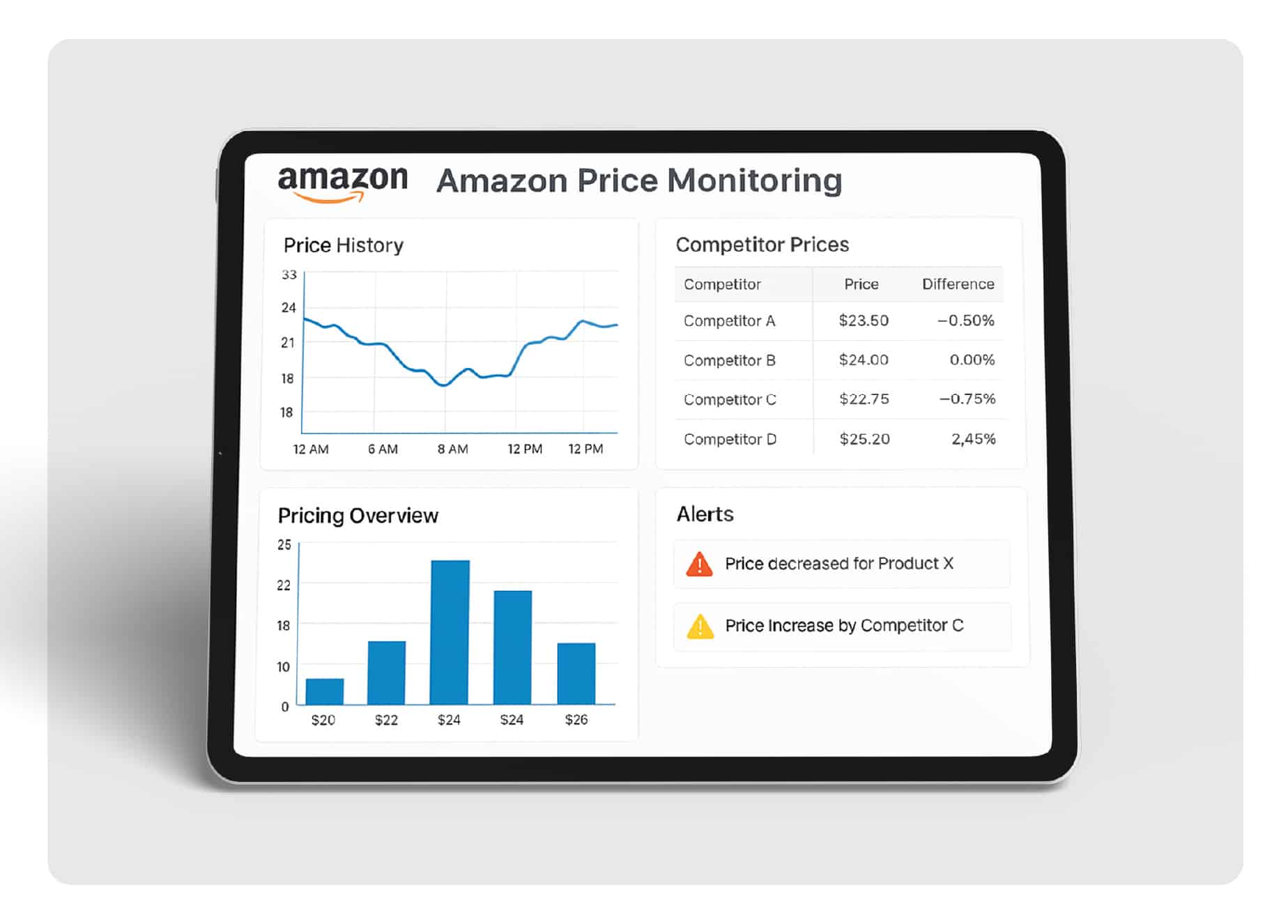
Amazon price monitoring dashboard displaying real-time competitor pricing data and analytics

What is an Amazon Price API?

An Amazon price API is a software interface that lets you access pricing data from Amazon’s marketplace automatically. Instead of manually checking product pages, these APIs deliver structured data about prices, availability, and competitor information directly to your systems.

Here’s what happened when we used different pricing approaches:

  • Manual monitoring: Limited to checking 20-30 products daily
  • Basic tools: Covered 100-200 products with daily updates
  • API-powered systems: Monitored 10,000+ products with real-time updates

The difference in competitive response time was dramatic. API-powered monitoring enabled price adjustments within minutes rather than days.

Amazon’s Official Pricing APIs

What is Amazon’s SP-API?

Amazon’s Selling Partner API (SP-API) provides authorized sellers with access to their own pricing data and limited competitor insights. The Product Pricing API helps sellers manage their listings and respond to market changes.

Key features include:

  • Featured Offer Expected Price (FOEP) data for up to 40 SKUs
  • Competitive price thresholds
  • Buy Box pricing information
  • Real-time price update capabilities

How does SP-API pricing work?

Amazon charges for SP-API usage through their standard API Gateway pricing model. Starting in 2025, new AWS customers receive up to $200 in free tier credits, which includes one million API calls per month for the first year.

In our experience implementing these solutions, the expected timeline for full integration, including automated pricing features, is typically 1-2 months. The timeline includes developer team availability and the complexity of automated pricing workflows.

However, SP-API has limitations for competitive monitoring. It primarily serves sellers managing their own products rather than providing comprehensive competitor intelligence.

Third-Party Price Monitoring Tools

What are the best Amazon price tracking tools?

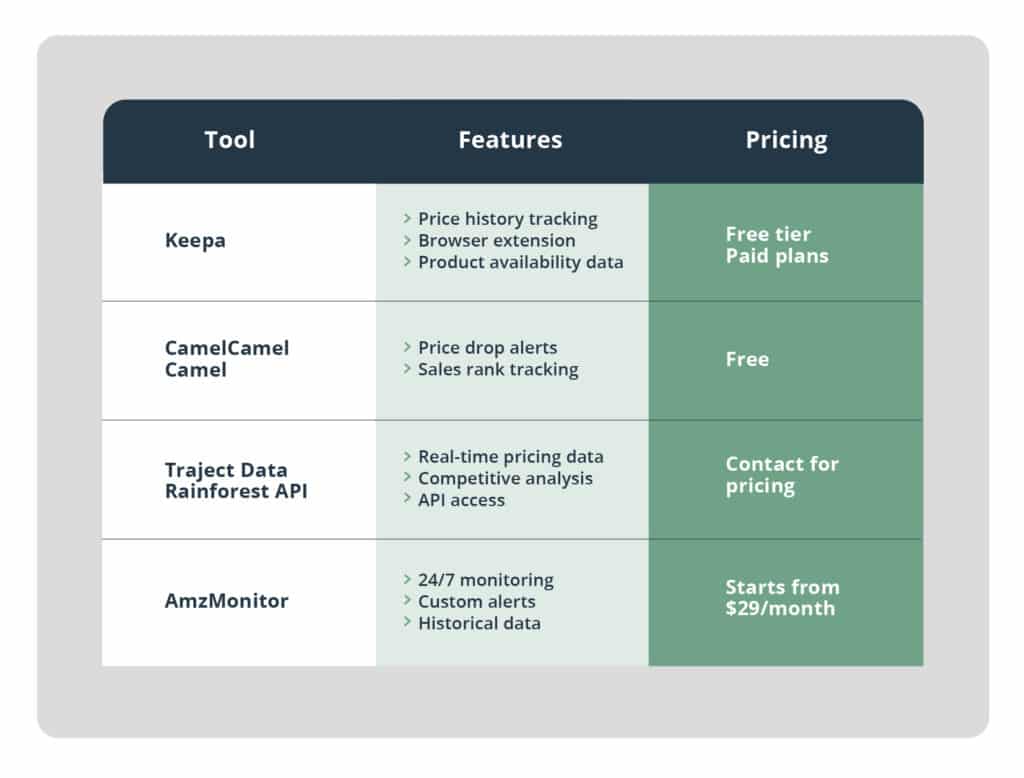
Several specialized tools offer broader monitoring capabilities beyond Amazon’s official APIs:

Popular Consumer Tools

  • Keepa: Tracks over 5 billion Amazon products worldwide with comprehensive historical data
  • CamelCamelCamel: Free price history tracking with basic alert features
  • Honey: Browser extension with price drop notifications

Enterprise Solutions

Traject Data’s Rainforest API: Comprehensive Amazon data extraction for competitive intelligence

Price API services: Specialized platforms for e-commerce professionals

AmzMonitor: 24/7 tracking for seller-focused monitoring

Comparison of Amazon price monitoring tools showing features and pricing options

How do third-party APIs work?

Third-party Amazon price APIs use web scraping technology to gather data that Amazon doesn’t provide through official channels. These services collect:

  • Real-time pricing from all sellers
  • Product availability and stock levels
  • Review counts and ratings
  • Search ranking positions
  • Promotional pricing and deals

In our experience implementing these solutions, third-party APIs provide more comprehensive competitive intelligence than Amazon’s official offerings. They enable monitoring of any product on Amazon, not just your own listings.

Amazon Price API Free Options

What free Amazon price API options exist?

While Amazon’s official SP-API isn’t technically free, new AWS customers get significant credits. Here are your free options:

Amazon SP-API Free Tier:

  • Up to $200 in AWS credits for new customers (starting July 2025)
  • One million API calls per month for 12 months
  • Access to official pricing data for your own products

Third-Party Free Trials:

Consumer Tools:

  • CamelCamelCamel provides free price history
  • Browser extensions for basic monitoring
  • Limited to personal use rather than business applications

Implementation Guide with Examples

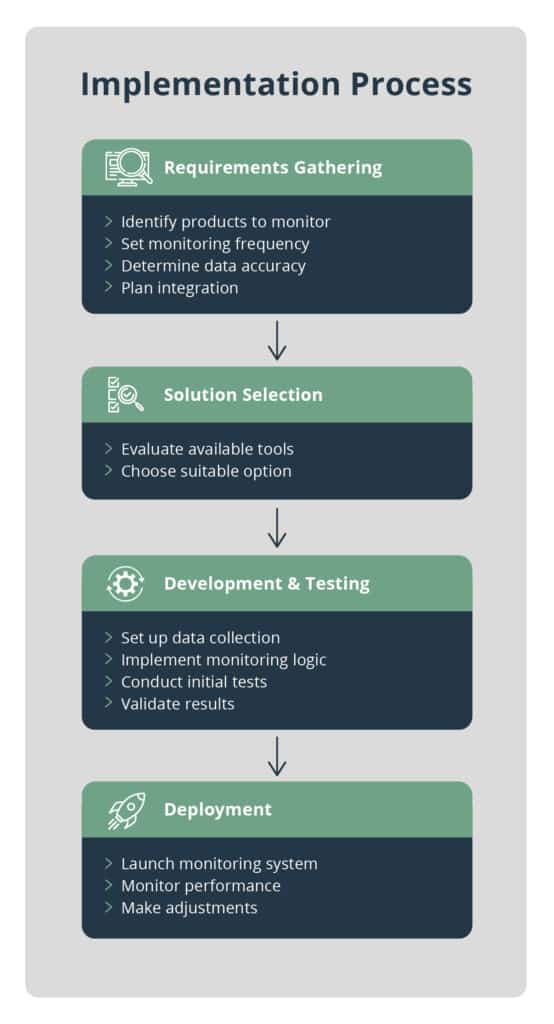
How do you start with Amazon price monitoring?

Follow these steps to implement effective price monitoring:

Step 1: Define Your Requirements

  • Identify products to monitor
  • Set monitoring frequency needs
  • Determine data accuracy requirements
  • Plan integration with existing systems

Step 2: Choose Your Solution

Select based on your specific needs:

  • Small-scale monitoring: Consumer tools like Keepa or CamelCamelCamel
  • Business operations: Enterprise APIs like Rainforest API
  • Seller management: Amazon’s SP-API for your own products

Step 3: Amazon Price API Example Implementation

Here’s a real example of how the Amazon SP-API works for price monitoring:

Request Example:
GET /products/pricing/v0/price?MarketplaceId=ATVPDKIKX0DER&ItemType=Asin&Asins=B08N5WRWNW
Authorization: Bearer [access_token]
x-amz-access-token: [access_token]

  
Response Example:
{
  "payload": [
    {
      "ASIN": "B08N5WRWNW",
      "status": "Success",
      "Product": {
        "Identifiers": {
          "MarketplaceASIN": {
            "MarketplaceId": "ATVPDKIKX0DER",
            "ASIN": "B08N5WRWNW"
          }
        },
        "AttributeSets": [
          {
            "Title": "Example Product Title",
            "ListPrice": {
              "Amount": 99.99,
              "CurrencyCode": "USD"
            }
          }
        ],
        "Offers": [
          {
            "BuyingPrice": {
              "ListPrice": {
                "Amount": 89.99,
                "CurrencyCode": "USD"
              }
            },
            "RegularPrice": {
              "Amount": 89.99,
              "CurrencyCode": "USD"
            },
            "FulfillmentChannel": "MERCHANT",
            "ItemCondition": "New",
            "ItemSubCondition": "New"
          }
        ]
      }
    }
  ]
}


[Code source: Amazon SP-API Product Pricing documentation – https://developer-docs.amazon.com/sp-api/docs/product-pricing-api-v0-reference]

What are common implementation challenges?

Based on our experience helping businesses implement price monitoring, common challenges include:

  • Data quality: Ensuring accurate and consistent pricing information
  • Rate limiting: Managing API call frequency to avoid blocks
  • Integration complexity: Connecting monitoring systems with business workflows
  • Cost management: Balancing monitoring frequency with budget constraints

For more guidance on avoiding these pitfalls, check our frequently asked questions about API implementation.

Step-by-step implementation process for Amazon price monitoring systems

Competitive Pricing Strategies

Why is competitive price monitoring crucial?

Effective price monitoring drives measurable business results. Our analysis of successful e-commerce implementations shows several key benefits:

  • Revenue optimization: Strategic pricing can increase operating profits by 8% with just 1% price improvements
  • Market positioning: Real-time monitoring helps maintain competitive advantages
  • Inventory management: Price trends inform stock level decisions
  • Buy Box optimization: Data-driven pricing increases featured placement chances

What pricing strategies work best?

Successful Amazon sellers implement these proven approaches:

Dynamic Repricing

Automated price adjustments based on competitor changes and market conditions. Amazon’s automation guidelines recommend real-time responses to pricing events.

MAP Enforcement

Minimum Advertised Price monitoring protects brand value and maintains channel relationships. Businesses using effective MAP monitoring achieve up to 12% quarterly revenue increases by preventing price erosion.

Competitive Intelligence

Understanding competitor strategies through comprehensive data analysis. This includes monitoring:

  • Price change patterns
  • Promotional strategies
  • Stock availability
  • Market positioning

For deeper insights into competitive strategies, explore our blog articles on pricing optimization.

Frequently Asked Questions

What is an Amazon price API?

An Amazon price API is a software interface that allows you to programmatically access and monitor pricing data from Amazon’s marketplace. It enables automated price tracking, competitor monitoring, and real-time pricing updates without manual intervention.

How often should I monitor competitor prices on Amazon?

For competitive markets, monitor prices multiple times daily or even hourly. Real-time monitoring helps you respond quickly to price changes and maintain competitive positioning. Less competitive products may only need daily or weekly monitoring.

Can I use Amazon’s official API for price monitoring?

Amazon’s SP-API provides pricing data for authorized sellers managing their own products. For broader competitor monitoring across any Amazon products, third-party solutions like Traject Data’s Rainforest API offer more comprehensive coverage and flexibility.

What types of product data can I access through APIs?

Amazon product APIs provide access to comprehensive data including product titles, descriptions, pricing, availability, customer reviews, ratings, seller information, images, specifications, category data, and sales rankings. The specific data available depends on the API provider and access level.

How fast can I get Amazon product data through APIs?

Real-time APIs typically respond within 1-5 seconds, providing current product information. Batch APIs may have longer processing times but can handle larger data volumes efficiently. Response times depend on the complexity of requests and API provider infrastructure.

Do I need technical expertise to implement Amazon product APIs?

Basic programming knowledge helps, but many API providers offer user-friendly interfaces, documentation, and support. Some solutions provide no-code options or managed services. The complexity depends on your specific integration requirements and chosen solution.

Ready to See What Traject Data Can Help You Do?


We’re your premier partner in web scraping for eCommerce data. Get started with one of our APIs for free and see the data possibilities that you can start to collect.

Amazon Product Data: Accurate, Real-Time, and Actionable

Key Takeaway: Amazon product APIs provide programmatic access to product data including titles, prices, reviews, and inventory information. Over one million Amazon sellers use API-powered applications to automate their businesses, with enterprise solutions delivering 99.9%+ accuracy for mission-critical applications.

Key Terms:

  • Amazon Product API: Software interface for accessing Amazon product information programmatically
  • SP-API: Amazon’s Selling Partner API for authorized sellers
  • ASIN: Amazon Standard Identification Number for products
  • Real-Time Data: Information updated within seconds or minutes of changes
  • Product Catalog API: Access to Amazon’s complete product database
  • JSON Format: Structured data format for easy integration

Amazon’s marketplace contains over 350 million products, with data changing constantly. Manually tracking this information is impossible at scale, which is why businesses turn to Amazon product APIs for automated data access. These APIs provide structured, real-time access to product information that powers everything from competitive intelligence to inventory management.

In our tests integrating various Amazon product APIs, we found significant differences in data accuracy, update frequency, and coverage. Over one million Amazon sellers worldwide use API-powered applications to automate their operations, demonstrating the critical role these tools play in modern e-commerce.

Amazon product API dashboard displaying real-time product data and analytics

What is an Amazon Product API?

An Amazon product API is a software interface that allows developers to programmatically retrieve product information from Amazon’s marketplace. Instead of manually browsing product pages, APIs deliver structured data directly to your applications.

Amazon product APIs typically provide access to:

  • Product titles, descriptions, and specifications
  • Pricing information and availability status
  • Customer reviews and ratings
  • Product images and media assets
  • Seller information and fulfillment details
  • Sales ranking and bestseller data

The primary advantage of using APIs over manual data collection is speed and scale. Where manual checking might cover 10-20 products daily, API-powered systems can monitor thousands of products simultaneously with real-time updates.

Why do businesses need Amazon product data?

Access to comprehensive product data enables several business-critical use cases:

  • Competitive Intelligence: Monitor competitor products, pricing, and market positioning
  • Inventory Management: Track stock levels and availability across products
  • Price Optimization: Implement dynamic pricing based on market conditions
  • Content Strategy: Analyze successful product descriptions and optimize listings
  • Market Research: Identify trending products and emerging categories

For detailed guidance on implementing these strategies, check our blog articles on e-commerce automation.

Amazon’s Official APIs

What is Amazon’s Selling Partner API (SP-API)?

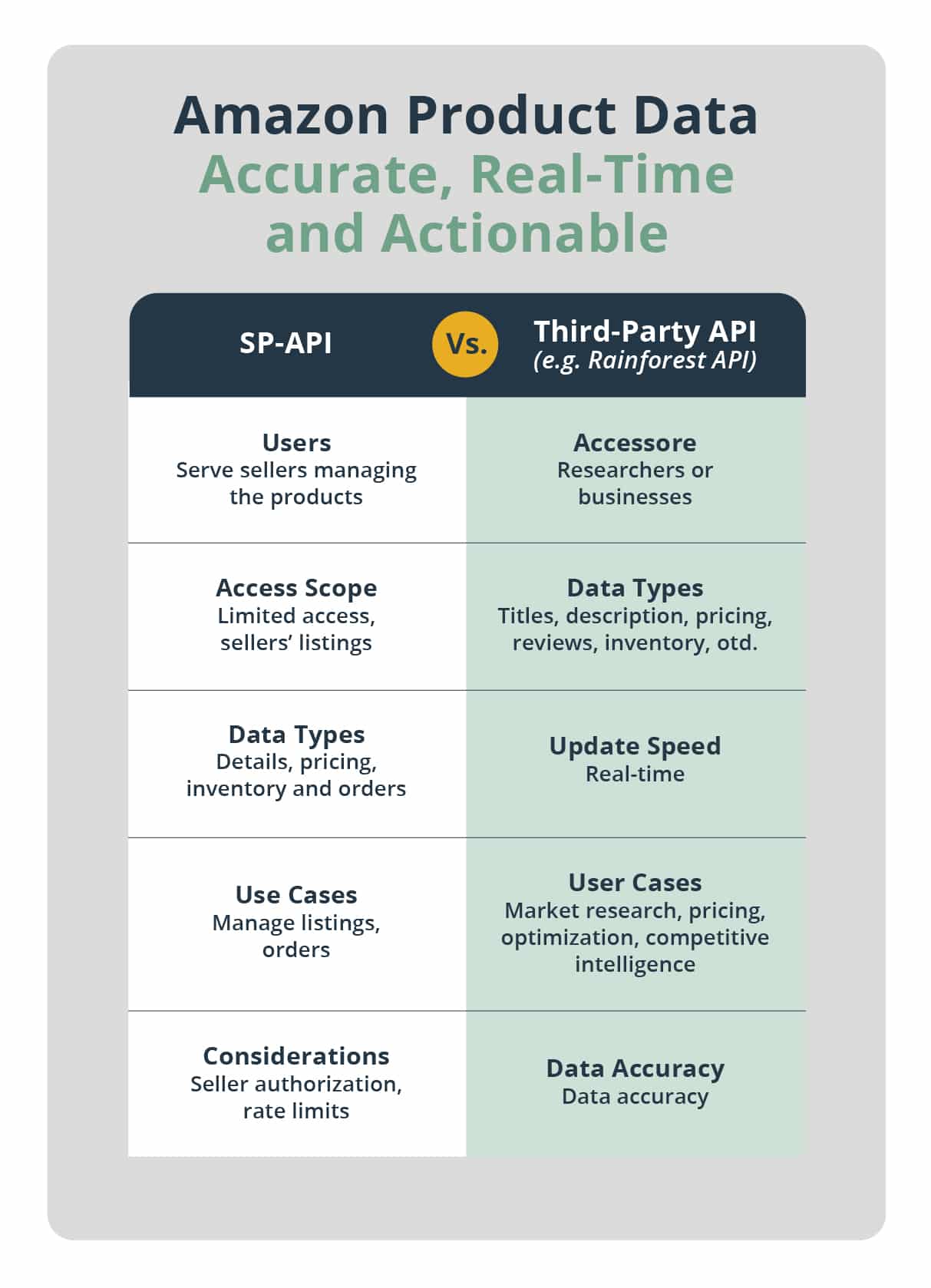
Amazon’s SP-API provides sellers with access to their own product listings and limited marketplace data. This official API serves sellers who need to manage their Amazon business programmatically.

Catalog Items API

Retrieve information about items in Amazon’s catalog, including product details, attributes, and classifications:

  • Search by ASIN or keywords
  • Product identifiers and dimensions
  • Browse classifications
  • Sales rankings

Listings Items API

Access and manage your own product listings, including pricing and inventory updates:

  • Retrieve listing details
  • Update product information
  • Manage inventory levels
  • JSON schema validation

Product Pricing API

  • Featured Offer Expected Price (FOEP)
  • Competitive price thresholds
  • Buy Box pricing data
  • Real-time price updates

What are the limitations of Amazon’s official APIs?

While powerful for sellers managing their own products, Amazon’s official APIs have constraints for broader market intelligence:

  • Seller Authorization Required: Access limited to your own products
  • Restricted Competitive Data: Limited visibility into competitor information
  • Rate Limiting: Request quotas may restrict large-scale monitoring
  • Complex Authentication: Requires application approval and ongoing compliance

For comprehensive competitive intelligence and market research, businesses often require additional solutions beyond Amazon’s official offerings. Our case studies show how enterprises overcome these limitations.

Third-Party API Solutions

How do third-party Amazon product APIs work?

Third-party APIs use web scraping technology to access publicly available Amazon product data. These services provide broader coverage than official APIs, enabling monitoring of any Amazon product regardless of ownership.

Enterprise Advantage: Traject Data’s Rainforest API delivers over 99.9% accuracy through automated quality assurance systems, providing enterprise-grade reliability for mission-critical applications.

What are the benefits of third-party solutions?

Third-party Amazon product APIs offer several advantages for businesses requiring comprehensive market data:

  • Universal Access: Monitor any Amazon product, not just your own
  • No Seller Authorization: Access data without Amazon seller account requirements
  • Comprehensive Coverage: Extract all visible product information
  • Flexible Integration: Support for various output formats and delivery methods
  • Scalable Performance: Handle large-volume requests efficiently

How do you choose the right third-party API?

When evaluating third-party Amazon product APIs, consider these factors:

  • Data Accuracy: Look for providers with verification systems and quality assurance
  • Update Frequency: Ensure real-time or near real-time data refresh
  • Coverage Scope: Verify support for required Amazon marketplaces
  • Integration Options: Confirm compatibility with your technical infrastructure
  • Reliability: Check uptime guarantees and service level agreements

For technical implementation details, review our comprehensive documentation.

Comparison of Amazon official APIs versus third-party product API solutions

Amazon Product Search API Examples

How do Amazon product search APIs work?

Amazon product search APIs allow you to query Amazon’s catalog using keywords, categories, or product identifiers. Here’s a real example of how these systems work:

API Request Example:
GET /catalog/2022-04-01/items/B08N5WRWNW
Host: sellingpartnerapi-na.amazon.com
Authorization: Bearer [access_token]
x-amz-access-token: [access_token]
marketplace-ids: ATVPDKIKX0DER
included-data: attributes,images,productTypes,salesRanks,summaries
  
JSON Response Example:
{
  "asin": "B08N5WRWNW",
  "attributes": {
    "item_name": [
      {
        "value": "Wireless Bluetooth Headphones",
        "language_tag": "en_US"
      }
    ],
    "brand": [
      {
        "value": "AudioTech",
        "language_tag": "en_US"
      }
    ],
    "list_price": [
      {
        "value": {
          "amount": 129.99,
          "currency": "USD"
        }
      }
    ]
  },
  "images": {
    "primary": {
      "large": {
        "url": "https://m.media-amazon.com/images/I/example.jpg",
        "height": 500,
        "width": 500
      }
    }
  },
  "productTypes": [
    {
      "productType": "HEADPHONES",
      "marketplaceId": "ATVPDKIKX0DER"
    }
  ],
  "salesRanks": [
    {
      "productCategoryId": "electronics",
      "rank": 1547,
      "classificationRanks": [
        {
          "classificationId": "wireless_headphones", 
          "title": "Wireless Headphones",
          "rank": 89
        }
      ]
    }
  ]
}
  

[Code source: Amazon SP-API Catalog Items documentation – https://developer-docs.amazon.com/sp-api/docs/catalog-items-api-v2022-04-01-reference]

What data can you search for?

Amazon’s Catalog Items API supports searches by identifiers or keywords, returning comprehensive product information:

  • Product Details: Titles, descriptions, brands, specifications
  • Visual Assets: Product images in multiple sizes and variations
  • Classification Data: Categories, browse nodes, product types
  • Market Performance: Sales rankings across categories
  • Pricing Information: List prices and currency details

Ready to try this yourself? Explore our interactive API demo to see real Amazon product data in action.

Amazon Product API Pricing Models

How much do Amazon product APIs cost?

Amazon product API pricing varies significantly between official and third-party solutions:

Amazon SP-API Costs

Third-Party API Pricing

  • Consumer Tools: Free to $20/month for basic monitoring
  • Business Solutions: $100-500/month for moderate volume
  • Enterprise Platforms: Custom pricing for high-volume needs

In our experience implementing these solutions, the total cost depends on several factors:

  • Request Volume: Number of API calls per month
  • Data Complexity: Types of product information required
  • Update Frequency: Real-time vs. batch processing needs
  • Integration Support: Technical assistance and documentation

What factors affect API pricing costs?

When evaluating Amazon product API pricing, consider these cost drivers:

  • Data Accuracy Requirements: Higher accuracy typically costs more
  • Geographic Coverage: Multiple marketplaces increase complexity
  • Custom Features: Specialized data processing or delivery
  • Support Level: Technical assistance and SLA guarantees

For detailed pricing information tailored to your needs, check our frequently asked questions about API costs.

Real-Time vs. Batch Data

Why is real-time data important for Amazon products?

Amazon’s dynamic marketplace requires current information for effective decision-making. Real-time Amazon data APIs source information directly from Amazon with response times between 1-5 seconds, ensuring you have the most current information available.

Real-time data provides critical advantages:

  • Competitive Response: React immediately to competitor price changes
  • Inventory Alerts: Know instantly when products go out of stock
  • Deal Monitoring: Catch lightning deals and limited-time offers
  • Buy Box Changes: Monitor when featured seller positions shift

When is batch data sufficient?

For certain use cases, periodic batch updates may meet requirements while reducing costs:

  • Historical analysis and trend identification
  • Content optimization and SEO research
  • Market research and category analysis
  • Long-term competitive intelligence

The choice between real-time and batch data depends on your specific business needs and response time requirements.

Implementation Guide with Code Examples

How do you get started with Amazon product APIs?

Follow these steps to implement Amazon product data collection:

  1. Define Requirements: Identify what product data you need and update frequency
  2. Choose Your Solution: Select between official APIs for your own products or third-party solutions for broader coverage
  3. Plan Integration: Design how data will flow into your existing systems
  4. Test Implementation: Start with a small dataset to verify accuracy and performance
  5. Scale Gradually: Increase volume and frequency based on initial results

What does a complete API integration look like?

Here’s a practical example using third-party APIs for comprehensive product monitoring:

Search Request Example:
import requests
import json

# Search for products by keyword
search_params = {
    'api_key': 'your_api_key',
    'type': 'search',
    'amazon_domain': 'amazon.com',
    'search_term': 'bluetooth headphones',
    'sort_by': 'price_low_to_high'
}

response = requests.get('https://api.rainforestapi.com/request', params=search_params)
search_data = response.json()

print(f"Found {len(search_data['search_results'])} products")
  
Product Detail Response:
{
  "search_results": [
    {
      "position": 1,
      "title": "Sony WH-1000XM4 Wireless Headphones",
      "asin": "B0863TXGM3",
      "link": "https://www.amazon.com/dp/B0863TXGM3",
      "image": "https://m.media-amazon.com/images/I/example.jpg",
      "rating": 4.4,
      "ratings_total": 73891,
      "price": {
        "symbol": "$",
        "value": 278.00,
        "currency": "USD"
      },
      "is_prime": true,
      "is_amazon_choice": true,
      "availability": {
        "type": "in_stock",
        "raw": "In Stock"
      }
    }
  ],
  "pagination": {
    "current_page": 1,
    "total_pages": 16,
    "results_per_page": 16
  }
}


Want to see this in action? Access our full documentation for complete code examples and integration guides.

What are common implementation challenges?

Based on our experience helping businesses implement Amazon product APIs, common challenges include:

  • Data Quality Validation: Ensuring accuracy and consistency of retrieved information
  • Rate Limit Management: Optimizing request patterns to avoid throttling
  • Error Handling: Building robust systems to handle API failures gracefully
  • Data Storage: Designing efficient storage for large volumes of product data

For guidance on overcoming these challenges, explore our case studies featuring successful API implementations.

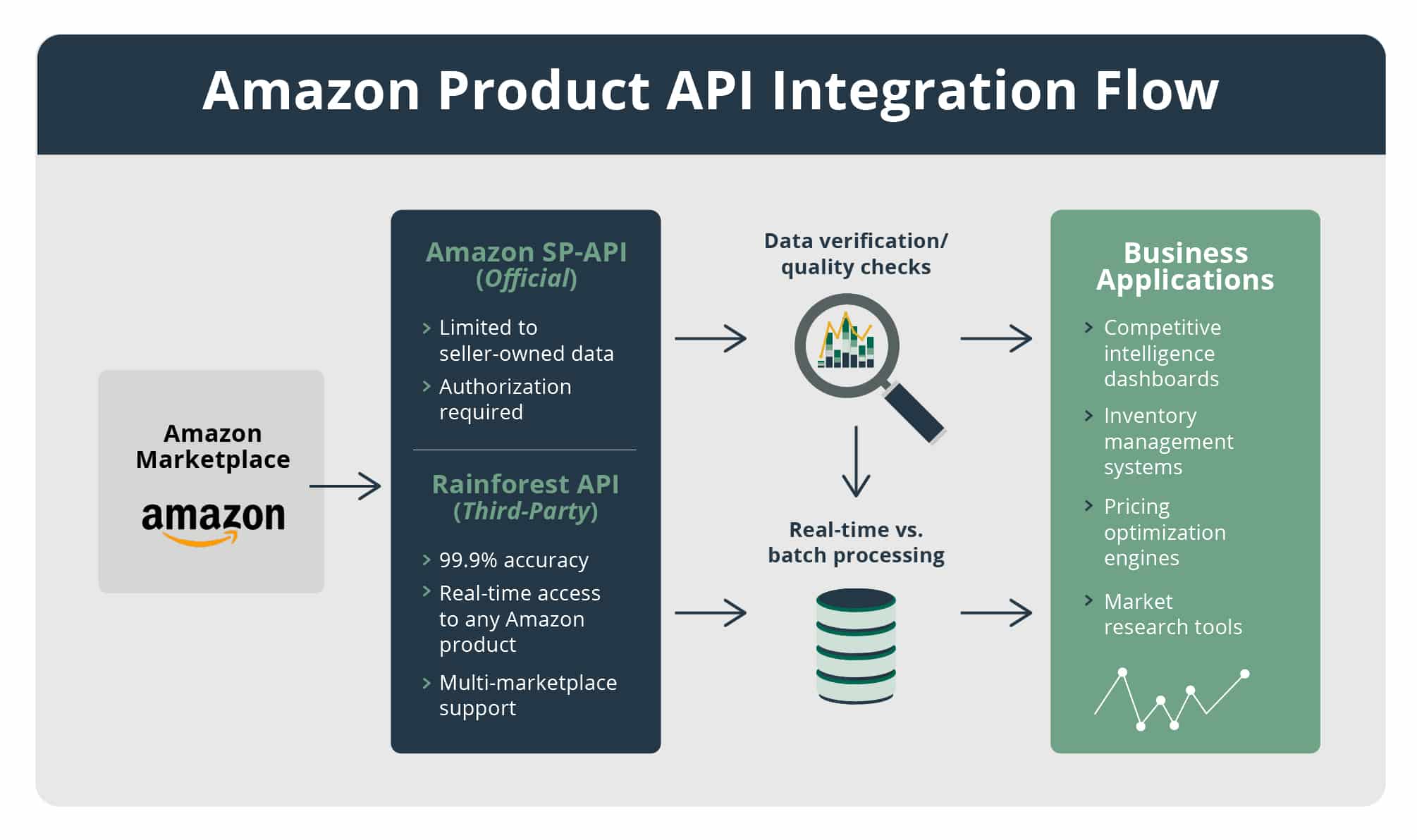
Amazon product API integration architecture and data flow diagram

Frequently Asked Questions

What is an Amazon product API?

An Amazon product API is a software interface that allows developers to programmatically access Amazon product data including titles, descriptions, prices, reviews, availability, and seller information in real-time. It eliminates the need for manual data collection by providing structured access to Amazon’s product database.

What’s the difference between Amazon’s official APIs and third-party solutions?

Amazon’s official APIs like SP-API serve sellers managing their own products with authorized access to specific data. Third-party APIs provide broader access to any Amazon product data for competitive intelligence and market research, without requiring seller authorization or product ownership.

How accurate is Amazon product API data?

Data accuracy varies by provider. Official Amazon APIs provide highly accurate data for authorized products. Quality third-party providers like Traject Data’s Rainforest API deliver over 99.9% accuracy through automated quality assurance systems and real-time data verification.

What types of product data can I access through APIs?

Amazon product APIs provide access to comprehensive data including product titles, descriptions, pricing, availability, customer reviews, ratings, seller information, images, specifications, category data, and sales rankings. The specific data available depends on the API provider and access level.

How fast can I get Amazon product data through APIs?

Real-time APIs typically respond within 1-5 seconds, providing current product information. Batch APIs may have longer processing times but can handle larger data volumes efficiently. Response times depend on the complexity of requests and API provider infrastructure.

Do I need technical expertise to implement Amazon product APIs?

Basic programming knowledge helps, but many API providers offer user-friendly interfaces, documentation, and support. Some solutions provide no-code options or managed services. The complexity depends on your specific integration requirements and chosen solution.

Ready to See What Traject Data Can Help You Do?


We’re your premier partner in web scraping for eCommerce data. Get started with one of our APIs for free and see the data possibilities that you can start to collect.

Harness the Power of APIs to Optimize Your Pricing Strategy

Digital technology has transformed consumer purchasing power. We can buy anything, anywhere, anytime, and the market is flooded with competition. As of 2025, there are approximately 30.7 million e-commerce stores worldwide. In the crazy world of ecommerce, your pricing strategy can make or break your business.

Companies that implement a structured pricing strategy can see a 40% increase in revenue year-over-year. But how do you implement an effective pricing strategy? A successful pricing strategy must be data-driven. Web scraping APIs for price tracking and competitive pricing provide real-time insights to help businesses make data-driven decisions and stay ahead of the competition.

The Role of Web Scraping APIs in Pricing Strategy

The beauty of online retail means that adjusting your prices based on market conditions is easy. The days of brick-and-mortar fixed pricing are gone. One in five ecommerce businesses now use dynamic pricing, automatically adjusting prices based on demand and inventory. Amazon, in particular, is known for its sophisticated dynamic pricing algorithms which update prices every few minutes based on demand, stock levels, and competitor pricing. Walmart is close behind, changing prices daily

The ability to track and analyze competitor pricing trends across multiple channels gives businesses an advantage. However, dynamic pricing makes it nearly impossible to manually stay on top of industry pricing trends. This is where price monitoring scraper APIs come in—they automate pricing intelligence, allowing businesses to track prices in real-time.

Major E-Commerce Platforms for Price Scraping

E-commerce giants like Amazon and Walmart dominate the online marketplace and set industry-wide pricing standards. Extracting pricing data from these platforms provides valuable insights into competitive pricing trends. Monitoring these marketplaces helps businesses react quickly to pricing shifts and implement strategic adjustments to stay ahead. 

Challenges in Price Scraping

While price scraping offers undeniable benefits, it also comes with challenges. Amazon and Walmart use sophisticated anti-scraping measures, including:

  • Bot detection
  • Rate limiting
  • IP blocking
  • CAPTCHAs

This results in frequent outages for homegrown and popular web scraping tools. The best price monitoring API for e-commerce must include advanced technology to handle frequent data updates, maintain accuracy, and avoid detection. 

Why Your Business Needs a Pricing API

A pricing API improves reliability and reduces downtime, ensuring uninterrupted access to real-time pricing data. Unlike traditional scraping methods, it’s faster, more efficient, and requires minimal maintenance.

A robust price monitoring API includes:

  • Built-in proxy management and anti-scraping defenses to bypass bot detection.
  • Automated updates that adapt to website changes without breaking.
  • Faster insights than manual scraping, keeping you ahead of competitors.

Use Cases for a Pricing Monitoring API

  • Competitive Pricing Analysis – Compare competitor pricing and adjust your strategy accordingly.
  • Identify Market Trends – Understand shifts in consumer demand and pricing fluctuations.
  • Price Matching Made Easy – Match or beat competitor prices to attract more customers.
  • Optimized Promotions – Plan strategic discounts using real-time pricing data.
  • Validate Supplier & Distributor Contracts – Ensure pricing agreements are being upheld across all sales channels.

Introducing Traject Data’s New Pricing Solution

At Traject Data, we know how important real-time pricing data is to your strategy. That’s why we’re excited to introduce our latest feature:

🚀 Amazon List Price Data 🚀

This powerful tool is designed to supercharge your pricing strategy by providing seamless access to real-time list prices.

Key Benefits of Traject Data’s APIs

  • Wide Coverage –Monitor pricing from Amazon, Walmart, Google, Target, Home Depot and Ebay.
  • Reliable Infrastructure – Get real-time data with minimal latency and downtime.
  • Seamless Integrations – Schedule automated data pushes to your preferred destination.
  • Scalability – Handle tens of millions of requests daily as your business grows.
  • Comprehensive Documentation & Support – Get expert guidance and fast issue resolution.
  • Flexible Pricing – Scale costs based on your needs with a free trial before committing.
  • Clean, Structured Data – We handle data parsing, so you get accurate results without extra processing.

Ready to Optimize Your Pricing Strategy?

The best way to automate price monitoring with an API is to leverage a trusted pricing intelligence solution like Traject Data. Contact us today to learn how our pricing monitoring APIs can help you gain a competitive edge!

Ready to See What Traject Data Can Help You Do?


We’re your premier partner in web scraping for SERP data. Get started with one of our APIs for free and see the data possibilities that you can start to collect.

Traject Data is Your Premier Partner in Web Scraping


Join thousands of satisfied users worldwide who trust Traject Data for all their eCommerce and SERP data needs. Whether you are a small business or a global enterprise, our entire team is committed to helping you achieve your goals and stay ahead in today's dynamic digital landscape. Unlock your organization's full potential with Traject Data. Get started today.

Get started today