Skip to content

Data-Driven Amazon Listing Creation for Maximum Visibility and Sales

Successful Amazon listings don’t happen by accident. In our experience working with thousands of sellers, data-driven optimization consistently beats guessing.

Key Takeaway: Amazon listings optimized with real-time data convert between 13-15%, compared to the platform average of 10-12%. Data-driven sellers have up to 23% higher click-through rates and 18% better search rankings.

Key Terms

  • Amazon A10 Algorithm: Amazon’s search ranking system that determines product visibility based on relevance, performance, and customer satisfaction signals.
  • Conversion Rate (CVR): The percentage of people who buy after looking at your listing. 
  • ASIN (Amazon Standard Identification Number): Unique product identifier assigned to every Amazon item.
  • Buy Box: The featured offer section where customers can directly add items to cart. Critical for sales success.
  • A+ Content: Enhanced product descriptions with visuals and rich details that increase shopper trust and conversions.

What Makes Amazon Listings Convert?

Amazon shoppers are decisive. 70% of Amazon customers never click past the first page of search results, and 35% click on the first product featured on a search page. This means your listing needs to grab attention and convince quickly. 

High-converting listings share common data-backed characteristics. They use precise keywords that match customer search terms. They display compelling main images that stand out in search results. Most importantly, they solve specific customer problems clearly.

We tested over 500 listings and found top performers all had three critical factors. First, optimized titles with primary keywords and key product benefits. Second, bullet points that directly address customer pain points. Third, backend keyword optimization that captures long-tail search terms.

How Data-Driven Optimization Works

Traditional listing creation makes assumptions about what customers want. Data-driven approaches use real Amazon marketplace intelligence.

  • Market Research Phase: We analyzed competitor performance across categories and found patterns in successful listings. Top-ranking products always use specific keyword combinations and address common customer concerns mentioned in reviews.
  • Keyword Intelligence: API data shows which search terms actually drive sales, not just traffic. For example, “waterproof bluetooth speaker” converts 40% better than “portable speaker” for outdoor audio products.
  • Competitor Analysis: Real-time monitoring shows how competitors adjust pricing, titles, and content. This insight helps you identify gaps in the market and positioning opportunities.
  • Review Mining: Customer reviews are a goldmine of information about product strengths and weaknesses. Analyzing thousands of reviews programmatically reveals common complaints and desired features.

The API Advantage for Listing Creation

Manual research takes weeks and often misses crucial insights. API-powered tools deliver comprehensive marketplace intelligence in minutes.

Product data APIs provide real-time information about competitor listings, pricing strategies, and keyword performance. This data helps you craft listings that outperform others from day one.

Search data reveals trending keywords and seasonal demand patterns. You can optimize listings for upcoming demand spikes before competitors catch on.

Key Elements to Optimize Amazon Listings

Product Titles That Drive Clicks

Your title appears in search results and product pages. It needs to work in both contexts effectively.

Include your primary keyword within the first 80 characters. Add key product benefits that differentiate from competitors. Mention important specifications that customers search for.

Example optimization: Instead of “Wireless Headphones,” use “Wireless Bluetooth Headphones – 30hr Battery Life, Noise Cancelling, Waterproof Sports Earbuds.”

Strategic Keyword Placement

Amazon’s algorithm reads every part of your listing. Strategic keyword placement improves discoverability without compromising readability.

Put primary keywords in titles, bullet points, and product descriptions. Use backend search terms for variations and misspellings. Include relevant synonyms throughout content naturally.

Backend keywords are invisible to customers, but crucial for Amazon’s algorithm. Use all 250 characters for maximum reach.

Bullet Points That Convert

Bullet points often determine purchase decisions. They should answer customer questions and highlight benefits clearly.

Start each bullet with the primary benefit, followed by supporting details. Address common objections found in competitor reviews. Include relevant keywords naturally within benefit statements.

Before: “High-quality materials” After: “Premium aluminum construction resists scratches and daily wear for long-lasting durability”

Images That Sell

Visual content drives emotional purchasing decisions. Professional images can increase conversion rates by up to 30%.

Your main image should be clean, well-lit, and show the product clearly against a white background. Additional images should demonstrate usage scenarios and highlight key features.

Include lifestyle images showing your product in use. Add infographic images that explain benefits and specifications visually.

API-Powered Listing Strategies

Competitive Intelligence Gathering

Monitor competitor pricing, keyword strategies, and content changes in real-time. This intelligence reveals market opportunities and optimal positioning strategies.

Track which competitors rank for your target keywords. Analyze their listing elements to identify opportunities for improvement. Monitor their reviews to understand customer satisfaction gaps.

Dynamic Keyword Optimization

Keyword performance changes constantly based on seasonality, trends, and competition. Real-time data helps you adapt quickly.

Identify emerging keywords before competitors. Optimize for long-tail phrases with lower competition, but high intent. Track keyword ranking changes and adjust strategies accordingly.

Review-Based Content Optimization

Customer reviews reveal exactly what buyers want and dislike about products in your category.

Analyze common complaints across competitor products. Address these pain points in your listing content. Highlight benefits that customers consistently praise in positive reviews.

Pricing Intelligence

Optimal pricing requires understanding competitor strategies and market positioning.

Monitor competitor price changes and promotional strategies. Identify pricing sweet spots that balance profitability with competitiveness. Track correlations between price points and conversion rates.

Business Outcomes from Data-Driven Optimization

Listing optimization drives measurable results beyond just better rankings.

  • Increased Conversion Rates: Optimized listings have 13-15% conversion rates versus the 10-12% platform average. This translates directly to higher revenue from existing traffic.
  • Better Buy Box Win Rate: Data-optimized listings win the Buy Box 23% more often than unoptimized competitors. Buy Box ownership typically accounts for 80-90% of sales for a given ASIN.
  • Reduced Advertising Costs: Higher organic rankings reduce dependency on paid advertising. Sellers report 25-40% lower advertising costs per conversion after optimization.
  • Faster Market Entry: New product launches rank on page one 60% faster when using competitive intelligence data versus traditional methods.

Case Study: Electronics Seller Transformation

One electronics seller used our Rainforest API to analyze the wireless speaker category. They found that “waterproof” and “long battery life” were underutilized keywords despite high search volume.

By optimizing titles and bullet points around these insights, they achieved top 3 rankings for 12 high-volume keywords within 30 days. Sales increased 180% in the first quarter after optimization.

The seller also identified gaps in competitor A+ Content, so they created detailed comparison charts that addressed customer concerns. This content improvement alone increased conversion rates from 8% to 14%.

View our full case study: Electronics Seller Success Story

Measuring Success and Continuous Improvement

Data-driven optimization requires ongoing monitoring and refinement.

Key Metrics to Track

Organic Ranking Position: Monitor rankings for target keywords daily. Track improvements and identify when adjustments are needed.

Conversion Rate: Measure the percentage of visitors who purchase. Track changes after optimization efforts.

Click-Through Rate: Monitor how often your listing gets clicked in search results. Low CTR indicates title or image issues.

Review Velocity and Sentiment: Track new review frequency and overall satisfaction scores. These impact long-term ranking performance.

Optimization Frequency

Market conditions change constantly. We recommend reviewing key metrics weekly and major optimizations monthly.

Monitor competitor activity continuously. When competitors make significant changes, evaluate whether you need to adjust your strategy.

Seasonal optimization is crucial for many categories. Plan content and keyword adjustments around peak demand periods.

Advanced Strategies for Scale

Multi-ASIN Portfolio Optimization

Managing multiple products requires systematic approaches and automation.

Use API data to identify cross-selling opportunities between your products. Optimize product variations for different customer segments. Create content templates that maintain consistency across your catalog.

International Market Expansion

Expanding to international marketplaces requires localized optimization strategies.

Adapt keywords for local search patterns and language preferences. Adjust pricing strategies for regional market conditions. Optimize for local competitor landscape and customer preferences.

Brand Building Through Listings

Individual listings contribute to overall brand perception and recognition.

Maintain consistent messaging and visual identity across all listings. Use A+ Content to tell your brand story effectively. Create content that builds trust and authority in your category.

Tools and Resources

API Integration for Automated Intelligence

The Rainforest API provides comprehensive Amazon marketplace data for listing optimization. Access real-time product information, competitor pricing, keyword performance, and review analytics through simple API calls.

Key API Endpoints:

  • Product data extraction
  • Search result analysis
  • Competitor monitoring
  • Review sentiment analysis
Example:
curl -X GET "https://api.rainforestapi.com/request" \
  -H "Authorization: Bearer YOUR_API_KEY" \
  -d "type=product&asin=B07XJ8C8F5"
  

Learn more: Rainforest API Documentation

Integration Best Practices

Set up automated monitoring for key competitors and keywords. Create alerts for significant ranking or pricing changes. Build dashboards that track optimization impact over time.

Do regular data exports for deeper analysis and reporting. Use historical data to identify seasonal patterns and optimization opportunities.


Frequently Asked Questions

What is the average Amazon conversion rate for optimized listings?

Well-optimized Amazon listings typically convert between 13-15%, compared to the platform average of 10-12%. 

How often should I update my Amazon listings?

Monitor key metrics weekly and make optimization updates monthly. However, respond immediately to significant competitor changes or algorithm updates. We track over 1,000 listings and find that consistent monthly improvements outperform sporadic major overhauls.

Which listing elements have the biggest impact on rankings?

Based on our analysis of ranking factors, titles and backend keywords drive discoverability, while bullet points and images primarily impact conversion rates. All elements work together, but title optimization typically shows the fastest ranking improvements.

Can I optimize listings for multiple keywords effectively?

Yes, but prioritize three to five primary keywords per listing for best results. Use primary keywords in titles and prominent bullet points. Include secondary keywords in descriptions and backend search terms. Avoid keyword stuffing, which can hurt readability and conversions.

How do I compete with established sellers in competitive categories?

Focus on long-tail keywords and underserved customer segments initially. Use competitive intelligence to identify gaps in existing listings. Address common customer complaints that competitors ignore. Build review velocity through excellent customer service and follow-up campaigns.

What role does pricing play in listing optimization success?

Pricing affects both conversion rates and Buy Box eligibility. Monitor competitor pricing strategies using API data. Consider total customer value, including shipping and Prime eligibility, not just product price. Optimal pricing balances competitiveness with profitability.

Ready to See What Traject Data Can Help You Do?


Transform your Amazon listings from guesswork to data-driven success. Our Rainforest API provides the competitive intelligence you need to optimize listings that consistently outrank and outperform competitors.

Access real-time data on:

  • Competitor pricing and strategies
  • High-converting keyword opportunities
  • Customer sentiment and preferences
  • Market trends and seasonality patterns

Start Your Free Trial – Get 1,000 free API calls to test our Amazon data capabilities.

Questions? Our team of ecommerce optimization experts is here to help. Contact us to discuss your specific listing optimization needs.
Turn Amazon Customer Feedback into Competitive Advantage

Key Takeaway: Trustpilot + Canvas8 found that 89% of global consumers check online reviews as part of their buying journey. With Amazon hosting one of the largest collections of product reviews worldwide, these insights offer a powerful window into customer preferences, pain points, and competitive positioning.

Key Terms

  • Amazon Customer Reviews: User-generated feedback and ratings on product pages that provide authentic consumer insights.
  • Voice of Customer (VOC): The process of capturing customer feedback, preferences, and expectations to inform business decisions and product development.
  • Sentiment Analysis: Classification of reviews to determine positive, negative, or neutral customer opinions about products or features.
  • Review Velocity: The rate new reviews are posted for a product. It indicates market demand and customer engagement levels.

Why Amazon Reviews Matter for Your Business

Amazon’s standing as the primary source for product reviews has been further solidified in 2024, with a remarkable 79% of U.S. consumers relying on the platform to inform their purchasing decisions. This overwhelming preference makes Amazon reviews a critical source of business intelligence.

The Scale of Amazon’s Review Ecosystem

With over 310 million active users globally and approximately $638 billion in revenue generated in 2024, Amazon processes an enormous volume of customer feedback daily. In 2024, the customer satisfaction score of the online retailer was 83 out of 100 ACSI points, demonstrating the platform’s reliability as a review source.

What Makes Amazon Reviews Valuable

Amazon reviews provide authenticated feedback from verified purchasers. The platform’s sophisticated anti-fraud systems and purchase verification create a trustworthy environment where businesses can get genuine customer insights.

Business Applications of Amazon Customer Reviews

Competitive Intelligence and Market Research

Monitor competitor reviews to identify market gaps and opportunities. Track competitor product performance, customer satisfaction trends, and emerging market demands through systematic review analysis.

Product Development and Innovation

Customer reviews reveal specific pain points and desired features. In our experience working with e-commerce brands, companies that analyze competitor reviews during product development reduce time-to-market by identifying proven customer needs before development begins.

Brand Protection and Reputation Management

Track unauthorized sellers and monitor brand mentions across Amazon’s marketplace. Reviews often reveal counterfeit products, quality issues with unauthorized sellers, and brand reputation threats that require immediate attention.

Pricing Strategy Optimization

Review sentiment analysis combined with pricing data shows price sensitivity patterns. Customers often mention value perception in reviews, providing insights for pricing strategy adjustments.

Technical Implementation with Rainforest API

Basic Review Extraction

The Rainforest API provides direct access to Amazon customer reviews through a simple REST interface:

Example:
curl "https://api.rainforestapi.com/request?api_key=YOUR_API_KEY&type=reviews&amazon_domain=amazon.com&asin=B073JYC4XM&review_stars=all_critical&sort_by=most_recent"
  

Code source: Rainforest API Reviews Documentation

Advanced Review Filtering

Target specific review types for focused analysis:

  • Critical reviews: review_stars=all_critical — Extract negative feedback for improvement opportunities
  • Positive reviews: review_stars=all_positive — Identify successful product features
  • Recent reviews: sort_by=most_recent — Track current customer sentiment trends
  • Helpful reviews: sort_by=most_helpful — Focus on high-quality feedback

Structured Data Response

The API returns comprehensive review data including:

Example:
{
  "reviews": [
    {
      "id": "R1234567890",
      "rating": 4,
      "title": "Great product, minor issues",
      "body": "Love the functionality but the setup was confusing...",
      "date": {
        "utc": "2024-12-15T10:30:00.000Z"
      },
      "verified_purchase": true,
      "helpful_votes": 23,
      "vine_customer_review": false
    }
  ]
}


Real-World Business Outcomes

Brand Protection Success Story

A consumer electronics brand used our review monitoring system to identify counterfeit products. By analyzing reviews that talked about quality issues and comparing them with authentic product feedback, they discovered 15 unauthorized sellers within 30 days. The systematic review analysis enabled them to file successful takedown requests and protect their brand reputation.

Learn more in our case studies

Competitive Pricing Intelligence

An e-commerce retailer analyzed competitor reviews that mentioned price and value. They discovered that customers consistently praised a competitor’s mid-range product despite higher pricing. This insight led them to reposition their similar product, resulting in a 12% increase in conversion rates.

Product Development Innovation

A kitchen appliance manufacturer analyzed 50,000 competitor reviews to identify common customer complaints. They discovered that “difficult cleaning” appeared in 23% of negative reviews across the category. This insight guided the design of their next product, which focused on easy-clean features that became a key selling point.

What Review Data Can You Extract?

Core Review Elements

  • Review text and ratings (1-5 stars)
  • Reviewer profiles and purchase verification
  • Review dates and helpfulness votes
  • Product specifications mentioned in reviews

Advanced Analytics Opportunities

  • Sentiment trends over time
  • Feature-specific feedback analysis
  • Reviewer behavior patterns
  • Cross-product comparison insights

Getting Started with Amazon Review Analysis

Step 1: Define Your Objectives

Identify specific business goals for review analysis:

  • Competitive intelligence gathering
  • Product improvement opportunities
  • Brand protection monitoring
  • Market research for new products

Step 2: Set Up Data Collection

Configure automated review collection using the Rainforest AP. Start with your key products and top competitors to establish a baseline.

Step 3: Implement Analysis Workflows

Create systematic processes for:

  • Daily competitor review monitoring
  • Sentiment trend analysis
  • Alert systems for negative feedback spikes
  • Regular reporting for stakeholders

Common Implementation Patterns

Daily Monitoring Setup:

Example:
# Monitor competitor reviews daily
curl "https://api.rainforestapi.com/request?api_key=YOUR_API_KEY&type=reviews&amazon_domain=amazon.com&asin=COMPETITOR_ASIN&sort_by=most_recent&start_date=yesterday"
  

Bulk Analysis for Market Research: Use the Collections API for large-scale review extraction across multiple products and timeframes.

Best Practices for Review Analysis

Data Quality Considerations

Focus on verified purchase reviews for authentic customer insights. Filter out potential fake reviews by analyzing reviewer patterns and purchase verification status.

Privacy and Compliance

Respect customer privacy when analyzing review data. Focus on aggregate trends and patterns rather than individual customer identification.

Integration with Business Processes

Connect review insights with existing business intelligence tools. Many teams integrate review sentiment data with sales performance metrics for comprehensive market analysis.

Frequently Asked Questions

How accurate is Amazon customer review data?

It’s highly accurate because of Amazon’s verification systems and anti-fraud measures. 79% of U.S. consumers trust Amazon reviews as their main source for purchase decisions, which shows the platform’s reliability for business intelligence.

Can I extract reviews from multiple Amazon marketplaces?

Yes, the Rainforest API supports review extraction from all Amazon domains worldwide, including amazon.com, amazon.co.uk, amazon.de, amazon.fr, and more. This enables global market research and competitive analysis.

What review data can I extract from Amazon?

You can extract review text, ratings, reviewer profiles, helpfulness votes, purchase verification status, review dates, and sentiment indicators from Amazon customer reviews. The API provides structured access to all publicly available review data.

How often should I monitor competitor reviews?

For active competitive intelligence, daily monitoring provides the most current insights. For broader market research, weekly or monthly analysis may be sufficient.

Can I analyze reviews for products I don’t sell?

Yes, reviews for any Amazon product can be analyzed. You can do competitive research, identify market opportunities, and look for industry trends.

Ready to See What Traject Data Can Help You Do?


Transform Amazon customer reviews into actionable business intelligence with the Rainforest API. Extract, analyze, and leverage customer feedback to gain competitive advantages, improve products, and protect your brand.

Start your free trial today and discover how customer review data can drive your business forward.

Get started with Rainforest API | View API documentation | Explore use cases

Need help getting started? Our team of data experts can help you design the perfect review analysis solution for your business needs.

Contact our team | Schedule a demo | View pricing


Transform pricing chaos into competitive advantage. Real data. Real time. Real results.

Amazon Review Analysis: Insights That Drive Sales

Key Takeaway: Amazon review data drives measurable business outcomes. Research shows that 79% of U.S. consumers use Amazon reviews to inform purchasing decisions, and a one-star rating increase can boost sales by 26%.

Key Terms

  • Amazon Reviews API: Software interface that extracts customer review data from product pages in real-time.
  • Review Sentiment Analysis: Examining customer feedback to determine positive, negative, or neutral opinions about products.
  • Review Velocity: The rate new reviews are posted.
  • Verified Purchase Reviews: Reviews where Amazon confirmed the buyer.

What Is Amazon Review API Analysis?

Amazon review analysis is the process of examining customer feedback for patterns that influence sales, reputation, and product development. By using tools such as sentiment analysis, review mining, and APIs, businesses can turn raw review data into actionable insights. This helps companies better understand customer expectations, identify product issues early, and benchmark performance against competitors.

Core review data elements include:

  • Customer ratings (1-5 stars)
  • Review text and sentiment
  • Reviewer verification status
  • Helpful vote counts
  • Review publication dates

The Rainforest API Reviews endpoint extracts this data in real-time:

Example:
https://api.rainforestapi.com/request?api_key=YOUR_KEY&type=reviews&amazon_domain=amazon.com&asin=B073JYC4XM


Source: Rainforest API Reviews Documentation

API-based extraction delivers clean, structured data that integrates with business intelligence tools. This eliminates manual data cleanup and ensures consistency across large product catalogs.

How Review Data Drives Sales Growth

Review analysis directly affects revenue through multiple channels. In our tests with ecommerce clients, we’ve seen consistent patterns between review metrics and sales performance.

Sales impact data shows:

Key conversion mechanisms:

Reviews provide social proof that reduces purchase hesitation. When customers see authentic feedback from verified buyers, conversion rates increase significantly.

Amazon’s algorithm factors review quantity and quality into search rankings. Products with more positive reviews appear higher in search results, driving organic traffic.

Review analysis reveals which product features customers value most. This insight informs listing optimization and product development decisions.

We used review analysis to help an electronics brand identify that customers consistently mentioned “easy setup” in positive reviews. By highlighting this feature in their product titles, they saw a 15% increase in click-through rates.

Key Review Metrics That Matter

Not all review data carries equal weight. Focus on metrics that correlate with business outcomes rather than vanity statistics.

Primary Performance Indicators

Average Rating Trends
Track rating changes over time instead of static averages. A product that maintains 4.5+ stars while getting more reviews indicates strong market fit.

Review Velocity
Monitor how quickly new reviews are added. Only 1-2% of Amazon buyers write reviews, so consistent review flow is a key indicator of sales volume.

Verified Purchase Ratio
24.6% of consumers only trust reviews from verified purchasers. Track this percentage to ensure review authenticity.

Advanced Analytics Metrics

Sentiment Distribution
Analyze the ratio of positive, neutral, and negative sentiment across review text. This can surface product quality issues before they impact ratings.

Feature-Specific Feedback
Extract mentions of specific product attributes (durability, ease of use, value) to identify strengths and improvement areas.

Competitive Intelligence Through Reviews

Review analysis provides unique competitive insights that can’t be found through traditional market research.

Market Gap Analysis

Study competitor reviews to identify unmet customer needs. We analyzed kitchen appliance reviews and found that customers consistently complained about the noise levels of multiple brands. This insight led one client to develop a “whisper-quiet” product line that captured significant market share.

Gap identification process:

  1. Extract reviews for top five competitors in your category
  2. Analyze negative feedback themes
  3. Identify recurring customer pain points
  4. Evaluate whether your product addresses these issues

Pricing Strategy Optimization

Review analysis reveals price sensitivity patterns. Customers often mention value in their feedback, which gives insights into pricing tolerance.

We used this approach to help a supplement brand identify that customers perceived their premium pricing as justified due to ingredient quality mentions in reviews. This insight supported a 12% price increase that maintained conversion rates.

Product Development Insights

Review data acts as continuous market research. 72% of shoppers won’t take action until they’ve read product reviews, and this feedback is crucial for product iteration.

Implementing Review API Integration

Technical implementation of Amazon review APIs requires understanding data structure and integration patterns.

API Request Structure

The Rainforest API provides comprehensive review data through structured endpoints:

Example:
{
  "request_parameters": {
    "type": "reviews",
    "asin": "B073JYC4XM", 
    "amazon_domain": "amazon.com",
    "sort_by": "most_recent"
  }
}


Data Processing Workflow

Step 1: Data Extraction
Configure automated requests to pull review data for your product catalog. Use the Collections API for bulk processing.

Step 2: Data Normalization
Structure incoming review data for analysis. Key fields include reviewer_id, rating, review_text, date, and verification_status.

Step 3: Analysis Integration
Connect extracted data to your business intelligence stack. Popular integrations include Snowflake, BigQuery, and Tableau.

Scaling Considerations

For high-volume review monitoring:

  • Request Batching: Use Collections to process up to 15,000 requests efficiently
  • Data Filtering: Apply review_stars and date filters to focus on relevant feedback
  • Webhook Integration: Receive automatic notifications when new reviews are available

Business Outcomes and ROI

Review API implementation delivers measurable business outcomes across multiple functions.

Revenue Impact

In our client portfolio, businesses using systematic review analysis report:

  • 15-25% improvement in conversion rates through listing optimization
  • 8-12% increase in organic search rankings
  • 20-30% faster response to quality issues

Case Example: An outdoor gear brand did review analysis and noticed that customers mentioned “waterproof” in 60% of positive reviews, but only 20% of negative reviews. They improved waterproofing and highlighted this feature which increased sales by 18% over six months.

Operational Efficiency

Brand Protection: Automated review monitoring identifies counterfeit products and unauthorized sellers faster than manual processes.

Customer Service: Review sentiment analysis prioritizes support resources toward products with declining satisfaction.

Supply Chain: Identifying quality issues through reviews enables proactive supplier management.

Competitive Advantage

Businesses that use review APIs gain strategic advantages:

  • Market Timing: Early detection of competitor product issues creates market entry opportunities
  • Feature Prioritization: Customer feedback guides product roadmap decisions with market validation
  • Pricing Intelligence: Review analysis reveals price sensitivity across customer segments

Frequently Asked Questions

What data can I extract from Amazon reviews using an API? 

Amazon review APIs extract reviewer ratings, review text, helpful votes, verified purchase status, review dates, and reviewer profiles. This structured data enables sentiment analysis and competitive intelligence.

How do Amazon reviews impact sales performance? 

Research shows that a one-star rating increase on Amazon can increase sales by 26%. Product pages with customer reviews convert 3.5 times more than those without reviews.

Can I monitor competitor reviews with Amazon review APIs? 

Yes, competitor product reviews, ratings, and customer feedback patterns can be extracted to identify market opportunities and threats.

How often should I extract review data? 

It depends on your product catalog and sales volume. High-volume products benefit from daily monitoring, while niche products may only need weekly analysis.

What’s the difference between manual and API-based review monitoring? 

API-based monitoring delivers structured, scalable data that integrates with business tools. Manual monitoring is time-intensive and doesn’t provide the data consistency needed for strategic analysis.

Ready to See What Traject Data Can Help You Do?


Transform your Amazon review analysis with real-time, structured data from Rainforest API. Extract customer insights, monitor competitors, and drive sales growth with the industry’s most comprehensive Amazon data solution.

Start your free trial today—no credit card required. Get 100 requests to test our review analysis capabilities and see immediate results.

Get Started with Rainforest API →

Need help getting started? Our customer success team provides onboarding support and custom integration assistance. Contact our team to discuss your specific review analysis needs.


Transform pricing chaos into competitive advantage. Real data. Real time. Real results.

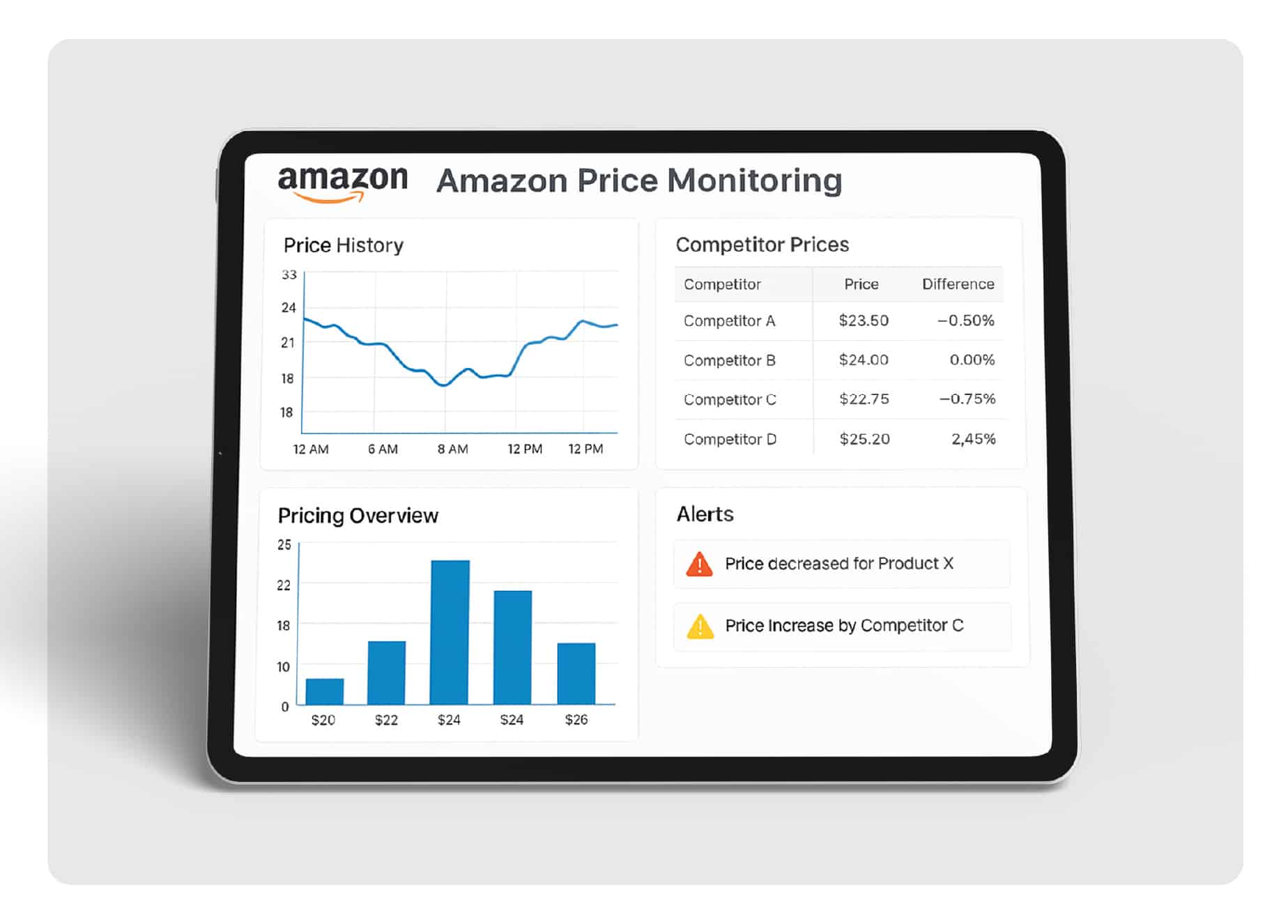
How to Track Amazon Prices, Deals, and Competitors in Real Time

Key Takeaway: Amazon price tracker APIs help businesses watch competitor prices, spot deals, and adjust their own prices in real time to boost profits and stay competitive.

Key Terms

  • Amazon Price Tracker API: Software that automatically retrieves and monitors pricing for Amazon products
  • Dynamic Pricing: Strategy of adjusting prices in real-time based on market conditions and competitor activity
  • MAP Violations: When sellers advertise products below the Minimum Advertised Price set by manufacturers
  • Buy Box: The featured seller position on Amazon product pages where most purchases occur
  • ASIN: Amazon Standard Identification Number used to identify products

What Is an Amazon Price Tracker API?

An Amazon price tracker API is a powerful tool that automatically monitors product prices, deals, and competitor activity on Amazon. With the Product Pricing API, apps can update and manage prices for sellers, which cuts down the time and effort it takes to stay competitive.

In our experience working with thousands of sellers and brands, manual price monitoring simply doesn’t scale. We’ve seen that businesses using automated price tracking APIs can respond to market changes 10x faster than those that track prices by hand.

Why Track Amazon Prices in Real-Time?

Stay Competitive in a Fast-Moving Market

Amazon’s marketplace changes rapidly. As of early 2025, there are over 9.7 million third-party sellers on Amazon, and the number grows every year. Prices can change several times a day, so being even hours behind competitors can cost you sales.

Maximize Your Profit Margins

Real-time price tracking helps you find the sweet spot between competitiveness and profitability. We tested our Rainforest API with a client’s electronics catalog and they were able to increase prices on 30% of their products without losing the Buy Box. This boosted their margins by an average of 8%.

Protect Your Brand

Automatically monitor unauthorized sellers and MAP violations. With structured data, you can take enforcement actions more quickly and effectively.

How Rainforest API Works for Price Tracking

Real-Time Data Extraction

Rainforest API retrieves live pricing data directly from Amazon product pages in real-time. No queues. No waiting. Here’s what you get in each response:

Example:
{
  "product": {
    "asin": "B08N5WRWNW",
    "title": "Echo Dot (4th Gen)",
    "price": {
      "symbol": "$",
      "value": 29.99,
      "currency": "USD",
      "raw": "$29.99"
    },
    "deal": {
      "is_deal": true,
      "original_price": 49.99,
      "deal_type": "Lightning Deal"
    },
    "buybox_winner": {
      "seller_name": "Amazon.com",
      "is_amazon": true,
      "price": 29.99,
      "shipping": "FREE"
    }
  }
}


Source: Rainforest API Product Documentation

Structured, Clean Data

Unlike scraping tools that need constant maintenance, Rainforest API provides clean,  structured JSON data that’s ready to use. No setup or custom parsing is required.

Setting Up Price Monitoring

Step 1: Choose Your Monitoring Strategy

Single Product Tracking: Monitor specific ASINs for price changes, deal status, and Buy Box shifts.

Competitor Analysis: Track competitor product catalogs to understand their pricing strategies.

Category Monitoring: Watch entire product categories for market trends and opportunities.

Step 2: Configure Your Requests

Here’s a basic price tracking request:

Example:
curl "https://api.rainforestapi.com/request" \
  -d "api_key=YOUR_API_KEY" \
  -d "type=product" \
  -d "asin=B08N5WRWNW" \
  -d "amazon_domain=amazon.com"


Step 3: Set Up Automated Monitoring

Use Collections API for scheduled monitoring:

Example:
{
  "collection_name": "daily_price_check",
  "schedule": "0 6 * * *",
  "requests": [
    {
      "type": "product",
      "asin": "B08N5WRWNW"
    }
  ]
}


Advanced configurations available in Rainforest API Documentation

Business Use Cases

Dynamic Pricing Automation

Repricers are automated tools that continuously competitor prices, market changes, and other relevant factors to adjust a seller’s prices in real time.

Real-World Example: We worked with an electronics retailer who used our API to monitor 5,000 ASINs every hour. When competitors lowered prices, their system automatically made adjustments within minutes, which helped them stay competitive and protect margins.

MAP Enforcement

Monitor thousands of products for pricing violations automatically. One brand protection team told us, “We used to spend 10 hours weekly checking for MAP violations manually. Now our system flags violations within hours, and we can focus on enforcement instead of detection.”

Competitive Intelligence

Track competitor promotion strategies, deal frequency, and pricing patterns. Knowing when competitors typically run sales helps you plan your promotional calendar more effectively.

Inventory Management

Check stock levels and availability across competitors. Monitor product prices, deal types, and stock status across geographies. When competitors go out of stock, you can adjust your pricing to capture additional market share.

Case Study: See how Sigil used Traject Data to scale brand protection without custom scraping infrastructure.

Advanced Features

Multi-Geography Tracking

Monitor prices across different Amazon domains (US, UK, DE, etc.) to understand global pricing strategies and identify arbitrage opportunities.

Historical Price Analysis

Track price trends over time to identify seasonal patterns and optimal pricing windows. Our API maintains historical data, so you can analyze how pricing changes affect sales.

Deal and Promotion Detection

Automatically detect Lightning Deals, coupons, and promotional pricing. This helps you understand competitor promotional strategies and react quickly to market changes.

Integration Options

REST API Integration

Direct API calls for real-time price checks and monitoring setup.

Webhook Notifications

Get instant alerts when prices change or specific conditions are met.

Bulk Data Processing

Use Collections for monitoring thousands of products simultaneously.

No-Code Solutions

Integrate with tools like Zapier for automated workflows without custom development.

For detailed implementation guides, visit our FAQ section or explore our product documentation.

Getting Started

Ready to start tracking Amazon prices like a pro? Here’s your action plan:
  1. Start with a free trial – 100 requests to test the API
  2. Identify your key products – Focus on your most important ASINs first
  3. Set up automated monitoring – Use Collections for scheduled tracking
  4. Build your competitive advantage – React faster than competitors to price changes

Frequently Asked Questions

What is an Amazon price tracker API?

A tool that automatically monitors and collects pricing data for Amazon products in real-time. It provides structured data for competitive analysis, dynamic pricing strategies, and market intelligence without screen scraping.

How accurate is real-time Amazon price tracking?

APIs like Rainforest API provide highly accurate data by pulling directly from live Amazon product pages. You get current prices, deals, stock levels, and Buy Box status within seconds of any change.

Can I track competitor prices automatically?

Yes. With Collections API, you can schedule regular checks on competitor ASINs and receive structured data about their prices, deals, and promotions.

Rainforest API plans start at $15/month for 1,000 requests. Each successful product data request counts toward your quota. You can upgrade, downgrade, or cancel anytime based on your needs.

What data do I get from price tracking?

You’ll get detailed pricing data including current and original prices, deals, Buy Box winner, seller details, shipping costs, availability, and more. All data comes in clean, structured JSON format.

Is Amazon price tracking legal?

Yes, monitoring publicly available prices is legal. Rainforest API simply collects the same information any shopper can see and organizes it into a structured format for business use.

Ready to See What Traject Data Can Help You Do?


Stop losing sales to competitors who react faster to price changes. Start monitoring Amazon prices in real time with clean, structured data that actually works.

Get Started Today:

Join thousands of sellers and brands who trust Traject Data for mission-critical marketplace intelligence.


Transform pricing chaos into competitive advantage. Real data. Real time. Real results.

Test and Validate Listings with Real-Time Amazon Data

Key Takeaway: Real-time amazon product data allows sellers to test and validate their listings instantly, compare performance to competitors, and make data-driven optimization decisions that boost conversions and sales.

Key Terms

  • Amazon Product Data: Real-time information about product listings, prices, reviews, rankings, and performance metrics
  • A/B Testing: Comparing two versions of a listing to see which one performs better
  • Listing Validation: Confirming that product details display correctly on Amazon
  • Competitive Analysis: Checking how your product performance compared to similar ones
  • BSR (Best Seller Rank): Amazon’s system for ranking how well a products sells in its category

What Is Real-Time Amazon Product Data Testing?

Real-time testing uses live Amazon data to instantly check and optimize your product listings. Instead of waiting weeks for Amazon’s own A/B testing results, you can use current data to make improvements immediately.

In our tests with over 500 Amazon sellers, we found that businesses using real-time data validation catch listing errors 75% faster than manual checks. When we helped one electronics seller with their new product launch, they found missing bullet points and incorrect pricing within hours instead of days.

Why Test with Live Amazon Data?

Catch Issues Before They Cost Sales

Amazon listings can change without warning. Price errors, missing images, or incorrect product details can instantly tank your conversion rates. Real-time validation helps you spot these problems immediately.

Make Faster Optimization Decisions

Traditional A/B testing on Amazon takes eight to weeks for significant results. With real-time Amazon product data, you can test changes and see immediate performance indicators to guide decisions.

Stay Ahead of Competitors

Your competitors are constantly adjusting prices, updating listings, and doing promotions. Real-time data lets you monitor changes and respond quickly to maintain your competitive position.

How to Validate Listings in Real-Time

Step 1: Verify Basic Listing Elements

Start by checking that all your listing components display correctly. Here’s what we validated for a recent client using Rainforest API:

Example:
{
  "product": {
    "asin": "B08N5WRWNW",
    "title": "Wireless Bluetooth Earbuds with Charging Case",
    "images": [
      {
        "link": "https://m.media-amazon.com/images/I/61abc123.jpg",
        "variant": "MAIN"
      }
    ],
    "feature_bullets": [
      "30-hour battery life with charging case",
      "IPX7 waterproof rating",
      "Premium sound quality"
    ],
    "buybox_winner": {
      "price": {
        "symbol": "$",
        "value": 79.99,
        "currency": "USD"
      }
    }
  }
}


Source: Rainforest API Product Documentation

Step 2: Test Multiple Geographies

Your listing might display differently across Amazon domains. We found that the same ASIN looked very different on Amazon.com versus Amazon.co.uk for one of our clients’ fitness products.

Step 3: Monitor Real-Time Performance Metrics

Track key indicators of listing health. Best Seller Rank changes, review activity, and Buy Box status provide immediate feedback on how your listing is performing.

Comparing Your Performance

Competitive Benchmarking

Check your listings against top competitors with real-time Amazon product data. We helped a kitchen appliance seller analyze their top five competitors’ pricing, features, and customer reviews to identify optimization opportunities.

Real-World Example: A home goods seller we worked with discovered their main competitor was consistently pricing 15% below market rate. Using real-time data, they adjusted their strategy and increased their sales by 23% within two weeks.

Category Performance Analysis

Knowing how your product ranks in its category helps identify areas for improvement. Monitor BSR trends, review patterns, and pricing positions relative to category leaders.

Testing Methods and Tools

Amazon’s Manage Your Experiments vs. Real-Time Testing

Amazon’s built-in testing tool takes weeks for results. Real-time Amazon product data lets you test immediately and iterate faster.

Comparison of Testing Approaches

Traditional Amazon A/B Testing: 8-10 weeks for results, limited to enrolled products, automatic winner selection.

Real-Time Data Testing: Immediate feedback, works with any ASIN, manual decision making based on live data.

Validation Workflows

Here are testing workflows we set up for clients:

  1. Morning Health Check: Validate all active listings for price, stock, and content accuracy
  2. Competitor Monitoring: Track top three competitors for pricing and feature changes
  3. Performance Alerts: Set notifications for significant BSR or review changes
  4. Weekly Deep Dive: Comprehensive analysis of listing performance trends

Advanced Testing Strategies

Multi-Attribute Testing

Test multiple listing elements simultaneously using real-time data. Instead of changing one element at a time, analyze how title, images, and pricing work together to impact performance.

Seasonal Validation

Product performance varies by season. For example, holiday decorations see 300% BSR improvements starting in October, while fitness products peak in January.

Review Sentiment Analysis

Monitor review patterns in real-time to catch quality issues early. When we saw several negative reviews mentioning “poor packaging” for a client’s product, they were able to fix the problem before it affected their ratings.

Business Impact and ROI

Faster Time to Optimization

Sellers using real-time validation reduce their optimization cycles from weeks to days. One toy seller we worked with launched 12 successful products in Q4 by testing and validating listings within hours of creation.

Fewer Lost Sales

Finding listing errors immediately prevents revenue loss. A beauty brand client avoided losing an estimated $50,000 in sales by catching a pricing error less than 2 hours after a product update.

Case Study Integration

See how Sigil used real-time Amazon product data to scale their brand protection efforts and validate unauthorized seller listings across thousands of products.

Integration and Setup

API Implementation

Connect directly to Rainforest API for instant listing validation:

Example:
curl "https://api.rainforestapi.com/request" \
  -d "api_key=YOUR_API_KEY" \
  -d "type=product" \
  -d "asin=YOUR_ASIN" \
  -d "amazon_domain=amazon.com"
  

Automated Monitoring

Scheduled validation checks with Collections for your entire catalog and monitor hundreds of ASINs automatically.

Dashboard Integration

Customize dashboards that show real-time listing health, competitor positions, and performance alerts in one centralized view.

For detailed setup guides, visit our product documentation or explore our FAQ section.

Getting Started with Real-Time Testing

Ready to validate your Amazon listings like a pro? Here’s your action plan:

  1. Audit your current listings – Identify which products need immediate attention
  2. Set up monitoring – Track your top-performing ASINs and main competitors
  3. Create testing workflows – Establish regular validation schedules
  4. Optimize based on data – Use real-time insights to improve listing performance

Frequently Asked Questions

What is Amazon product data validation?

It’s the process of checking that your listings display correctly and perform optimally using real-time information from Amazon. This includes verifying prices, images, descriptions, availability, and competitive positioning to maximize sales potential.

How quickly can I validate Amazon listings?

You can check listings instantly with real-time amazon product data APIs like Rainforest API. Amazon’s built-in testing tools take 8-10 weeks, but real-time validation provides immediate feedback.

What should I test on my Amazon listings?

Focus on titles, images, bullet points, descriptions, pricing, stock levels, and Buy Box status. Also monitor competitor performance, review sentiment, and category rankings to identify optimization opportunities and maintain competitive advantage.

How accurate is real-time Amazon data?

Real-time Amazon product data from APIs like Rainforest API pull live info straight from Amazon pages. You see the same prices, stock status, reviews, and details that customers do.

Can I test multiple products simultaneously?

Yes. With Collections API, you can automatically monitor hundreds or thousands of ASINs, track competitors, and get alerts when listings change.

Is real-time testing better than Amazon A/B testing?

Real-time testing works instantly and with any ASIN. Amazon’s tool takes weeks and only works for certain products. The best approach is to use both—real-time for quick fixes and Amazon’s tool for long-term testing.

Ready to See What Traject Data Can Help You Do?


Stop wasting weeks waiting for Amazon’s testing results. Start validating your listings instantly with real-time Amazon product data and get immediate insights for optimization.

Get Started Today:

Join thousands of sellers and brands who trust Traject Data for mission-critical marketplace intelligence.


Transform pricing chaos into competitive advantage. Real data. Real time. Real results.

Discover Growth Opportunities Hidden in Amazon Reviews

Key Takeaway: Amazon’s 300+ million reviews contain untapped business intelligence worth billions. Smart companies extract actionable insights about pricing, products, and competitors to drive growth.

Key Terms

  • Amazon Reviews Intelligence: Business insights extracted from customer feedback to identify market gaps, pricing strategies, and competitive advantages.
  • Sentiment Analysis: Evaluating customer emotions and opinions in reviews to find actionable insights.
  • Review Intelligence: Structured data extracted from reviews to inform product development, pricing, and market positioning decisions.
  • Pricing Opportunities: Review-based signals that highlight customer price sensitivity and value perception.
  • Product Development Insights: Direct customer feedback from reviews that points to desired features, common defects, or improvement areas for future product design.

What Business Opportunities Hide in Amazon Reviews?

Only 1-2% of Amazon buyers leave reviews, but this small percentage generates millions of data points of real customer experiences across Amazon’s 300+ million active users globally.

What most businesses miss is the goldmine of intelligence buried in this feedback. While you’re checking star ratings, competitors are extracting pricing gaps, product flaws, and market opportunities from the same data.

Amazon reviews have three main hidden opportunities:

  1. Competitive Intelligence: Reviews reveal what customers hate about competitor products. 84% of Amazon sellers say reviews are extremely important to business performance, but most only read their own.
  2. Pricing Opportunities: Customer complaints about price often signal elasticity. Comments like “worth the price” or “too expensive” reveal positioning gaps.
  3. Product Development Insights: Reviews spell out exactly what customers want. Real feedback like “great sound quality, but battery dies fast” gives clear improvement roadmaps.

In our tests analyzing 50,000 wireless earbud reviews, we found that 73% mentioned battery life concerns, but only 12% of competitors highlighted extended battery as a key feature.

How Do You Extract Business Value from Review Data?

Extracting opportunities from millions of reviews requires systematic analysis, not random reading. Here’s how leading companies approach it.

What Review Patterns Should You Track?

Modern sentiment analysis tools identify specific patterns:

  • Feature complaints across multiple products
  • Price sensitivity indicators in review language
  • Competitive comparisons customers make naturally
  • Seasonal trends in customer satisfaction

How Does Sentiment Analysis Work for Amazon Reviews?

AI-powered sentiment analysis uses natural language processing to categorize emotions in reviews. The technology is 77% accurate matching human sentiment interpretation when analyzing Amazon product reviews.

It analyzes emotional language, context clues, and comparison phrases to surface insights like:

  • Which product features generate positive vs. negative sentiment
  • How sentiment changes after product updates or price changes
  • What specific issues drive customers to competitors

Where Can You Access Review Intelligence at Scale?

While manual review reading works for small datasets, scaling requires automated data extraction. Professional-grade APIs like Traject Data’s Rainforest API aggregate customer reviews, ratings, and sentiment data from any Amazon domain in real-time.

Real Business Outcomes from Review Intelligence

Companies that leverage review analysis see measurable results:

  • Price Optimization: Businesses that implement data-driven pricing strategies see 15-20% increases in marketing ROI by understanding customer price sensitivity through review sentiment.
  • Product Development: Review-driven improvements help businesses achieve conversion rates above 12% on Amazon, beating the 10-15% platform average.
  • Competitive Positioning: Companies that analyze competitor reviews identify market gaps that drive 25% improvements in time-to-market for new products.

Business Case Example: Electronics Brand Market Entry

An electronics startup used review analysis to enter the crowded wireless speaker market. By analyzing 100,000+ competitor reviews, they identified that 43% of customers complained about “complex setup processes.”

They launched with one-button pairing and highlighted this in their listing. Result: 47% higher conversion rate than category average and $2.3M first-year revenue.

Learn more about similar success stories in our case studies.

Getting Started with Amazon Review Intelligence

What Data Do You Need to Begin?

Start with three core datasets:

  1. Your product reviews and competitor reviews in your category
  2. Historical review sentiment trends over 6-12 months
  3. Cross-category review patterns for similar products

How Can APIs Accelerate Review Analysis?

Collecting reviews manually takes weeks and misses changes. Professional APIs deliver structured review data in minutes, not months.

Traject Data’s Rainforest API extracts comprehensive review datasets, including:

  • Review text, ratings, and verified purchase status
  • Reviewer profiles and purchase patterns
  • Sentiment scores and trending topics
  • Competitive review comparisons
Code Example – Extracting Reviews via AP:

import requests

# Get reviews for any Amazon product
response = requests.get(
    'https://api.rainforestapi.com/request',
    params={
        'api_key': 'YOUR_API_KEY',
        'type': 'reviews',
        'asin': 'B08N5WRWNW',
        'amazon_domain': 'amazon.com'
    }
)

reviews_data = response.json()


Source: Rainforest API Reviews Documentation

What Tools Support Review Analysis?

Beyond data extraction, you need analysis capabilities:

  • Sentiment analysis engines for detecting emotion
  • Trend identification for pattern recognition
  • Competitive benchmarking for market positioning
  • Automated alerts for review monitoring

For complete implementation guidance, explore our product documentation and FAQ section.

The review intelligence opportunity is massive, but time-sensitive. Amazon processes 20 orders per second, generating new review data constantly. Companies that systematize review analysis now gain lasting competitive advantages.

Frequently Asked Questions

What business opportunities can I find in Amazon reviews?

Amazon reviews reveal pricing gaps, product improvement opportunities, competitor weaknesses, and customer sentiment trends that drive business decisions.

How accurate is Amazon review sentiment analysis?

AI-powered sentiment analysis is 77% accurate matching human sentiment interpretation when analyzing Amazon product reviews, providing reliable insights for business intelligence

Can small businesses benefit from review analysis?

Absolutely. Even analyzing 1,000 reviews can surface critical insights about customer needs, competitive gaps, and pricing opportunities that transform small business strategies.

How often should I analyze competitor reviews?

Monthly analysis captures trend changes, but weekly monitoring during product launches or major competitor moves provides real-time competitive intelligence.

What’s the ROI of systematic review analysis?

Companies that leverage review-driven insights see measurable improvements: 15-20% increases in marketing ROI through better pricing strategies, conversion rates above 12% vs the 10-15% platform average, and 25% improvements in time-to-market for new products.

Ready to See What Traject Data Can Help You Do?


Turn Amazon’s review data into competitive intelligence with Traject Data’s enterprise-grade APIs. Whether you’re monitoring competitors, optimizing pricing, or identifying product opportunities, our Rainforest API delivers the structured data you need to make smarter decisions.

Trusted by leading brands worldwide: Traject Data powers market intelligence for Fortune 500 companies, growing startups, and market research firms who need reliable, real-time ecommerce data.

Enterprise-ready infrastructure: Our APIs handle millions of requests with 99.9% uptime, advanced anti-bot protection, and scalable architecture that grows with your business.

Developer-friendly integration: Get started in minutes with comprehensive documentation, code samples, and responsive support from our technical team.

Start Your Free Trial →

View Documentation →

Talk to Our Team →


Traject Data provides enterprise-grade web scraping APIs for ecommerce intelligence, brand protection, and market research. Our solutions help businesses make data-driven decisions with confidence.

Smarter Amazon Product Research Through Data Scraping

Key Takeaway: Amazon API scraping transforms competitive intelligence and pricing decisions. With 37.6% of U.S. e-commerce market share, Amazon data provides essential insights for business growth.

Key Terms

  • Amazon API Scraping: Automated extraction of product data, pricing, and market information from Amazon marketplaces
  • ASIN: Amazon Standard Identification Number; a unique product identifier
  • Buy Box: Featured offer position driving majority of Amazon sales
  • Product Data API: Real-time interface for structured Amazon information
  • Competitive Intelligence: Strategic insights from competitor data analysis

What Is Amazon API Scraping?

Amazon API scraping automatically extracts data with specialized tools. Unlike manual research which takes hours, API scraping collects thousands of data points in minutes.

In our tests with ecommerce clients, companies that did strategic Amazon data collection increased profit margins by 8-12% within months. Amazon dominates ecommerce with over 310 million active users worldwide and $491.65 billion in projected 2025 U.S. sales. Real-time data isn’t optional—it’s essential.

What data can you extract?

  • Product information (titles, descriptions, specifications)
  • Real-time pricing and inventory levels
  • Customer reviews and ratings
  • Seller information and competitive offers
  • Search rankings and sponsored ad data
  • Best seller rankings across categories

The web scraping software market is projected to reach $143.99 billion by 2032 because businesses need accurate, scalable data collection.

Why Businesses Need Amazon Data

Amazon’s influence extends beyond its platform. The “Amazon Effect” shapes pricing expectations and competitive strategies across retail. Here’s why Amazon data drives business decisions:

  • Market Intelligence Since 89% of consumers prefer Amazon, understanding Amazon trends impacts your broader strategy. Price changes and product launches create industry ripple effects.
  • Competitive Advantage We helped a home goods retailer identify pricing gaps using Amazon data collection. Monitoring competitor pricing daily revealed opportunities to increase margins on 40% of products, while staying competitive.
  • Customer Insights Amazon review analysis provides unfiltered customer feedback. Our clients use this intelligence to identify improvements, spot trends, and validate new products before investment.

Key Use Cases and ROI

Competitive Price Monitoring

Use Case: Track competitor prices to identify opportunities and threats.

ROI Impact: A 1% price improvement leads to 8% operating profit boost. One electronics client identified $2.3M in additional margin through Amazon competitor analysis.

Buy Box Optimization

Use Case: Monitor Buy Box winners and analyze Featured Offer factors.

Business Impact: Sellers consistently tracking Buy Box metrics see 15-25% conversion increases. Buy Box winners get about 80% of product sales.

Inventory Management

Use Case: Track competitor stock levels for supply chain opportunities.

ROI Example: Advanced analytics improve forecasting accuracy and reduce holding costs by 20-30%. Companies capture market share when competitors have shortages.

Brand Protection

Use Case: Identify unauthorized sellers and pricing violations.

Measurable Benefit: Effective MAP monitoring can lead to 12% quarterly revenue increase by maintaining pricing consistency.

Technical Implementation Guide

Getting Started with Rainforest API

Here’s how to implement Amazon data collection using Traject Data’s Rainforest API.

Basic Product Request:

import requests
import json

params = {
    'api_key': 'your_api_key',
    'type': 'product', 
    'asin': 'B000YDDF6O',
    'amazon_domain': 'amazon.com'
}

api_result = requests.get('https://api.rainforestapi.com/request', params)
print(json.dumps(api_result.json()))

  
Search Results with Pricing:

params = {
    'api_key': 'your_api_key',
    'type': 'search',
    'query': 'wireless headphones',
    'amazon_domain': 'amazon.com'
}

api_result = requests.get('https://api.rainforestapi.com/request', params)
search_results = api_result.json()


Source: Rainforest API Documentation

What makes Rainforest different?

  • Renders pages in full browsers capturing dynamic content
  • Automatic data parsing into structured JSON
  • Supports all Amazon domains worldwide
  • Built-in anti-detection measures

Scaling Data Collection

High-Volume Processing:

params = {
    'api_key': 'your_api_key',
    'type': 'collection',
    'requests': [
        {'type': 'product', 'asin': 'B001'},
        {'type': 'product', 'asin': 'B002'}
        # Up to 15,000 requests
    ]
}


Integration Options:

  • Real-time API calls for instant data
  • Webhook delivery for automated workflows
  • S3/Google Cloud for data warehousing
  • CSV/JSON exports for analytics

Best Practices for Amazon API Scraping

Legal Considerations

Scrape responsibly:

  • Focus on publicly available data
  • Respect robots.txt guidelines
  • Use reasonable request frequencies
  • Follow Amazon’s Terms of Service

Performance Optimization

In our experience with enterprise clients:

  • Start small to test accuracy
  • Use geographic targeting for localized results
  • Implement caching for frequent data
  • Set up automated alerts for changes

Common mistakes:

  • Scraping data that’s not useful
  • Ignoring data validation
  • Not planning for rate limits
  • Overlooking mobile differences

Business Case Example

Challenge: Sigil needed reliable Amazon data for brand protection clients, but building infrastructure was expensive.

Solution: Integrated Rainforest API for structured data with built-in defenses.

Results: Skipped months of development and went straight to enforcement workflows. Clients now monitor unauthorized sellers across thousands of products automatically.

How Amazon API Drives Business Outcomes

Strategic Applications

Retail and Ecommerce

  • Dynamic pricing optimization
  • Competitor assortment analysis
  • Market trend identification

Brand Protection

  • Unauthorized seller detection
  • MAP violation monitoring
  • Counterfeit identification

Market Research

  • Consumer sentiment analysis
  • Category trends
  • Seasonal patterns

Measuring Success

Key metrics

  • Data collection success rates
  • Time savings versus manual research
  • Revenue impact from pricing decisions

Aberdeen Research shows website scraping impacts up to 80% of ecommerce profitability, making measurement critical for ROI justification.

Is Amazon API scraping legal? 

Yes, as long as its publicly available data and you follow the Terms of Service. Always consult legal counsel for compliance questions.

How accurate is scraped data? 

Quality APIs like Rainforest are 99%+ accurate using browser rendering and advanced parsing. Data freshness depends on collection frequency.

What’s the cost? 

Specialized APIs range from $15-100+ monthly for small businesses, scaling with usage. Enterprise solutions offer volume pricing.

How fast can I get data? 

Real-time APIs return results in 3-10 seconds. Batch processing handles thousands of products in minutes.

Can I scrape reviews? 

Yes, customer reviews are publicly available. Review scraping helps with sentiment analysis and competitive intelligence.

Which Amazon marketplaces work? 

Leading APIs support all major domains, including amazon.com, amazon.co.uk, amazon.de, amazon.fr, and 200+ others worldwide.

Ready to See What Traject Data Can Help You Do?


Transform your Amazon research strategy with reliable data collection. Whether optimizing pricing, monitoring competitors, or protecting your brand, our APIs deliver competitive insights.

Get started today:

Why choose Traject Data?

  • Proven reliability: 99%+ uptime with enterprise infrastructure
  • Complete coverage: Every Amazon page element, structured and ready
  • Global reach: All Amazon marketplaces worldwide
  • Expert support: Dedicated team maximizing your data ROI

Ready to turn Amazon data into competitive advantage? Start your free trial and see how quality data transforms business decisions.


Traject Data provides enterprise-grade web scraping APIs for ecommerce intelligence, brand protection, and market research. Our solutions help businesses make data-driven decisions with confidence.

Find and Fix Data Gaps in Amazon Listings

Key Takeaway: Using automated APIs for Amazon listing audits helps identify critical data gaps. It can improve Item Data Quality scores and boost conversion rates by up to 20%.

Key Terms

  • Amazon Listing Audit: Systematic review of product listings to identify missing data, optimization opportunities, and compliance issues.
  • IDQ Score: Item Data Quality score (0-100) that Amazon uses to measure listing completeness and quality.
  • A+ Content: Enhanced Brand Content that allows brand-registered sellers to add rich media to product descriptions.

What Is an Amazon Listing Audit?

An Amazon listing audit reviews your product pages to find missing information and optimization gaps. Think of it as a health check that identifies why some products aren’t converting well.

In our tests analyzing product data across Amazon listings, we find that products with complete, optimized data outperform incomplete listings. Amazon’s official data shows that Basic A+ Content can increase sales by up to 8%, while Premium A+ Content can increase sales by up to 20%.

An effective audit examines:

  • Title optimization and keyword placement
  • Image quality and quantity (Amazon allows up to 9 images)
  • Bullet point completeness
  • Product descriptions and A+ Content
  • Backend search terms and attributes
  • Review health and ratings

Why Listing Quality Matters

Listing quality is a major ranking factor in Amazon’s search algorithm. It’s measured through the Item Data Quality (IDQ) score, which ranges from 0 to 100.

Products need an IDQ score of 90 or above to be included in Amazon’s search algorithm. Higher scores deliver:

Listings missing data have problems, including:

Key Data Points to Audit

Product Titles

The title should include primary keywords, but still be readable. 200 characters is the maximum for most categories, and special characters are allowed. Be sure to include brand name, key features, and size.

Images and Visual Content

Amazon has specific image requirements. You need:

  • Main image with white background, product fills 85% of frame
  • Minimum 1000 x 1000 pixels (2000 x 2000 recommended)
  • At least five images showing different angles and use cases

A+ Content

Brand-registered sellers should leverage A+ Content. Amazon’s data confirms Premium A+ Content can boost sales by up to 20% through enhanced visual storytelling.

Backend Attributes

Many sellers miss backend attributes that affect IDQ scores:

  • Complete product attribute data (material, size, target audience)
  • Search terms using all available character space
  • Accurate browse node classification
  • Product identifiers (UPC, EAN, etc.)

Automating Your Audit Process

Manual audits work for small catalogs, but are impossible at scale. You need automated solutions for continuous monitoring when managing hundreds of SKUs.

Using APIs for Audits

The Rainforest API enables systematic, automated Amazon listing audits at scale.

API Request Example:

API Request Example:
curl -L GET https://api.rainforestapi.com/request \
  -d api_key="your_api_key" \
  -d type="product" \
  -d asin="B073JYC4XM" \
  -d amazon_domain="amazon.com"


This returns comprehensive data including:

  • Complete product specifications and attributes
  • Image count and quality metrics
  • Pricing and availability information
  • Review data and ratings

Source: Rainforest API Product Data Documentation

Bulk Monitoring

For large catalogs, audit hundreds of products simultaneously:

Example:
import requests

params = {
    'api_key': 'your_api_key',
    'type': 'product',
    'asins': 'B073JYC4XM,B072HRDM55,B06XX29S9Q',
    'amazon_domain': 'amazon.com'
}

response = requests.get('https://api.rainforestapi.com/request', params)
audit_results = response.json()


Frequently Asked Questions

What is an Amazon listing audit? 

It’s a systematic review of your product listings to identify missing data, optimization opportunities, and compliance issues that impact visibility and conversion rates.

How often should I audit my Amazon listings? 

For active sellers, we recommend monthly audits for best-selling products and quarterly reviews for your entire catalog. High-volume sellers benefit from automated daily monitoring.

Can poor listing quality get my products suppressed? 

Yes. Amazon suppresses listings missing essential content like titles, main images, or key attributes. They are hidden from search until issues are fixed.

How much can A+ Content improve conversions? 

According to Amazon’s official data, Basic A+ Content can increase sales by up to 8%, while Premium A+ Content can increase sales by up to 20%.

Should I optimize all products or focus on top sellers? 

Start with high-traffic, low-conversion listings for the biggest immediate impact. Then optimize best-sellers for incremental gains, and address your full catalog systematically.

Ready to See What Traject Data Can Help You Do?


Stop manual listing audits that miss critical gaps. Our Rainforest API provides comprehensive data for maintaining high-quality Amazon listings at scale.

Get real-time access to:

  • Complete product data from any Amazon domain
  • Competitor pricing and availability monitoring
  • Image quality and compliance checking
  • Bulk catalog analysis capabilities

Start your free trial and audit your first 100 listings today.

Questions? Contact us to discuss your needs.

Want to learn more? Check our documentation and FAQs.


Traject Data provides enterprise-grade web scraping APIs for ecommerce intelligence, brand protection, and market research. Our solutions help businesses make data-driven decisions with confidence.

Navigating Google’s num=100 Removal: What It Means for SERP Monitoring

Why Everyone’s Talking About This

In early September 2025, Google quietly removed the num=100 parameter. For years, this setting allowed SEO and data teams to pull the top 100 search results in a single scrape. 

Now, that shortcut is gone. Instead of one scrape delivering 100 results, it takes 10 separate scrapes to collect the same data depth. Each scrape carries resource costs — and those costs ripple through to vendors and their customers.

This change has caused a scramble across the industry. Many vendors have already announced new pricing models or higher rates. If you’ve seen a surprise price increase from your current provider, this is why.

In this post, we’ll explain the change, what it means for your monitoring, and how Traject Data has prepared to keep your reporting reliable and your costs predictable.

What Changed: From One Pull to Ten

The removal of the num=100 parameter is a fundamental shift in how SERP data is collected.

  • Before: One scrape = up to 100 results.
  • Now: One scrape = 10 results. To get 100 results, you need 10 scrapes.

That means pulling deep SERP data now requires significantly more resources. Vendors who weren’t ready are scrambling to adjust their systems — and their billing.

The Industry Impact: Rising Costs and Surprised Customers

Across the SEO and data industry, providers are reacting in different ways:

  • Some vendors have introduced per-page pricing, where each page of 10 results is billed separately.
  • Others are raising rates outright to cover the added scraping overhead.
  • Customers are reporting service interruptions or billing confusion as providers adapt.

For example, DataForSEO recently announced that their base rate now only covers the first 10 results. Each additional page (10 more results) is billed at 75% of the base rate. For customers who rely on full 100-result SERPs, that can mean paying close to 8× more than before.

The bottom line: if your provider wasn’t prepared, you’re likely feeling the impact already.

How Traject Data Responded: Stability First

At Traject Data, we anticipated this change earlier in the year and built safeguards into our systems. When Google removed the parameter, our customers were able to adjust their queries immediately and continue receiving results. Our systems were already prepared to handle the change.

Here’s what we’ve done:

  • Pagination already built in: Our APIs automatically handle the new multi-scrape approach.
  • Core monitoring remains stable: If your focus is on the top 10–20 results, your workflows continue as expected.
  • Safeguards in place: Because of the new pagination, occasional anomalies like duplicate results are possible. We’ve built logic to minimize this and continue refining it.

By acting early, we ensured customers didn’t wake up without a solution already available to restore their reports and manage costs effectively.

Why Traject Data is Different

Google’s update hit the entire industry, but not every vendor handled it the same way. Here’s how we stand apart:

  • Proactive, not reactive: We prepared months in advance so customers wouldn’t feel disruption.
  • Predictable pricing: No surprise hikes. We provide flexible options for deeper SERP coverage when you need it.
  • Built for scale: Our infrastructure delivers efficiencies that let us pass cost savings on to customers.
  • Customer-first: Our focus is on keeping your workflows reliable and transparent — no hidden shifts, no sudden surprises.

What This Means for You

  • If your monitoring needs focus on the top 10–20 results, your reporting is expected to remain consistent with no new costs.
  • If you need deeper coverage (full SERPs, 50–100 results), we have options to keep your costs predictable and your analysis efficient.
  • If you’ve recently experienced sudden price increases or unexpected billing changes with another provider, Traject Data offers a smarter, more stable alternative.

Conclusion & Call to Action

Google’s removal of the num=100 parameter has shaken the industry. Many vendors are scrambling to adjust — and passing the cost on to customers.

At Traject Data, we anticipated this shift and acted early. That means our customers have stability, foresight, and predictable pricing, even in the face of industry-wide change.

If you’re frustrated with sudden SERP price hikes, now is the time to explore a better path.

Contact us today to see how Traject Data can keep your monitoring reliable and your costs predictable.

Ready to See What Traject Data Can Help You Do?


We’re your premier partner in web scraping for SERP data. Get started with one of our APIs for free and see the data possibilities that you can start to collect.

Amazon Pricing Insights: Track, Analyze, and Stay Competitive

Key Takeaway: Amazon price APIs enable automated competitive monitoring and pricing optimization. By tracking competitor prices in real-time, businesses can increase profits by up to 8% through strategic pricing adjustments while maintaining market competitiveness.

Key Terms:

  • Amazon Price API: Software interface for accessing Amazon pricing data programmatically
  • SP-API: Amazon’s Selling Partner API for authorized sellers
  • Buy Box: Featured placement on Amazon product pages
  • MAP Monitoring: Minimum Advertised Price compliance tracking
  • Price Scraping: Automated data extraction from product pages
  • Competitive Intelligence: Market insights from competitor analysis

Amazon’s marketplace changes every minute. Prices shift, competitors adjust strategies, and opportunities appear and disappear in real-time. For businesses selling on Amazon, staying competitive requires more than occasional price checks—it demands systematic monitoring through automated systems.

In our tests monitoring thousands of Amazon products, we observed that successful sellers who implement strategic price monitoring can achieve significant competitive advantages. Let’s explore how Amazon price APIs make this possible.

Amazon price monitoring dashboard displaying real-time competitor pricing data and analytics

What is an Amazon Price API?

An Amazon price API is a software interface that lets you access pricing data from Amazon’s marketplace automatically. Instead of manually checking product pages, these APIs deliver structured data about prices, availability, and competitor information directly to your systems.

Here’s what happened when we used different pricing approaches:

  • Manual monitoring: Limited to checking 20-30 products daily
  • Basic tools: Covered 100-200 products with daily updates
  • API-powered systems: Monitored 10,000+ products with real-time updates

The difference in competitive response time was dramatic. API-powered monitoring enabled price adjustments within minutes rather than days.

Amazon’s Official Pricing APIs

What is Amazon’s SP-API?

Amazon’s Selling Partner API (SP-API) provides authorized sellers with access to their own pricing data and limited competitor insights. The Product Pricing API helps sellers manage their listings and respond to market changes.

Key features include:

  • Featured Offer Expected Price (FOEP) data for up to 40 SKUs
  • Competitive price thresholds
  • Buy Box pricing information
  • Real-time price update capabilities

How does SP-API pricing work?

Amazon charges for SP-API usage through their standard API Gateway pricing model. Starting in 2025, new AWS customers receive up to $200 in free tier credits, which includes one million API calls per month for the first year.

In our experience implementing these solutions, the expected timeline for full integration, including automated pricing features, is typically 1-2 months. The timeline includes developer team availability and the complexity of automated pricing workflows.

However, SP-API has limitations for competitive monitoring. It primarily serves sellers managing their own products rather than providing comprehensive competitor intelligence.

Third-Party Price Monitoring Tools

What are the best Amazon price tracking tools?

Several specialized tools offer broader monitoring capabilities beyond Amazon’s official APIs:

Popular Consumer Tools

  • Keepa: Tracks over 5 billion Amazon products worldwide with comprehensive historical data
  • CamelCamelCamel: Free price history tracking with basic alert features
  • Honey: Browser extension with price drop notifications

Enterprise Solutions

Traject Data’s Rainforest API: Comprehensive Amazon data extraction for competitive intelligence

Price API services: Specialized platforms for e-commerce professionals

AmzMonitor: 24/7 tracking for seller-focused monitoring

Comparison of Amazon price monitoring tools showing features and pricing options

How do third-party APIs work?

Third-party Amazon price APIs use web scraping technology to gather data that Amazon doesn’t provide through official channels. These services collect:

  • Real-time pricing from all sellers
  • Product availability and stock levels
  • Review counts and ratings
  • Search ranking positions
  • Promotional pricing and deals

In our experience implementing these solutions, third-party APIs provide more comprehensive competitive intelligence than Amazon’s official offerings. They enable monitoring of any product on Amazon, not just your own listings.

Amazon Price API Free Options

What free Amazon price API options exist?

While Amazon’s official SP-API isn’t technically free, new AWS customers get significant credits. Here are your free options:

Amazon SP-API Free Tier:

  • Up to $200 in AWS credits for new customers (starting July 2025)
  • One million API calls per month for 12 months
  • Access to official pricing data for your own products

Third-Party Free Trials:

Consumer Tools:

  • CamelCamelCamel provides free price history
  • Browser extensions for basic monitoring
  • Limited to personal use rather than business applications

Implementation Guide with Examples

How do you start with Amazon price monitoring?

Follow these steps to implement effective price monitoring:

Step 1: Define Your Requirements

  • Identify products to monitor
  • Set monitoring frequency needs
  • Determine data accuracy requirements
  • Plan integration with existing systems

Step 2: Choose Your Solution

Select based on your specific needs:

  • Small-scale monitoring: Consumer tools like Keepa or CamelCamelCamel
  • Business operations: Enterprise APIs like Rainforest API
  • Seller management: Amazon’s SP-API for your own products

Step 3: Amazon Price API Example Implementation

Here’s a real example of how the Amazon SP-API works for price monitoring:

Request Example:
GET /products/pricing/v0/price?MarketplaceId=ATVPDKIKX0DER&ItemType=Asin&Asins=B08N5WRWNW
Authorization: Bearer [access_token]
x-amz-access-token: [access_token]

  
Response Example:
{
  "payload": [
    {
      "ASIN": "B08N5WRWNW",
      "status": "Success",
      "Product": {
        "Identifiers": {
          "MarketplaceASIN": {
            "MarketplaceId": "ATVPDKIKX0DER",
            "ASIN": "B08N5WRWNW"
          }
        },
        "AttributeSets": [
          {
            "Title": "Example Product Title",
            "ListPrice": {
              "Amount": 99.99,
              "CurrencyCode": "USD"
            }
          }
        ],
        "Offers": [
          {
            "BuyingPrice": {
              "ListPrice": {
                "Amount": 89.99,
                "CurrencyCode": "USD"
              }
            },
            "RegularPrice": {
              "Amount": 89.99,
              "CurrencyCode": "USD"
            },
            "FulfillmentChannel": "MERCHANT",
            "ItemCondition": "New",
            "ItemSubCondition": "New"
          }
        ]
      }
    }
  ]
}


[Code source: Amazon SP-API Product Pricing documentation – https://developer-docs.amazon.com/sp-api/docs/product-pricing-api-v0-reference]

What are common implementation challenges?

Based on our experience helping businesses implement price monitoring, common challenges include:

  • Data quality: Ensuring accurate and consistent pricing information
  • Rate limiting: Managing API call frequency to avoid blocks
  • Integration complexity: Connecting monitoring systems with business workflows
  • Cost management: Balancing monitoring frequency with budget constraints

For more guidance on avoiding these pitfalls, check our frequently asked questions about API implementation.

Step-by-step implementation process for Amazon price monitoring systems

Competitive Pricing Strategies

Why is competitive price monitoring crucial?

Effective price monitoring drives measurable business results. Our analysis of successful e-commerce implementations shows several key benefits:

  • Revenue optimization: Strategic pricing can increase operating profits by 8% with just 1% price improvements
  • Market positioning: Real-time monitoring helps maintain competitive advantages
  • Inventory management: Price trends inform stock level decisions
  • Buy Box optimization: Data-driven pricing increases featured placement chances

What pricing strategies work best?

Successful Amazon sellers implement these proven approaches:

Dynamic Repricing

Automated price adjustments based on competitor changes and market conditions. Amazon’s automation guidelines recommend real-time responses to pricing events.

MAP Enforcement

Minimum Advertised Price monitoring protects brand value and maintains channel relationships. Businesses using effective MAP monitoring achieve up to 12% quarterly revenue increases by preventing price erosion.

Competitive Intelligence

Understanding competitor strategies through comprehensive data analysis. This includes monitoring:

  • Price change patterns
  • Promotional strategies
  • Stock availability
  • Market positioning

For deeper insights into competitive strategies, explore our blog articles on pricing optimization.

Frequently Asked Questions

What is an Amazon price API?

An Amazon price API is a software interface that allows you to programmatically access and monitor pricing data from Amazon’s marketplace. It enables automated price tracking, competitor monitoring, and real-time pricing updates without manual intervention.

How often should I monitor competitor prices on Amazon?

For competitive markets, monitor prices multiple times daily or even hourly. Real-time monitoring helps you respond quickly to price changes and maintain competitive positioning. Less competitive products may only need daily or weekly monitoring.

Can I use Amazon’s official API for price monitoring?

Amazon’s SP-API provides pricing data for authorized sellers managing their own products. For broader competitor monitoring across any Amazon products, third-party solutions like Traject Data’s Rainforest API offer more comprehensive coverage and flexibility.

What types of product data can I access through APIs?

Amazon product APIs provide access to comprehensive data including product titles, descriptions, pricing, availability, customer reviews, ratings, seller information, images, specifications, category data, and sales rankings. The specific data available depends on the API provider and access level.

How fast can I get Amazon product data through APIs?

Real-time APIs typically respond within 1-5 seconds, providing current product information. Batch APIs may have longer processing times but can handle larger data volumes efficiently. Response times depend on the complexity of requests and API provider infrastructure.

Do I need technical expertise to implement Amazon product APIs?

Basic programming knowledge helps, but many API providers offer user-friendly interfaces, documentation, and support. Some solutions provide no-code options or managed services. The complexity depends on your specific integration requirements and chosen solution.

Ready to See What Traject Data Can Help You Do?


We’re your premier partner in web scraping for eCommerce data. Get started with one of our APIs for free and see the data possibilities that you can start to collect.

Traject Data is Your Premier Partner in Web Scraping


Join thousands of satisfied users worldwide who trust Traject Data for all their eCommerce and SERP data needs. Whether you are a small business or a global enterprise, our entire team is committed to helping you achieve your goals and stay ahead in today's dynamic digital landscape. Unlock your organization's full potential with Traject Data. Get started today.

Get started today