Skip to content

Amazon Product Data: Accurate, Real-Time, and Actionable

Key Takeaway: Amazon product APIs provide programmatic access to product data including titles, prices, reviews, and inventory information. Over one million Amazon sellers use API-powered applications to automate their businesses, with enterprise solutions delivering 99.9%+ accuracy for mission-critical applications.

Key Terms:

  • Amazon Product API: Software interface for accessing Amazon product information programmatically
  • SP-API: Amazon’s Selling Partner API for authorized sellers
  • ASIN: Amazon Standard Identification Number for products
  • Real-Time Data: Information updated within seconds or minutes of changes
  • Product Catalog API: Access to Amazon’s complete product database
  • JSON Format: Structured data format for easy integration

Amazon’s marketplace contains over 350 million products, with data changing constantly. Manually tracking this information is impossible at scale, which is why businesses turn to Amazon product APIs for automated data access. These APIs provide structured, real-time access to product information that powers everything from competitive intelligence to inventory management.

In our tests integrating various Amazon product APIs, we found significant differences in data accuracy, update frequency, and coverage. Over one million Amazon sellers worldwide use API-powered applications to automate their operations, demonstrating the critical role these tools play in modern e-commerce.

Amazon product API dashboard displaying real-time product data and analytics

What is an Amazon Product API?

An Amazon product API is a software interface that allows developers to programmatically retrieve product information from Amazon’s marketplace. Instead of manually browsing product pages, APIs deliver structured data directly to your applications.

Amazon product APIs typically provide access to:

  • Product titles, descriptions, and specifications
  • Pricing information and availability status
  • Customer reviews and ratings
  • Product images and media assets
  • Seller information and fulfillment details
  • Sales ranking and bestseller data

The primary advantage of using APIs over manual data collection is speed and scale. Where manual checking might cover 10-20 products daily, API-powered systems can monitor thousands of products simultaneously with real-time updates.

Why do businesses need Amazon product data?

Access to comprehensive product data enables several business-critical use cases:

  • Competitive Intelligence: Monitor competitor products, pricing, and market positioning
  • Inventory Management: Track stock levels and availability across products
  • Price Optimization: Implement dynamic pricing based on market conditions
  • Content Strategy: Analyze successful product descriptions and optimize listings
  • Market Research: Identify trending products and emerging categories

For detailed guidance on implementing these strategies, check our blog articles on e-commerce automation.

Amazon’s Official APIs

What is Amazon’s Selling Partner API (SP-API)?

Amazon’s SP-API provides sellers with access to their own product listings and limited marketplace data. This official API serves sellers who need to manage their Amazon business programmatically.

Catalog Items API

Retrieve information about items in Amazon’s catalog, including product details, attributes, and classifications:

  • Search by ASIN or keywords
  • Product identifiers and dimensions
  • Browse classifications
  • Sales rankings

Listings Items API

Access and manage your own product listings, including pricing and inventory updates:

  • Retrieve listing details
  • Update product information
  • Manage inventory levels
  • JSON schema validation

Product Pricing API

  • Featured Offer Expected Price (FOEP)
  • Competitive price thresholds
  • Buy Box pricing data
  • Real-time price updates

What are the limitations of Amazon’s official APIs?

While powerful for sellers managing their own products, Amazon’s official APIs have constraints for broader market intelligence:

  • Seller Authorization Required: Access limited to your own products
  • Restricted Competitive Data: Limited visibility into competitor information
  • Rate Limiting: Request quotas may restrict large-scale monitoring
  • Complex Authentication: Requires application approval and ongoing compliance

For comprehensive competitive intelligence and market research, businesses often require additional solutions beyond Amazon’s official offerings. Our case studies show how enterprises overcome these limitations.

Third-Party API Solutions

How do third-party Amazon product APIs work?

Third-party APIs use web scraping technology to access publicly available Amazon product data. These services provide broader coverage than official APIs, enabling monitoring of any Amazon product regardless of ownership.

Enterprise Advantage: Traject Data’s Rainforest API delivers over 99.9% accuracy through automated quality assurance systems, providing enterprise-grade reliability for mission-critical applications.

What are the benefits of third-party solutions?

Third-party Amazon product APIs offer several advantages for businesses requiring comprehensive market data:

  • Universal Access: Monitor any Amazon product, not just your own
  • No Seller Authorization: Access data without Amazon seller account requirements
  • Comprehensive Coverage: Extract all visible product information
  • Flexible Integration: Support for various output formats and delivery methods
  • Scalable Performance: Handle large-volume requests efficiently

How do you choose the right third-party API?

When evaluating third-party Amazon product APIs, consider these factors:

  • Data Accuracy: Look for providers with verification systems and quality assurance
  • Update Frequency: Ensure real-time or near real-time data refresh
  • Coverage Scope: Verify support for required Amazon marketplaces
  • Integration Options: Confirm compatibility with your technical infrastructure
  • Reliability: Check uptime guarantees and service level agreements

For technical implementation details, review our comprehensive documentation.
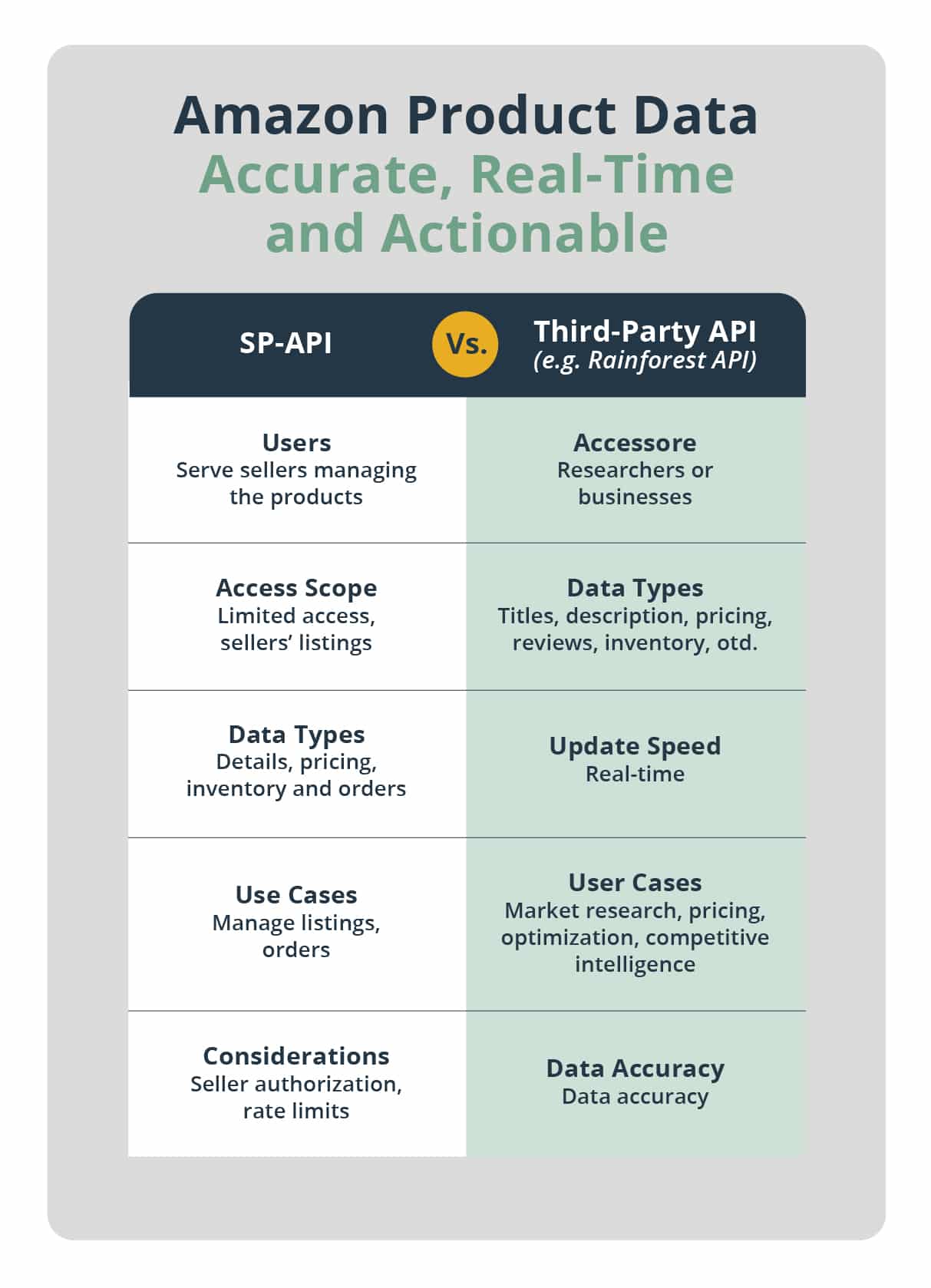
Comparison of Amazon official APIs versus third-party product API solutions

Amazon Product Search API Examples

How do Amazon product search APIs work?

Amazon product search APIs allow you to query Amazon’s catalog using keywords, categories, or product identifiers. Here’s a real example of how these systems work:

API Request Example:
GET /catalog/2022-04-01/items/B08N5WRWNW
Host: sellingpartnerapi-na.amazon.com
Authorization: Bearer [access_token]
x-amz-access-token: [access_token]
marketplace-ids: ATVPDKIKX0DER
included-data: attributes,images,productTypes,salesRanks,summaries
  
JSON Response Example:
{
  "asin": "B08N5WRWNW",
  "attributes": {
    "item_name": [
      {
        "value": "Wireless Bluetooth Headphones",
        "language_tag": "en_US"
      }
    ],
    "brand": [
      {
        "value": "AudioTech",
        "language_tag": "en_US"
      }
    ],
    "list_price": [
      {
        "value": {
          "amount": 129.99,
          "currency": "USD"
        }
      }
    ]
  },
  "images": {
    "primary": {
      "large": {
        "url": "https://m.media-amazon.com/images/I/example.jpg",
        "height": 500,
        "width": 500
      }
    }
  },
  "productTypes": [
    {
      "productType": "HEADPHONES",
      "marketplaceId": "ATVPDKIKX0DER"
    }
  ],
  "salesRanks": [
    {
      "productCategoryId": "electronics",
      "rank": 1547,
      "classificationRanks": [
        {
          "classificationId": "wireless_headphones", 
          "title": "Wireless Headphones",
          "rank": 89
        }
      ]
    }
  ]
}
  

[Code source: Amazon SP-API Catalog Items documentation – https://developer-docs.amazon.com/sp-api/docs/catalog-items-api-v2022-04-01-reference]

What data can you search for?

Amazon’s Catalog Items API supports searches by identifiers or keywords, returning comprehensive product information:

  • Product Details: Titles, descriptions, brands, specifications
  • Visual Assets: Product images in multiple sizes and variations
  • Classification Data: Categories, browse nodes, product types
  • Market Performance: Sales rankings across categories
  • Pricing Information: List prices and currency details

Ready to try this yourself? Explore our interactive API demo to see real Amazon product data in action.

Amazon Product API Pricing Models

How much do Amazon product APIs cost?

Amazon product API pricing varies significantly between official and third-party solutions:

Amazon SP-API Costs

Third-Party API Pricing

  • Consumer Tools: Free to $20/month for basic monitoring
  • Business Solutions: $100-500/month for moderate volume
  • Enterprise Platforms: Custom pricing for high-volume needs

In our experience implementing these solutions, the total cost depends on several factors:

  • Request Volume: Number of API calls per month
  • Data Complexity: Types of product information required
  • Update Frequency: Real-time vs. batch processing needs
  • Integration Support: Technical assistance and documentation

What factors affect API pricing costs?

When evaluating Amazon product API pricing, consider these cost drivers:

  • Data Accuracy Requirements: Higher accuracy typically costs more
  • Geographic Coverage: Multiple marketplaces increase complexity
  • Custom Features: Specialized data processing or delivery
  • Support Level: Technical assistance and SLA guarantees

For detailed pricing information tailored to your needs, check our frequently asked questions about API costs.

Real-Time vs. Batch Data

Why is real-time data important for Amazon products?

Amazon’s dynamic marketplace requires current information for effective decision-making. Real-time Amazon data APIs source information directly from Amazon with response times between 1-5 seconds, ensuring you have the most current information available.

Real-time data provides critical advantages:

  • Competitive Response: React immediately to competitor price changes
  • Inventory Alerts: Know instantly when products go out of stock
  • Deal Monitoring: Catch lightning deals and limited-time offers
  • Buy Box Changes: Monitor when featured seller positions shift

When is batch data sufficient?

For certain use cases, periodic batch updates may meet requirements while reducing costs:

  • Historical analysis and trend identification
  • Content optimization and SEO research
  • Market research and category analysis
  • Long-term competitive intelligence

The choice between real-time and batch data depends on your specific business needs and response time requirements.

Implementation Guide with Code Examples

How do you get started with Amazon product APIs?

Follow these steps to implement Amazon product data collection:

  1. Define Requirements: Identify what product data you need and update frequency
  2. Choose Your Solution: Select between official APIs for your own products or third-party solutions for broader coverage
  3. Plan Integration: Design how data will flow into your existing systems
  4. Test Implementation: Start with a small dataset to verify accuracy and performance
  5. Scale Gradually: Increase volume and frequency based on initial results

What does a complete API integration look like?

Here’s a practical example using third-party APIs for comprehensive product monitoring:

Search Request Example:
import requests
import json

# Search for products by keyword
search_params = {
    'api_key': 'your_api_key',
    'type': 'search',
    'amazon_domain': 'amazon.com',
    'search_term': 'bluetooth headphones',
    'sort_by': 'price_low_to_high'
}

response = requests.get('https://api.rainforestapi.com/request', params=search_params)
search_data = response.json()

print(f"Found {len(search_data['search_results'])} products")
  
Product Detail Response:
{
  "search_results": [
    {
      "position": 1,
      "title": "Sony WH-1000XM4 Wireless Headphones",
      "asin": "B0863TXGM3",
      "link": "https://www.amazon.com/dp/B0863TXGM3",
      "image": "https://m.media-amazon.com/images/I/example.jpg",
      "rating": 4.4,
      "ratings_total": 73891,
      "price": {
        "symbol": "$",
        "value": 278.00,
        "currency": "USD"
      },
      "is_prime": true,
      "is_amazon_choice": true,
      "availability": {
        "type": "in_stock",
        "raw": "In Stock"
      }
    }
  ],
  "pagination": {
    "current_page": 1,
    "total_pages": 16,
    "results_per_page": 16
  }
}


Want to see this in action? Access our full documentation for complete code examples and integration guides.

What are common implementation challenges?

Based on our experience helping businesses implement Amazon product APIs, common challenges include:

  • Data Quality Validation: Ensuring accuracy and consistency of retrieved information
  • Rate Limit Management: Optimizing request patterns to avoid throttling
  • Error Handling: Building robust systems to handle API failures gracefully
  • Data Storage: Designing efficient storage for large volumes of product data

For guidance on overcoming these challenges, explore our case studies featuring successful API implementations.
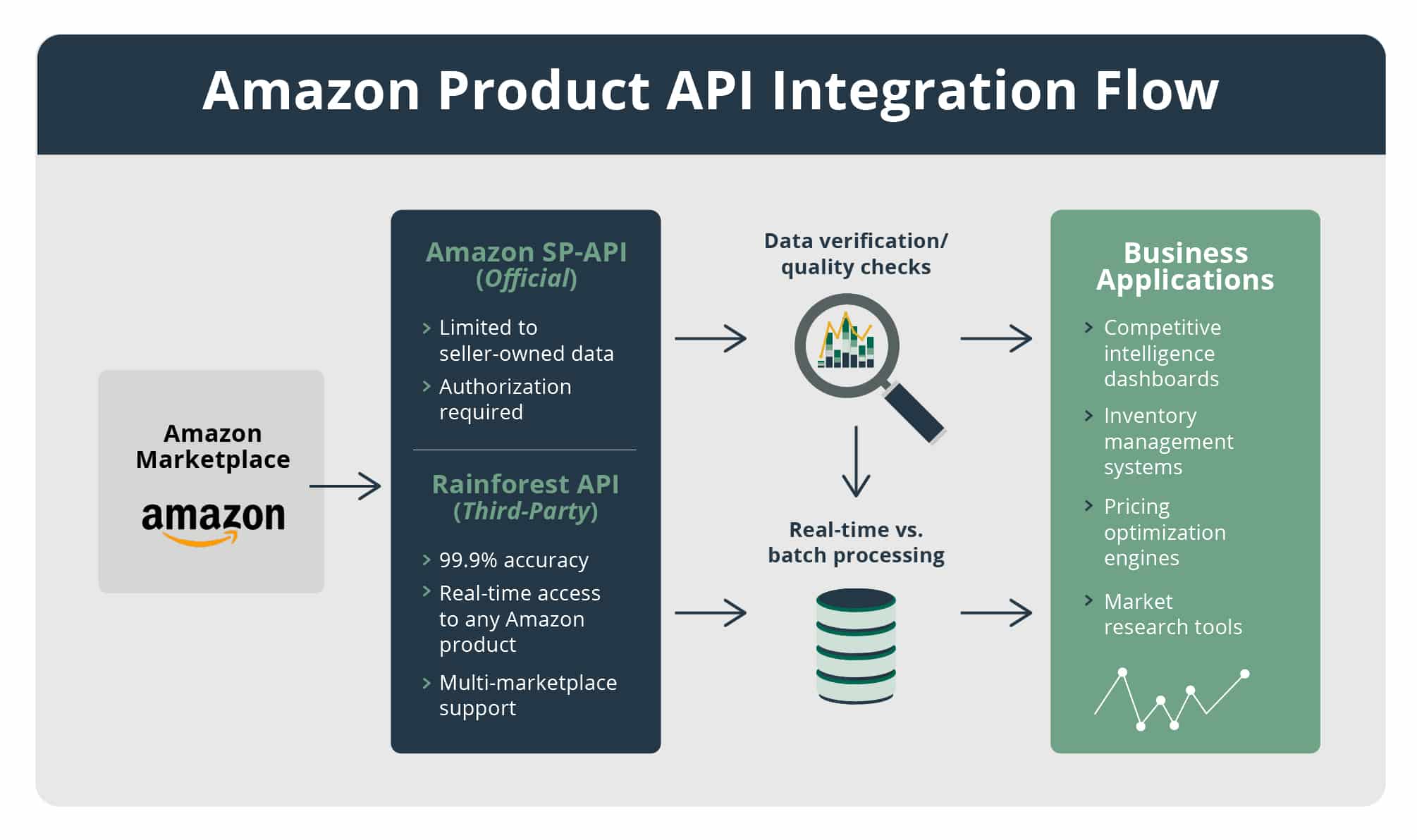
Amazon product API integration architecture and data flow diagram

Frequently Asked Questions

What is an Amazon product API?

An Amazon product API is a software interface that allows developers to programmatically access Amazon product data including titles, descriptions, prices, reviews, availability, and seller information in real-time. It eliminates the need for manual data collection by providing structured access to Amazon’s product database.

What’s the difference between Amazon’s official APIs and third-party solutions?

Amazon’s official APIs like SP-API serve sellers managing their own products with authorized access to specific data. Third-party APIs provide broader access to any Amazon product data for competitive intelligence and market research, without requiring seller authorization or product ownership.

How accurate is Amazon product API data?

Data accuracy varies by provider. Official Amazon APIs provide highly accurate data for authorized products. Quality third-party providers like Traject Data’s Rainforest API deliver over 99.9% accuracy through automated quality assurance systems and real-time data verification.

What types of product data can I access through APIs?

Amazon product APIs provide access to comprehensive data including product titles, descriptions, pricing, availability, customer reviews, ratings, seller information, images, specifications, category data, and sales rankings. The specific data available depends on the API provider and access level.

How fast can I get Amazon product data through APIs?

Real-time APIs typically respond within 1-5 seconds, providing current product information. Batch APIs may have longer processing times but can handle larger data volumes efficiently. Response times depend on the complexity of requests and API provider infrastructure.

Do I need technical expertise to implement Amazon product APIs?

Basic programming knowledge helps, but many API providers offer user-friendly interfaces, documentation, and support. Some solutions provide no-code options or managed services. The complexity depends on your specific integration requirements and chosen solution.

Ready to See What Traject Data Can Help You Do?


We’re your premier partner in web scraping for eCommerce data. Get started with one of our APIs for free and see the data possibilities that you can start to collect.

Walmart’s Food & Beverage Pricing Volatility: What Tariffs Are Hiding

Tariff policies have been anything but steady in 2025 — shifting, pausing, and updating multiple times. In our last two posts, we explored how Amazon categories reacted. Now, we turn to Walmart’s Food & Beverage aisle, where between January and July 2025, price swings were striking. Using Traject Data’s Bluecart ecommerce scraping pricing API, we tracked Walmart’s prices to uncover how tariffs and promotions are shaping category-level volatility

In most subcategories, nearly 4 in 5 products shifted 30% or more from their starting price. Such movements are more than noise — they’re an early warning for supply chain leaders, category managers, and pricing teams to adjust sourcing strategies and prepare for downstream retail pricing shifts.

Among them, Sweet Snacks stood out not just for volatility, but for scale. With the largest product count in the category — followed by Beverages and Bakery Products — its price movements carried more weight across Walmart’s assortment.

What the Data Shows

  • Volatility is widespread: Nearly 80% of products in Walmart’s Food & Beverage subcategories saw swings of 30% or more from their January baseline. The risk of major pricing shocks isn’t confined to niche segments — it’s spread across the aisle.
  • Movement is persistent: Prices didn’t just shift once and settle. They kept moving throughout the first half of the year. Some categories saw sharper, more frequent changes than others, signaling the market is still in flux and may require ongoing pricing adjustments.

Risk Categories

Volatility Watch: % of SKUs Shifting More Than 30%

Tracking price changes with ecommerce web scraping apis

Volatility is high across the aisle, but not all subcategories move the same. Sweet Snacks, Beverages, and Bakery Products lead in swings, while Dairy and Frozen Foods lag slightly — a signal that some areas react faster to cost, supply, or promotional changes than others.

Price Trajectory for Sweet Snacks

Month-over-month % change highlighting post-Q1 rebound and sustained increases through Q2

Tracking price changes with ecommerce web scraping apis

At the start of the year, Sweet Snacks prices held steady, then fell by about 3% in March compared to February. Interestingly, this dip coincided with Walmart’s online-only Super Savings Week (March 24–April 1), a major promotional event that likely contributed to lower prices, alongside seasonal sales, category-specific discounts, or clearance activity.

By April, prices stabilized as the market adjusted to evolving cost structures and promotional pressures. For context — though not direct causation — this March dip and April pause occurred just after early-March tariff implementations (following late-February announcements), and the April 9 decision to pause most reciprocal tariffs globally for 90 days while sharply raising rates on Chinese goods.

From May through July, prices climbed steadily. This rebound may reflect the pullback from heavy discounting, supply chain recalibrations, and tariff-driven cost pass-through to retail pricing.

The pattern raises a critical question:
Are tariff-driven disruptions in your category being masked by short-term promotional dips — only to emerge later as sustained price increases?

Why Ecommerce Scraping Pricing APIs Matter

Tracking these rapid shifts manually is impossible. Price changes driven by tariff policies, promotions, and supply chain resets can unfold daily across thousands of SKUs.

That’s where an ecommerce scraping pricing API becomes essential. With real-time monitoring, teams can:

  • Detect category volatility before it erodes margins
  • Compare competitive pricing across marketplaces like Walmart and Amazon
  • Adjust sourcing strategies based on tariff-driven cost fluctuations
  • Respond to promotions quickly instead of reacting weeks later

Traject Data’s ecommerce APIs give retailers, manufacturers, and brand protection teams the ability to monitor price movements at scale — providing early warnings of volatility and helping teams move from reactive to proactive.

What Walmart’s Tariff-Driven Price Swings Mean for Your Ecommerce Strategy

Walmart’s Food & Beverage price patterns show how quickly category-level shifts can ripple through entire assortments. From sharp swings to subtle month-over-month climbs, these movements call for:

  • Faster pricing updates
  • Closer supplier coordination
  • More agile promotion strategies

Even small changes in high-volume categories can compound into margin risk. Real-time monitoring with an ecommerce scraping pricing API ensures you catch the change early enough to act.

“Nearly 80% of Walmart’s Food & Beverage products swung more than 30% in just six months. That’s not volatility to watch — that’s volatility to act on. Tariff shifts and promotions don’t just move prices in the moment, they set the stage for months of margin pressure or opportunity.”

— Ria Delamere, CTPO, Traject Data

Use an Ecommerce Scraping Pricing API to Stay Ahead of Tariffs

Get the complete dataset or run a custom volatility scan for your categories of interest. With Traject Data’s ecommerce APIs, you can identify products most at risk of tariff-driven price shocks and protect your margins.

👉 Learn more about Traject Data’s ecommerce scraping pricing APIs

Want to explore more on price tracking after tariff changes? Check out our earlier posts:

Amazon Pulls Out of Google Shopping Ads: How Ecommerce APIs Keep PPC Agencies Ahead

AI shopping agents are no longer science fiction. Numerous engines like Google, ChatGPT, and Perplexity are now designed to provide personalized shopping advice, product comparisons, and recommendations. 

That’s great for buyers, but not so great for Amazon. Why? Because Amazon is losing control of the shopper experience.

As Marketplace Pulse founder Juozas Kaziukėnas puts it:

“Shopify and Amazon aren’t afraid of AI shopping in principle. They’re afraid of AI shopping they don’t control. They’re betting they can block the competition’s tools long enough to build their own and make them the standard.”

Welcome to the AI Shopping Wars.

Amazon vs. Google: From Partners to Rivals

For years, Amazon and Google worked together. Amazon spent heavily on Google Shopping ads, and Google benefited from Amazon’s retail dominance. But that partnership has fractured.

In May 2025, Google announced significant advancements in AI-powered shopping, including automated purchases for users. If shoppers rely on AI-shopping agents instead of browsing Amazon, it’s a direct hit to Amazon’s ad revenue and customer loyalty.

Amazon’s response has been swift and aggressive:

  1. Blocking AI crawlers. Amazon cut off Google from crawling its product listings. Earlier in the year, it did the same with ChatGPT, Claude, and Perplexity, making Amazon listings invisible in many AI-driven shopping tools.
  2. Pulling out of Google Shopping ads. Amazon discontinued all of its Google Shopping ads, causing Google to lose one of its biggest retail advertisers.
  3. Launching its own AI agent. Amazon introduced “Buy for Me”, an AI shopping assistant that keeps the shopper fully inside Amazon’s ecosystem.

Amazon isn’t just protecting its ad spend, it’s reclaiming total control over the customer journey.

The Challenge for Digital Marketing Agencies

When Amazon changes the rules, your clients feel it immediately:

  • CPC swings wreck campaign efficiency. Cost-per-click (CPC) rates have dropped by 1–4% on average, with some categories seeing declines as steep as 40%. Others report drops of 7–12% across verticals.
  • Visibility disappears overnight. If Amazon isn’t bidding, the entire ad landscape shifts in unpredictable ways.
  • Competitor pricing volatility. Stockouts, coupon launches, and delivery slowdowns can flip the script with no warning.

For PPC and digital marketing agencies, relying on guesswork isn’t an option.

The Opportunity: Data-Driven Agencies Win

Agencies that can see the shifts in real time will not only protect their clients, they’ll gain trust, renew contracts, and upsell services.

Take the example from Elizabeth Greene’s team at Junglr: they tested a bidding hack in the supplements category (surfaced by Brandon Young) and unlocked impressions without raising bids. That’s not just a clever hack, it’s proof that when you have the right data inputs, you can turn volatility into opportunity.

That’s where Traject Data’s SERP and ecommerce APIs come in.

The Ecommerce Web Scraping API Advantage

Two APIs in the Traject Data suite, SERPWOW and Rainforest, give agencies the visibility they need:

  • SERPWOW: Track who is winning or losing placements for any keyword in real time. Capture both ad slots and organic rankings.
  • Rainforest: Enrich those ASINs with pricing, stock, delivery speed, and coupon data.

Together, they give you the competitive intelligence Amazon doesn’t want you to see.

Workflow for PPC Agencies

Here’s how digital marketing agencies can put Traject Data’s ecommerce APIs to work:

Step 1: See who’s on the page (SERPWOW)

  • Run keyword SERPs and capture ad placements.
  • Show clients exactly how visibility shifts when Amazon pulls out of auctions.

Step 2: Pull competitive product details (Rainforest)

  • Feed ASINs from SERPWOW into Rainforest’s Product Details endpoint.
  • Track pricing moves, coupon launches, and stock levels.

Step 3: Compare over time 

  • Run API calls hourly, daily, or in sync with campaigns.
  • Spot volatility like stockouts, delivery delays, or aggressive price cuts.

Step 4: Trigger smarter bidding

  • Ramp bids when rivals run out of stock.
  • Shift spend when delivery slows.
  • Decide when to defend against price cuts, and when to let competitors bleed margin.

Example API Calls

  • SERPWOW Search Endpoint → Capture ASINs and placements for a keyword in real time.
  • Rainforest Product Details Endpoint → Enrich those ASINs with pricing, stock, and delivery data.

Combine the two data sets for insights you can turn into action for clients immediately.

Putting It All Together

The AI Shopping Wars are here, and Amazon pulling out of Google Shopping ads is just the beginning. Who knows what will be next. The only way agencies can stay ahead is with real-time ecommerce data.

With Traject Data’s APIs, you can:

  • Retention → Answer tough client questions with hard evidence.
  • Upsell → Turn sharper insights into premium services.
  • Scale → Apply one proven workflow across your entire client portfolio.

In a market where Amazon is rewriting the rules daily, ecommerce APIs give PPC agencies the edge they need to keep clients confident and campaigns profitable.

Web Scraping for Tariffs with a SERP API: How to Stay Ahead in a Shifting Trade Landscape

Tariffs. They dominate headlines and introduce uncertainty across industries. For businesses that import, export, manufacture, or rely on global supply chains, changing tariff policies can bring serious financial and operational challenges.

That’s where web scraping for tariffs comes in. By extracting real-time data from the web, businesses can monitor market trends, competitor pricing, and regulatory changes—empowering faster, smarter decisions. When paired with a SERP API, web scraping becomes even more powerful, automating the collection of search engine data for fast, scalable insights.

Why Use Web Scraping for Tariffs?

Web scraping helps businesses gather actionable data from critical online sources, including:

With this data, companies can track how tariffs are impacting product pricing, supply chains, and competitor behavior. Whether you’re adjusting sourcing strategies or setting new price points, scraping relevant data helps reduce risk and improve agility.

In today’s volatile trade environment, staying informed is no longer optional—it’s essential.

How a SERP API Supports Tariff Intelligence

A Search Engine Results Page (SERP) API enables businesses to automatically collect Google search results in real time. Traject Data’s Scale SERP API makes it easy to extract structured information from SERPs—including organic listings, “People Also Ask” questions, featured snippets, and even AI Overviews.

For companies navigating tariffs, a SERP API offers several key benefits:

1. Real-Time Monitoring of Tariff News and Policy Changes

  • Automated tracking: Continuously query Google for phrases like “2025 U.S. steel tariffs” or “China trade agreement updates.”
  • Custom alerts: Set up notifications when new laws, trade agreements, or tariff rate changes hit the news.

2. Competitor and Market Analysis

  • Competitor pricing: Scrape product listings to understand how competitors are adjusting their prices in response to new tariffs.
  • Market trends: Identify changes in product offerings, logistics routes, or sourcing strategies driven by tariff policy.

3. Supply Chain Risk Intelligence

  • Supplier monitoring: Track updates about suppliers in high-tariff regions—such as delays, route changes, or closures.
  • Vendor risk assessment: Use SERP data to evaluate third-party vendors’ stability and compliance amid trade policy shifts.

4. SEO and Reputation Management

  • SEO optimization: Target tariff-related search queries to ensure your content ranks as decision-makers look for solutions.
  • Reputation monitoring: Stay ahead of how your brand is being discussed in the context of global trade.

A Valuable Public Resource: USITC DataWeb

If you’re researching the Harmonized Tariff Schedule (HTS) of the United States, the U.S. International Trade Commission (USITC) DataWeb is a helpful resource. It provides public access to:

  • Import duty rates by product category
  • Annual updates to U.S. tariff policy
  • Trade agreements with preferential or zero tariffs

While DataWeb is useful for static analysis, it doesn’t provide the real-time visibility needed to respond quickly to shifting conditions. That’s where dynamic tools like SERP APIs and ecommerce APIs come in.

How Ecommerce APIs Help with Tariff Intelligence

In addition to scraping search engine results, ecommerce APIs provide critical pricing and inventory data that reflects real-world reactions to tariffs.

Traject Data offers ecommerce APIs for Amazon, Walmart, and Target—three of the largest online retailers and key bellwethers for consumer pricing trends. By monitoring how these platforms adjust to tariffs, businesses can:

  • Track real-time price fluctuations by product category
  • Understand shifts in inventory availability
  • Benchmark against major retailers’ pricing strategies

Together with a SERP API, ecommerce APIs give you a comprehensive view of how tariffs are impacting both perception and performance in the market.

Start Web Scraping for Tariffs Today

With the right tools and strategy, web scraping for tariffs can give your business a clear edge in an unpredictable market. Traject Data’s Scale SERP API is designed to help you stay ahead of change by delivering real-time insights from the world’s most important search engine.

Whether you’re tracking competitor pricing, monitoring policy shifts, or optimizing your SEO, our SERP API and ecommerce data products provide the intelligence you need to act quickly and confidently.

→ Ready to future-proof your tariff strategy? Contact Traject Data to get started.

Ready to See What Traject Data Can Help You Do?


We’re your premier partner in web scraping for SERP data. Get started with one of our APIs for free and see the data possibilities that you can start to collect.

Same Furniture, Higher Prices: What Our Ecommerce Scraping API Found

In a previous blog post, we took a broad look at how recent tariff changes were shaking up product prices and inventory for Acme Furniture across Amazon. We gave you a snapshot of the market using data from our ecommerce scraping API, tracking how tariffs ripple through ecommerce supply chains in real time. 

This time, we’re zooming in.

Previously, we looked at Acme Furniture’s overall brand performance across two suppliers. Now, we’re peeling back the layers to focus on specific subcategories and eventually drilling all the way down to individual SKUs. Think of it like peeling an onion—layer by layer—until we uncover exactly how tariffs are shaping ecommerce pricing.

Focusing on the Essentials

Acme Furniture sells a wide range of products, but for this post, we’re focusing on three high-impact categories:

  • Bedroom Furniture
  • Dining Room Furniture
  • Living Room Furniture

We chose these categories because they represent the essential pieces that make up any home.So when prices shift in these categories, the ripple effects touch both consumers and sellers across the ecommerce ecosystem.

Here’s what we found using our ecommerce API to monitor Amazon product pricing in real time.

A Closer Look at Price Trends

As you can see from the chart (below), all three furniture categories saw significant price increases between February and March:

  • Bedroom Furniture: Prices surged from around $700 in January to over $1,100 by May before dipping slightly to $800 in June.
  • Dining Room Furniture: Prices climbed from $800 in January to nearly $1,000 by March.
  • Living Room Furniture: Starting at about $400, prices nearly doubled to $800 in the same period.
Web scraping to track price changes

All three categories are trending upward. That matters because these aren’t specialty goods—they’re core household items.

For consumers, that means everyday furniture is becoming harder to afford.
For retailers, it means rethinking pricing, sourcing, and promotion strategies.

From Category to SKU: Zooming in on Bedroom Furniture

Bedroom furniture experienced the most dramatic price swings of all three categories. Let’s take a deeper look at two specific products—tracked over six months—to illustrate how price shifts are playing out on the product level.

Product 1: Bed Frame

In January, this basic full bed frame was priced at $258.84. While it ticked up slightly in February, the real jump came in April when it jumped to $301.41. By June, the price hit $348.40—a 34.6% increase over just six months. That’s not a luxury bed. That’s just a place to sleep. And it’s now $90 more expensive than it was in January.

Tracking Price Shifts in Your Home: What’s Changed from January to June

Web scraping ecommerce API tracks prices after tariff increases

Product 2: Chest of Drawers

This item tells an even more dramatic story. It was priced at $1,102.90 in January and reached $1,638 by June—a staggering $535 increase.

For families furnishing an entire home, that kind of increase can be a deal-breaker.

Web scraping ecommerce API tracks prices after tariff increases

“We’re watching essentials get priced like premium goods. Tariffs are a big part of the story. When a basic chest of drawers climbs $500 in six months, retailers can’t afford to rely on assumptions. These aren’t broad inflation trends; they’re specific, SKU-level shifts driven by sourcing decisions and policy changes. Having raw, real-time data lets retailers spot these price movements early, adjust strategies accordingly, and avoid being caught flat-footed as the middle market gets increasingly volatile.”

— Heather Wold, Group Product Manager, Traject Data

Regional Price Differences: Same Product, Different Costs

Our ecommerce APIs don’t just track pricing across retailers—they also track geographic variation.

For this analysis, we looked at prices across three major U.S. cities (Chicago, New York, Los Angeles) and one Canadian location (Amazon.ca). Even for the same product, pricing varied by location.

Bed Frame by City

At first, prices across Chicago, NYC, and LA were relatively stable. But starting in March:

  • Chicago & NYC stayed in a similar range
  • Los Angeles showed a steeper price climb

This could reflect regional shipping costs, local demand, or warehouse availability. But the takeaway is clear: even the same product on the same platform (like Amazon) doesn’t cost the same everywhere.

Web scraping ecommerce API tracks prices after tariff increases

Chest of Drawers by City

This product followed a similar trend—especially in LA:

  • All cities started near the same price point in January
  • Prices began rising in February
  • Chicago and NYC spiked in May
  • LA consistently trended higher

There’s volatility across the board, but LA appears to lead the pack in price increases.

Web scraping ecommerce API tracks prices after tariff increases

While it’s clear that all cities experienced price increases, understanding the nuances behind regional trends requires more analysis across a wider range of products. For now, it’s evident that geographical factors contribute to varying price points, and consumers in different locations may experience different affordability challenges based on these shifts.

The Bigger Picture: What It Means for Ecommerce

This deep dive into Acme Furniture is just a preview of what’s possible with modern ecommerce scraping apis.

Web scraping for ecommerce is no longer about just monitoring availability or reviews—it’s a critical strategy for tracking pricing dynamics, SKU-level shifts, and competitive positioning in real time. Whether you’re a retailer, brand protection team, or data analyst, tools like the Rainforest API by Traject Data let you move beyond assumptions and act on accurate, granular insights.

What’s Next?

So far, we’ve looked at:

  • One brand: Acme Furniture
  • One source country: China
  • One retailer: Amazon
  • Three cities: Chicago, NYC, and LA

There’s still so much more to explore:

  • How do products sourced from Vietnam compare?
  • Are groceries and clothing seeing similar trends?
  • How do these price shifts play out on other retailers?
  • How volatile is pricing on a week-to-week basis?

Stay tuned. In upcoming posts, we’ll broaden the lens to include more categories, more countries of origin, and more retailers—delivering fresh insights powered by our ecommerce web scraping APIs.

Want to Track Ecommerce Prices in Real Time?

Traject Data’s Rainforest API and ecommerce scraping APIs are built for businesses that need high-resolution, real-time ecommerce data. Whether you’re tracking price trends, detecting MAP violations, or monitoring the impact of tariffs, our tools give you the competitive edge.

Learn more about our ecommerce APIs

Traject Data eCommerce APIs

Complete real-time ecommerce product information scraper APIs for product development, price strategy and market research.

Explore the APIs

The Anti-Bot Arms Race Is Here – Part 2

Part 2 of 2: Build vs. Buy in 2025

Let’s not overcomplicate this. We’re not talking about scraping Google or launching a full-blown marketplace monitoring operation. This is basic. One site. A few thousand pages. No logins. No personalization. Just a straightforward scrape.

And even that is falling apart faster than most teams can keep up with.

DIY Always Starts Easy

It starts with a script. Add some proxies. Maybe a CAPTCHA solver. Schedule it to run at night.

Feels like it’s working—until:

  • The site layout changes and your selectors stop working
  • CAPTCHAs trigger every fifth request
  • Your proxies get flagged and traffic slows to a crawl
  • The script still runs, but it’s quietly collecting junk

No alerts. No stack trace. Just broken data that looks fine—until someone actually reads it.

What It Really Takes to Keep a Scraper Alive

Even at small scale—one or two ecommerce sites, a few thousand pages a day—here’s what it actually takes to keep that setup running:

Task DIY Cost
Proxy/IP rotation $1,000–$2,500/month
CAPTCHA solving $250–$750/month
Engineering time 5–10 hours/week
Monitoring & alerts Often skipped

That adds up to $75K–$100K per year. And that’s just to stay functional. No load balancing. No redundancy. Just holding things together with duct tape and hope.

Quiet Failures Are the Most Dangerous

Most scrapers don’t fail loudly. They fail silently.

We’ve seen teams scrape a product page for weeks before realizing a key field was returning an empty string. The job ran. The logs were clean. The data was useless.

In one case, a pricing team missed a competitor’s discount campaign for nearly two weeks. Their scraper had been flagged and was only returning cached content. The reports looked fine. Until they weren’t.

The Real Cost Isn’t Tools—It’s Time

Sure, proxies and CAPTCHA solvers cost money. But the real drain is your team’s time.

Every hour spent chasing 403s and tweaking selectors is time not spent on product, customers, or shipping real features. And usually, scraping isn’t anyone’s actual job. It’s just something someone agreed to “get working.”

Now you’re maintaining infrastructure you never meant to build.

Specialization Wins in 2025

In 2025, scraping isn’t just a technical task. It’s an operational discipline.

And that changes the conversation. The question is no longer “what will it cost to build?” It’s “what else will we not be doing because we’re choosing to build this?”

Hardly anyone builds their own payment stack or email system anymore. Scraping is heading in the same direction. Not because it’s impossible, but because it no longer makes sense to compete with specialists when your edge lies somewhere else.

A good scraping partner doesn’t just write code. They’ve already built the browser behavior, detection evasion, fallback logic, and monitoring you’ll wish you had when your script quietly breaks on a holiday weekend.

You’re not outsourcing scraping because it’s hard. You’re outsourcing it because your team has more important problems to solve.

Final Word: Can You Carry It?

If you’re just testing the waters or pulling a few pages, go for it. No judgment.

But if scraped data is powering decisions, reports, or products, then it’s not a script anymore. It’s a system.

And systems need owners. They need monitoring. They need attention.

So the real question isn’t “Can we build this?”
It’s “Do we want to carry it?”

If the answer’s yes, build it and build it right.
If not, find a partner who treats it like the critical infrastructure it is.

Traject Data eCommerce APIs

Complete real-time ecommerce product information scraper APIs for product development, price strategy and market research.

Explore the APIs

The Anti-Bot Arms Race Is Here…and It’s Killing DIY Scraping

Part 1 of 2: Why brand protection teams can’t afford to go it alone anymore

Scraping Ain’t What It Used to Be

If I had a dollar for every customer who thought they could spin up a few scripts and scale overnight, I’d be somewhere sunny, pretending I didn’t even know what a 429 error was.

We’ve seen teams buy scraping vendors thinking they were getting a well-oiled machine. What they got was fragile scripts and burned IPs. Others try to bolt scraping onto their existing roadmap. “We’ll just run it in the background,” they say. But scraping never stays in the background for long.

Now we’re in the age of AI, and everyone thinks they’ve found a shortcut. Just ask a natural language agent to spit out some code and voilà, instant scraper. Sorry to break it to you, but AI recognizes AI. That’s one of the fastest ways to get detected and blocked. Static, auto-generated code isn’t fooling anyone.

If your brand protection work depends on web data, you’re probably keeping tabs on rogue sellers, pricing violations, or fake reviews. And yeah, it’s tempting to build your own setup. Grab a few proxies, fire up a headless browser, toss in some error handling, and call it a day. How hard could it be?

Reality Check: Scraping Is Now Infrastructure

Here’s the reality. Scraping isn’t what it used to be, and in 2025, it’s not something you can just spin up and forget. That’s not because you’ve done anything wrong. It’s because the internet itself got smarter. Web defenses are now built with machine learning, dynamic challenges, and AI-level fingerprinting. Scraping today isn’t a side project or a clever workaround. It’s infrastructure. And if you don’t have people who know exactly what breaks first and why, you’re going to spend more time firefighting than getting data.

At Traject Data, we’ve seen what happens when teams try to patch things together mid-flight. It’s rarely about effort. It’s about keeping up with a moving target. So instead of trying to outsmart every platform update, we work with customers to navigate around the noise, clean, consistent data that actually shows up when and where they need it.

AI Is the New Gatekeeper

Modern anti-bot systems do more than block IPs. They use AI to analyze how you scroll, click, and interact. They evaluate your browser fingerprint, flag anything suspicious, and dynamically escalate defenses. Static tools won’t hack it anymore.

Common detection methods include:

  • Behavioral detection: Move too fast or too smooth? You’re out.
  • Fingerprinting: Headless browsers are easy prey.
  • Dynamic challenges: Rotating CAPTCHAs, JavaScript traps, hidden fields.

Even seasoned in-house teams get blindsided. We’ve seen proxy bans, silent failures, and delayed data tank entire quarters. One customer paused their roadmap for three months to fix their scraping pipeline. That’s not scaling, that’s survival mode.

Unless you’re treating web scraping as a full-time mission, you’re just buying time. And eventually, you’ll run out.

Google’s January 2025 Update: A Turning Point

In January, Google quietly made JavaScript rendering mandatory for accessing search results. If your scrapers still relied on static HTML, they broke, instantly.

“Google is blocking search result scraping, causing global outages at many popular rank tracking tools like Semrush.”

Search Engine Journal

SE Ranking confirmed delays. Semrush downplayed the issue. But SEOs on the ground told a different story:

“Definitely affecting my tools as well — we use a 3rd party data supplier and ALL the major ones were blocked yesterday.”

@RyanJones

By March, Semrush reported that AI Overviews, Google’s generative AI answers, were showing up in 13.14% of desktop queries in the U.S., up from 6.49% in January. That’s a massive shift in just two months.

So not only did the gates get harder to bypass, the content behind them started changing faster, too.

Cloudflare Joins the Fight

In July 2025, Cloudflare added fuel to the fire. They started blocking AI crawlers by default and launched a beta pay-per-crawl model, letting sites charge bots for access.

While marketed as AI policy, it affects anyone scraping behind Cloudflare, including ecommerce, review, and marketplace sites. These systems use machine learning, not static rules, so a tiny tweak in their detection logic could silently disable your scrapers overnight.

The teams that survive have invested in:

  • Advanced browser session simulation
  • Fingerprint spoofing with built-in randomness
  • Real-time challenge detection and solving
  • Continuous monitoring and fast human response

You’re Scraping Platforms, Not Just Sites

This is the real shift. his isn’t about bypassing one website. It’s about constantly adapting to platform-wide defenses from Google and Cloudflare. When they change the rules, your whole category of traffic can vanish.

In brand protection, missing even a single day of coverage is risky. Fake sellers, bad pricing, counterfeit products, all slip through during downtime.

That’s why scraping can’t be a side hustle anymore.

Part 2, Build vs. Buy in 2025

In part two, we dive into:

  • The real cost of DIY scraping: engineering, ops, downtime
  • Infrastructure complexity and hidden risk
  • Why partners like Traject Data offer scalable, reliable solutions
  • What real ROI looks like when you offload the heavy lifting

Read Part 2 here. Or if you’re already trying to hold a fragile pipeline together, talk to us. Let’s skip the wild goose chase and get reliable data.

Traject Data eCommerce APIs

Complete real-time ecommerce product information scraper APIs for product development, price strategy and market research.

Explore the APIs

Nintendo Pulled the Plug on Amazon Listings. Here’s What It Teaches Us About Brand Protection

While I was technically on vacation—beach chair, drink in hand—I couldn’t resist diving into Nintendo’s latest plot twist. (No surprise. My brain doesn’t do “off.”)

The short version?

Nintendo launched the Switch 2 in early June. Fans were ready. Listings popped up on Walmart, Target, and other major retailers. But on Amazon U.S.? Crickets. No official listing—just a flood of third-party sellers flipping consoles at inflated prices.

What happened?

According to Bloomberg (June 30, 2025), Nintendo pulled official Switch 2 listings from Amazon after discovering that unauthorized sellers were importing the console from Southeast Asia and undercutting U.S. pricing strategies. Amazon had essentially become a back door for grey-market units—something Nintendo couldn’t allow during a high-stakes product launch.

Both companies denied any rift. But as The Verge reported (July 7, 2025), the Switch 2 eventually reappeared on Amazon—this time with an invite-only purchase option. It’s still there… just behind a velvet rope.

Why this matters beyond gaming

This isn’t just about Nintendo. It’s a wake-up call for every brand selling online. Even iconic companies can lose control of how their products are listed, priced, and sold on platforms like Amazon.

From MAP (Minimum Advertised Price) violations and grey-market leakage to rogue sellers and skewed search results, these disruptions aren’t just annoying. They erode revenue, reputation, and customer trust.

If Nintendo had to pull its listings to regain control, how are you staying ahead of this?

Brand Protection in the Age of Amazon

This is exactly the kind of challenge we solve at Traject Data.

Our Rainforest API is built for brand protection on Amazon and other major ecommerce platforms. We don’t rely on marketplace APIs that limit your view to curated data. Instead, we scrape live listings—what your customers actually see—and deliver clean, structured data that helps you take fast, decisive action.

Traject Data enables you to:

That’s the visibility our brand protection API provides. Fast. Flexible. No velvet rope required.

The Bigger Picture

Nintendo’s “Amazon pause” wasn’t a glitch—it was a calculated reset. They pulled listings in late June and didn’t return until mid-July, well after launch day. That may work when you’re Nintendo. But for most brands, disappearing from the world’s largest online marketplace isn’t an option.

This is the new reality: listing chaos, grey-market back doors, and third parties playing by their own rules.

The question isn’t if this will happen to your brand.

It’s when—and whether you’ll have the data to respond.

Stay in Control with Traject Data

We provide ecommerce APIs for Amazon, Walmart, Target, and Google Shopping so you can monitor your brand across the platforms that matter most. Whether you’re tracking unauthorized sellers, pricing violations, or SKU mismatches, we give you the data to act fast.

Want to protect your brand online? Reach out to Traject Data and get started today.

How Ecommerce APIs Reveal Tariff Impacts on Amazon Prices and Supply Chains

At the start of this year, we began tracking approximately 10,000 products across three major U.S. retailers: Amazon, Walmart, and Target. Why? Because the trade landscape was already heating up. With headlines swirling about shifting tariff policies, changes in import duties, and the mounting pressure on global supply chains, we wanted to see how these forces were playing out, not just at a macro level, but on the product pages themselves.

We didn’t begin with a specific hypothesis or assumption. We decided to watch the data and see what patterns emerged.

Now, six months in, there are plenty of questions to explore. Did prices jump? Did products go out of stock? Were marketplaces absorbing the shock? Were certain products, suppliers, or regions reacting faster than others? Were specific categories hit harder than others? And when did these shifts appear — immediately or much later, after the policies were implemented?

In this post, we’ll zoom in on a single retailer: Amazon, and a subset of products (ACME Furniture) tied to two key sourcing countries: China and Vietnam. The data showed a clear pattern of disruption and two very different reaction timelines. One sharp and early. One slower, but still consequential.

The Immediate Impact: Early Movements Observed in Products Sourced from China

January–March

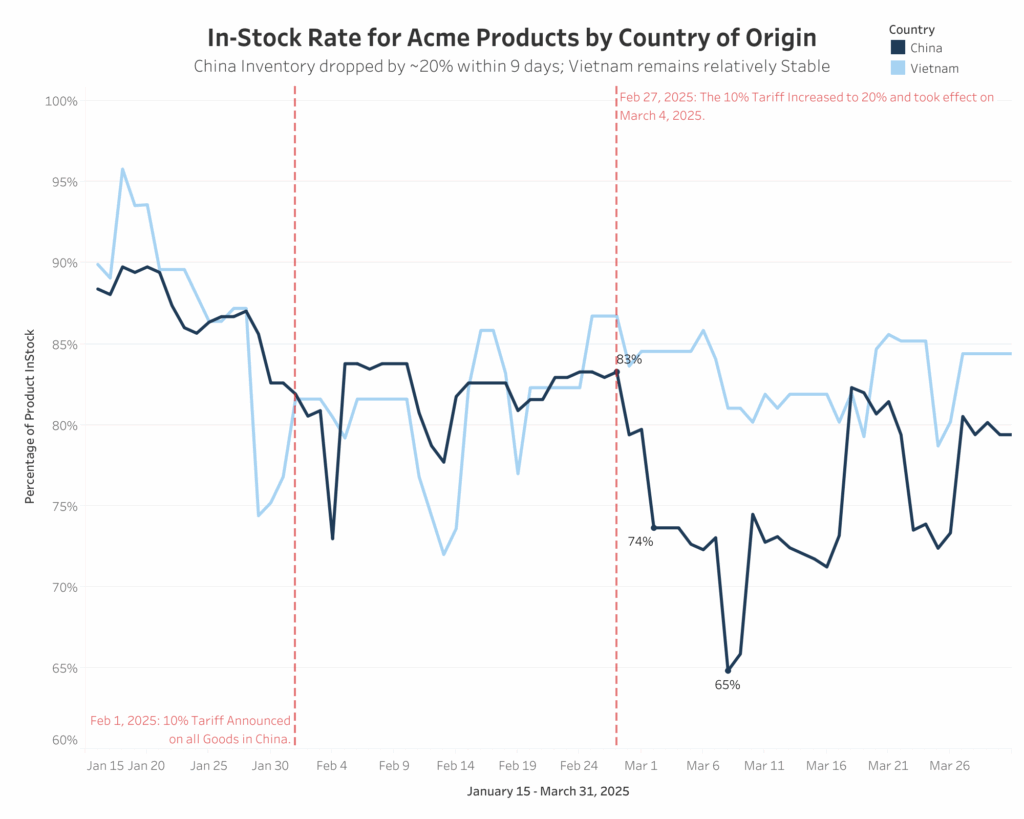
Back in January, prices and inventory levels for Acme-branded products on Amazon looked pretty stable. Products sourced from China and Vietnam hovered around the same price range, roughly $740–760, and inventory levels were strong, with over 80-85% of items in stock.

The first signs of stress

News of upcoming tariffs began circulating by the end of January, and on February 1, 2025, a 10% tariff on all Chinese imports was announced. An additional 20% was officially announced on February 27. Although the tariff wasn’t implemented until March 4, we noticed a sharp drop in availability almost immediately after the February 27 announcement. 

It didn’t take long for the impact to show up on the shelves — or, in this case, the product listings. Within just 5 days, availability for products sourced from China dropped from 83% to 74% and by March 8, it fell further to 64%, a nearly 20% drop in availability in less than 10 days. This sudden drop raised eyebrows. Was it a supply disruption? A shift in sourcing? Anticipation of the tariff? Whatever the reason, the impact was immediate. It may point to suppliers rushing to sell off existing inventory before the tariff took effect. Alternatively, it could reflect delays or halts in new shipments due to disruptions or uncertainty after the announcement. In contrast, Vietnam-sourced products experienced a short-lived dip in late January, but from early February onward, their inventory stayed stable around 85% with no sustained dips as seen in China.

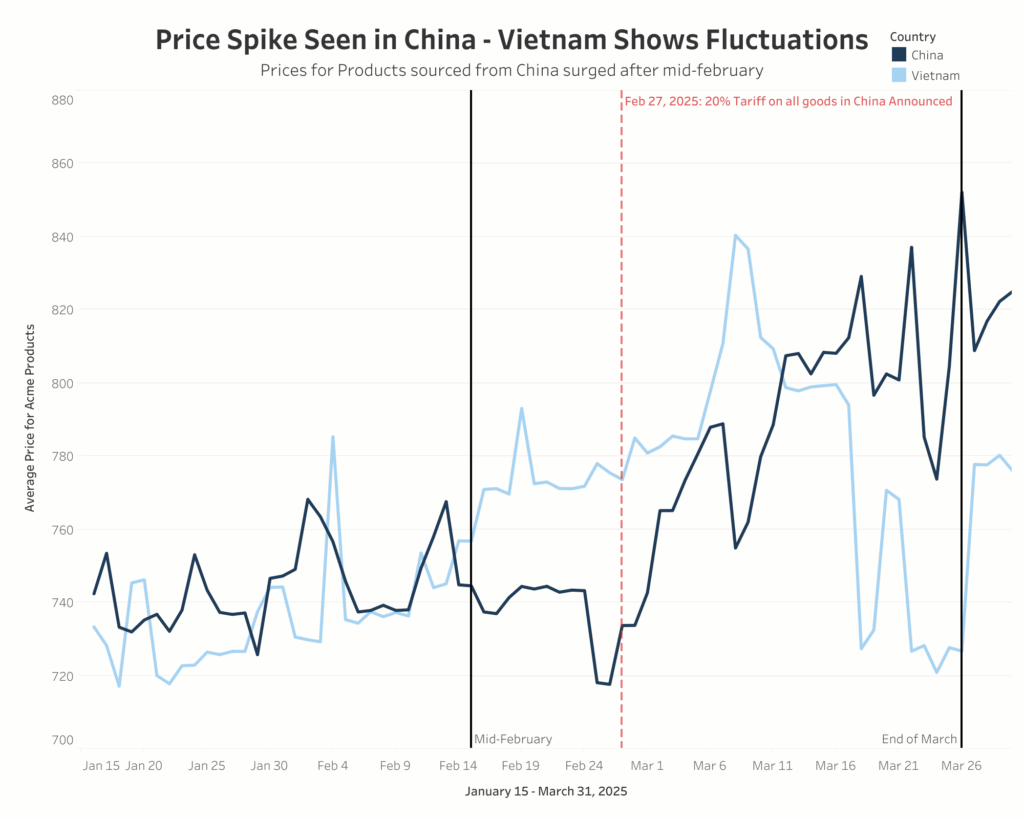
Then came the price movement, and it wasn’t subtle. Following the sharp drop in availability for China-sourced products, prices began to shift as well. Around mid-February, even before the second tariff was officially announced, we started seeing a gradual rise. What had been a stable average of around $750 climbed steadily, crossing the $800 mark by early March. After the February 27 announcement, the trend intensified, with prices reaching close to $860 by the end of March. This behavior suggests that sellers were not only anticipating higher import costs but were also starting to pass them along, either to preserve margins or test how much price movement the market would absorb. 

Products sourced from Vietnam showed some fluctuations and spikes, particularly around mid-February and early March, even reaching close to $840 at one point, but these weren’t sustained. Prices quickly fell back down and mostly hovered between $760–780, occasionally dipping to the $720–760 range by late March. While the line was volatile, there was no clear upward trend through the period, suggesting that Vietnam remained relatively insulated from tariff-driven pricing pressures, at least for now.

The Delayed Reaction: Vietnam’s Steady Climb

April-June

As we moved into Q2, things began to shift more visibly — and this time, Vietnam wasn’t sitting still.

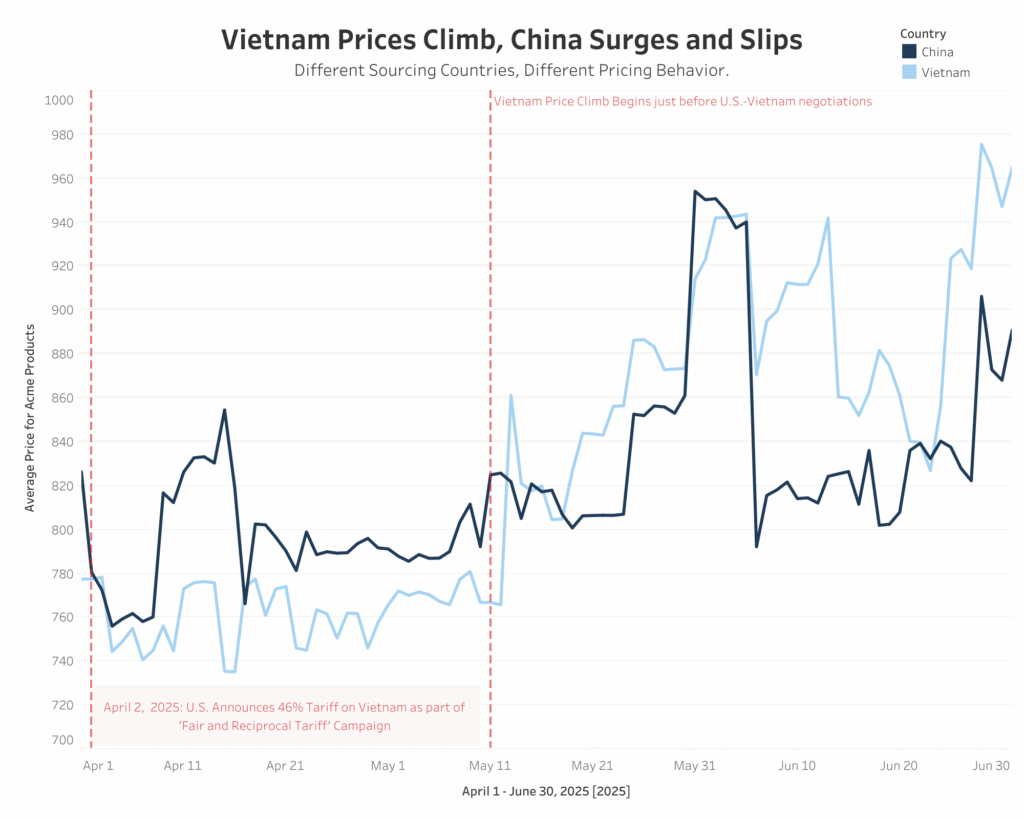
Throughout early April, products sourced from China remained elevated, holding steady around the $850 mark. This wasn’t entirely unexpected. With the U.S. imposing steep reciprocal tariffs on Chinese goods, up to 125% by April 9. Those levels held firm until around May 31–June 5, when prices took another sharp jump, briefly spiking toward $950 before settling back into the $830–850 range.  

Vietnam, on the other hand, told a quieter but persistent story. For most of April, Vietnamese products stayed under $770, showing no major deviation, even after the potential 46% tariff on Vietnamese goods in early April. That changed after May 11. Just days before formal U.S.-Vietnam negotiations began in Washington, we started seeing a clear, upward shift in prices. It wasn’t a spike; it was a steady climb. From mid-May to the end of June, Vietnamese prices rose consistently, ultimately pushing past $900. No sudden drops. No dramatic surges. Just a slow, confident march upward — one that suggests pricing adjustments were being made gradually, perhaps in anticipation of long-term cost changes, or as suppliers adapted to the shifting trade environment.

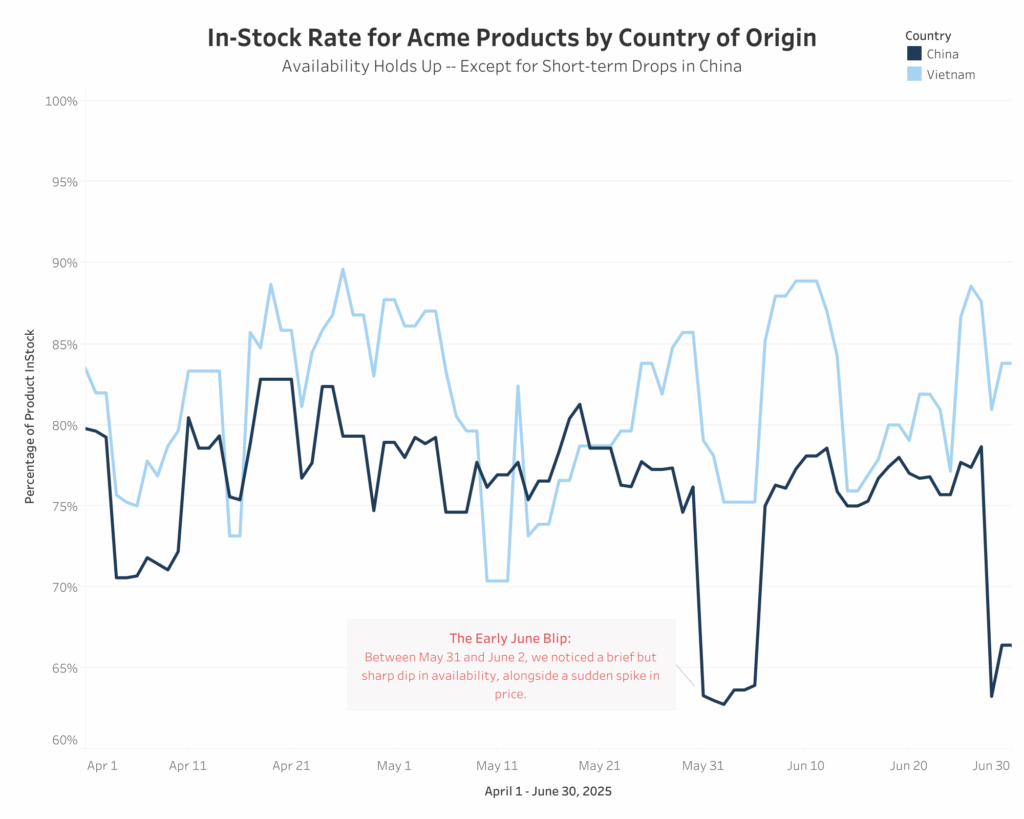
When we look at in-stock rates, the contrast is surprisingly calm. China-sourced products held steady between 75–80% availability across most of Q2, without the dramatic dips we saw back in March. Earlier, we noticed a sharp but temporary spike in prices from May 31-June 5, and we see there’s a similar and slight dip around the same time in product availability for China. Neither the price spike nor the stock drop lasted long, but the overlap raises questions. Was it a momentary stockout? A rush in orders? Or just a pricing overreaction? We can’t say for sure, but this short-lived bump reminds us how fast markets can respond to even the hint of disruption, especially when trade policy is already in flux.

Vietnam, on the other hand, maintained strong availability throughout, hovering around or above 85%, with no major stock issues observed. That stability makes the consistent price climb even more interesting. Unlike the case with China, there wasn’t a supply squeeze driving the rise, no sudden dips in availability to explain the shift. Instead, the data points to something more deliberate. 

The fact that prices rose while in-stock rates remained high suggests that sellers weren’t reacting to shortages — they were responding to perceived risk. With the U.S. floating a potential 46% tariff on Vietnamese goods in April and entering tense negotiations by mid-May, the increase in prices was likely less about immediate disruptions and more about gradual supplier adjustments — a way to prepare for possible cost increases and ongoing trade uncertainty. In other words, Vietnam’s rising prices weren’t a reaction to disruption — they were a signal of expectation. That slow, steady climb aligns with a market adjusting proactively, not defensively. And in a way, it reinforces just how differently the two supply chains, China and Vietnam, absorbed the shock of Q2’s tariff tensions.

While China’s pricing story was volatile and reactive, Vietnam’s was patient but firm. And that distinction — fast shock versus slow adaptation — might hint at deeper differences in how these sourcing pipelines absorb and respond to policy uncertainty.

“Tariffs don’t show up in strategy decks. They show up on product pages. Our Rainforest API caught it in real time. China’s supply chain took a hit fast. Vietnam climbed slow and steady. This stuff doesn’t scream. It whispers. And if you’re not watching closely, you miss it. Brands need to be tracking live data at the SKU level. Otherwise, you’re making decisions blind. The shelf is shifting whether you’re looking or not.”

– Ria Delamere, CTPO at Traject Data

Bringing Clarity to Chaos: Traject Data’s Role in Ecommerce Monitoring

This kind of granular, real-time analysis wouldn’t be possible without reliable ecommerce APIs — and that’s exactly where Traject Data comes in. With access to live and historical product data across major retailers like Amazon, Walmart, and Target, Traject Data’s SERP and ecommerce APIs make it easy to track price shifts, stock changes, and competitive movements as they happen. Whether you’re monitoring tariff impacts, analyzing supplier behavior, or forecasting future disruptions, our data helps you see the story unfolding at the product level — not just in policy papers. In an environment where global trade policy can shift overnight, having this level of visibility is more than useful — it’s essential.

Sources

How to Scrape Amazon ASIN Numbers (Without the Headaches)

If you’re working with Amazon product data—whether for ecommerce analytics, price tracking, or product research—you’ve likely run into the need to collect Amazon ASINs at scale. In this post, we’ll show you how to scrape Amazon ASIN numbers quickly and reliably using an ASIN lookup API designed for performance and scale. Let’s dive in.

What Is an Amazon ASIN?

The Amazon Standard Identification Number (ASIN) is a unique 10-character alphanumeric code used by Amazon to identify products in its marketplace.

Here are a few key facts about ASINs:

  • Amazon’s internal ID system: ASINs help Amazon track and organize millions of products.
  • Not globally standardized: Unlike UPCs or EANs, ASINs only exist within Amazon’s ecosystem.
  • Books are different: For books, the ASIN is typically the same as the ISBN.
  • Regional differences: A single product may have different ASINs across marketplaces like Amazon.com, Amazon.ca, or Amazon.co.uk.

Where to Find an Amazon ASIN (Manually)

If you only need one or two ASINs, manual lookup is fine:

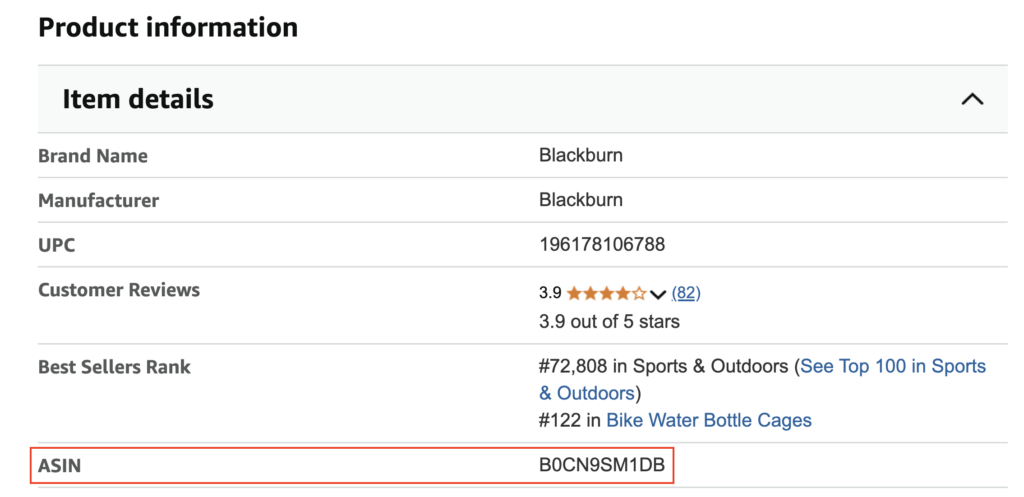
  • Check the product detail page under “Product Information”
  • Look in the URL, typically found after /dp/

But if you need to find hundreds or thousands of ASINs—especially based on barcodes or product identifiers—manual methods won’t cut it. That’s where an ASIN lookup API becomes essential.

Why Scraping Amazon ASINs Is Hard (Without an API)

Scraping Amazon at scale is no easy task:

  • Ever-changing HTML structures: Amazon’s dynamic layout and A/B testing can easily break DIY scrapers.
  • Anti-scraping defenses: CAPTCHAs, IP blocking, and rate limits make automated scraping unreliable.
  • Compliance issues: Understanding Amazon’s terms of service is crucial.
  • Time and cost of maintenance: Scrapers require constant updates and monitoring.
  • Data cleanup: Raw scraped data often needs validation and filtering before it’s usable.

Instead of building your own solution, you can use a specialized ASIN lookup API like Traject Data’s Rainforest API, which handles all the heavy lifting.

How to Use Rainforest API for ASIN Lookup

The Rainforest API makes it easy to scrape Amazon ASINs by converting barcodes (GTINs, UPCs, EANs, or ISBNs) into ASINs automatically. This makes it one of the most effective ASIN lookup APIs on the market.

How ASIN Lookup Works with Rainforest API

  1. Set type=product
  2. Add the gtin parameter (e.g., a UPC, ISBN, or EAN)
  3. Specify the correct Amazon domain using amazon_domain

Rainforest will look up the GTIN on the Amazon site you specify, convert it into an ASIN, and return complete product data.

Example: ASIN Lookup by EAN

https://api.rainforestapi.com/request?api_key=demo&type=product&amazon_domain=amazon.co.uk>in=5702015866637
  

This query returns the ASIN and product details for the EAN 5702015866637 on amazon.co.uk.

You can review all product data parameters here.

Why Choose Rainforest API as Your ASIN Lookup Tool?

Traject Data’s Rainforest API is:

  • Purpose-built for Amazon product scraping
  • Bypasses anti-scraping blocks automatically
  • Converts GTINs to ASINs reliably
  • Returns structured, clean product data
  • Supports bulk queries for scale

Whether you’re managing a product catalog, tracking marketplace trends, or building an ecommerce app, the Rainforest API is the ASIN lookup API built to save you time and effort.

Start Scraping Amazon ASINs Today

Looking for a fast, reliable way to scrape ASINs from Amazon?

Traject Data’s Rainforest API is your go-to ASIN lookup API—built to handle large-scale, automated product lookups with ease.

👉 Sign up for free to try the Rainforest API
👉 Explore the full Rainforest API documentation
👉 Watch the Rainforest API “Get Started” video

Traject Data is Your Premier Partner in Web Scraping


Join thousands of satisfied users worldwide who trust Traject Data for all their eCommerce and SERP data needs. Whether you are a small business or a global enterprise, our entire team is committed to helping you achieve your goals and stay ahead in today's dynamic digital landscape. Unlock your organization's full potential with Traject Data. Get started today.

Get started today