Skip to content

Harnessing the Power Of SERP APIs to Spearhead Your SEO Strategy

Organic traffic means interested buyers looking for your product come knocking at your door rather than chasing down each lead one pay-per-click at a time. SEO leads have a 700% higher close rate than outbound leads, and the vast majority of marketers consider organic traffic and SEO to generate more leads than other marketing initiatives. 

But I’m guessing you’re already convinced of the importance of SEO and rank tracking, so the next question is: how do you get there? With the vast ocean of content available today, ranking high on a search page doesn’t happen automatically. You have to put in the work. Smart companies like Zappos have improved their rank in search by investing heavily in SEO to stand out in highly competitive markets. 

To succeed at SEO, you need data—accurate, real-time data—to stay on top of search engine performance. This data is retrieved using SERP APIs (Search Engine Results Page APIs) also known as Search Engine APIs or web scraping APIs. These tools allow marketers to access critical search data directly from platforms like Google and Bing, enabling data-driven decisions that can significantly improve SEO strategies.

Google ranking system continually evolves through algorithm updates that impact search results, which can vary by geographic location, language, device, and user behavior. Additionally, Google frequently conducts A/B tests, meaning that users in test groups may see different results than others. These factors make it impractical to manually track search engine rankings, making SERP APIs essential for efficient monitoring.

Leveraging a trusted SERP API ensures that your data is not only accurate but also up-to-date. With real-time SERP data, you can continuously monitor search trends, competitor performance, and ranking shifts without the hassle of manually gathering information. This automation is crucial to act quickly and seize opportunities in an ever-changing landscape.

What Do SERP APIs Do?

SERP APIs deliver critical search engine result page information directly from the source. By querying search engines like Google, Bing, Yahoo, and region-specific engines like Baidu and Naver, these APIs provide up-to-the-minute data about how specific search terms are ranking, the appearance of the full search results page, and location-specific performance. This real-time data is invaluable for tracking SEO performance with precision.

Whether you want to monitor keyword rankings, identify which results are appearing in featured snippets, or evaluate local SERPs for more targeted strategies, a SERP API gives you a powerful toolset to gather this information at scale. Unlike manual web scraping or traditional scraping tools, a SERP API provides structured data efficiently, which is crucial for analyzing SERP data and making strategic SEO decisions.

With the right API, you can track an extensive range of metrics:

  • Search term rankings
  • Position changes over time
  • Full-page results, including featured snippets, ads, and related questions
  • Geographic performance, helping you localize campaigns

Using SERP APIs to Make Decisions

Data-driven decision-making is the foundation of modern SEO strategies. By using SERP tracking APIs, you can easily monitor keyword movements in real-time. This enables quick identification of market shifts, helping to adjust content strategies as necessary. If a keyword suddenly drops in ranking, marketers can investigate and take action before losing valuable traffic.

Tracking competitive activity is another major benefit of using SERP APIs. With continuous monitoring, you can stay informed about changes in competitor rankings, keyword targeting, and even their presence in rich results like image packs or featured snippets. This gives you the competitive edge to adjust your strategy and stay on top of the market.

For data analysis, SERP APIs enable the export of search data in various formats. Whether integrating JSON or HTML files into a custom dashboard or analyzing data in tools like Excel or Google Sheets, this structured, exportable data can be visualized to identify trends, gaps, and opportunities.

  • Track keyword rankings to identify emerging opportunities
  • Analyze Search Engine Results Pages (SERPs) for actionable insights
  • Generate automated, real-time reports for easier decision-making
  • Stay ahead of competitors by monitoring their activity

How to Choose the Right SERP API

Not all SERP API providers are created equal. When evaluating a SERP API provider, consider these key factors to ensure you’re selecting the best fit for your needs:

  • Infrastructure: The API should be built on reliable infrastructure to provide real-time data with minimal latency and downtime.
  • Search Engine Coverage: Depending on your market, you’ll need a SERP API that can pull data from various search engines, not just Google. Ensure that your API covers Bing, Yahoo, Amazon, and Ebay. Depending on the geographic markets you want to reach, you’ll also need an API that covers regional search engines such as Baidu, Yandex, and Naver.
  • Performance and Reliability: Fast, reliable SERP data is essential for efficient analysis. The SERP scraper should deliver clean, structured results that comply with search engine API guidelines. Some APIs return data in raw, unstructured formats that require additional parsing to remove extraneous information, which can slow down analysis. Advanced APIs streamline this by automating the parsing process, providing ready-to-analyze data from the start.
  • Integration Abilities: Whether you’re integrating the SERP API into an existing tool or analytics platform, seamless integration is vital. Evaluate the SERP API vendor’s batch automation and delivery options. Can the API provider deliver the required data to your specified destination frequently enough to keep you updated on search results?
  • Scalability: As your SEO requirements expand, your SERP API should be capable of scaling alongside them. Look for a provider that can manage large request volumes—tracking thousands or even millions of keywords and their ranking changes in real time—without sacrificing performance. Flexible, scalable pricing is also key, allowing you to adjust costs based on your current needs as your business grows.
  • Documentation and Support: Good documentation reduces the learning curve for your developers. Additionally, responsive customer support ensures that any issues are addressed promptly, minimizing downtime and enhancing your ability to act quickly on your SEO data.
  • Free Trial: Before committing to a contract, leverage a free trial of a SERP API to explore its capabilities and assess whether it’s suitable for your needs.

Work with Traject Data for Your SERP API Needs

At Traject Data, we understand that every business has unique SEO needs. That’s why we offer three distinct SERP APIs tailored to fit different business models with the ability to scale as your needs scale:

  • SerpWoW supports web scraping tools for all major search engines, including Google, Bing, Yahoo, Baidu, Yandex, Naver, Amazon and Ebay. 
  • Scale SERP provides clean and trusted search data for Google, including localized search results. 
  • VALUE SERP is a pay-as-you-go API that gives you the data you need when you need it, at the best price.

Ready to optimize your SEO strategy with reliable search engine data? Learn more about how Traject Data can help you stay ahead of the competition.

Ready to See What Traject Data Can Help You Do?


We’re your premier partner in web scraping for SERP data. Get started with one of our APIs for free and see the data possibilities that you can start to collect.
Prime Big Deal Days: Rainforest API Helps Customers Gather Valuable Data

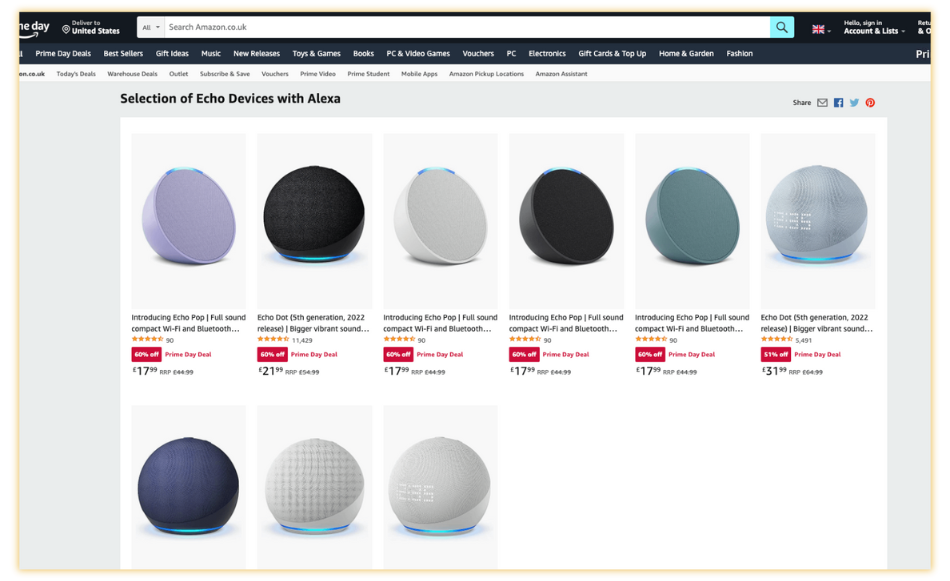
To build their own effective pricing and product strategies, Amazon sellers and competitors need to keep an eye on the strategies of successful brands, especially during major sales events like Prime Days. Rainforest API captures timely deal and discount data to keep your Amazon analytics and tools fresh.

  • Track ASINs at scale without worrying about maintaining web scrapers
  • Monitor competitor pricing
  • Learn how to optimize your assortment
  • Analyze competitor ad strategy

      In the weeks leading up to the recent Prime Big Deal Days, the Rainforest API team added new features which expanded Prime deals data collection from multiple page (request) types. In the days leading up to the sale, the team carried out testing to prepare for enhanced blockers. What were the results?

      • 24.6M Product Requests with a 94.16% success rate
      • 7.29 M Offers Requests with a 99.5% success rate
      • 6.21M Search Requests with a 99.82% success rate

      Here’s the latest on how Rainforest API can support your competitive and market insights during Prime sales events:

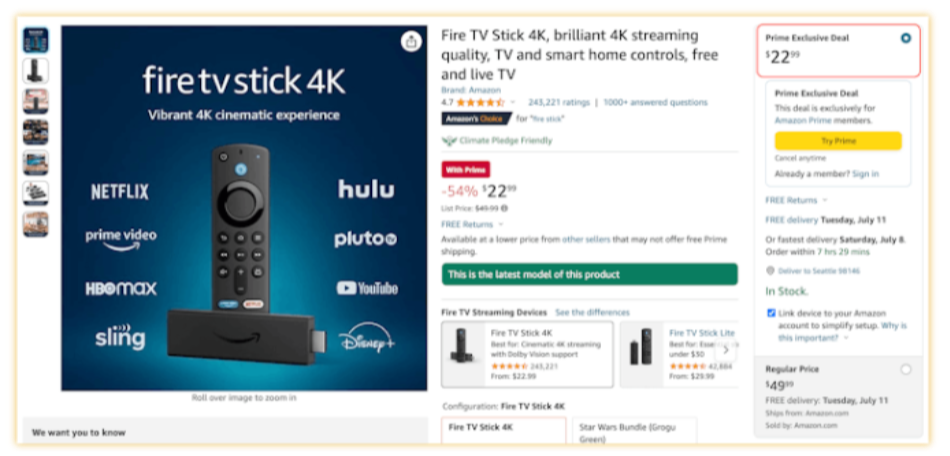
      Rainforest product results capture Prime Exclusive deals and deal badge

      Rainforest API returns results with is_prime_exclusive_deal when request type=product to indicate whether a product is a Prime Exclusive Deal. View docs.

      [NEW since last Prime Day] Rainforest can now return results with deal_badge when request type=product to indicate that a deal badge is present and the text presented.

      [NEW] Rainforest deals results capture Prime Day and Prime Exclusive deals

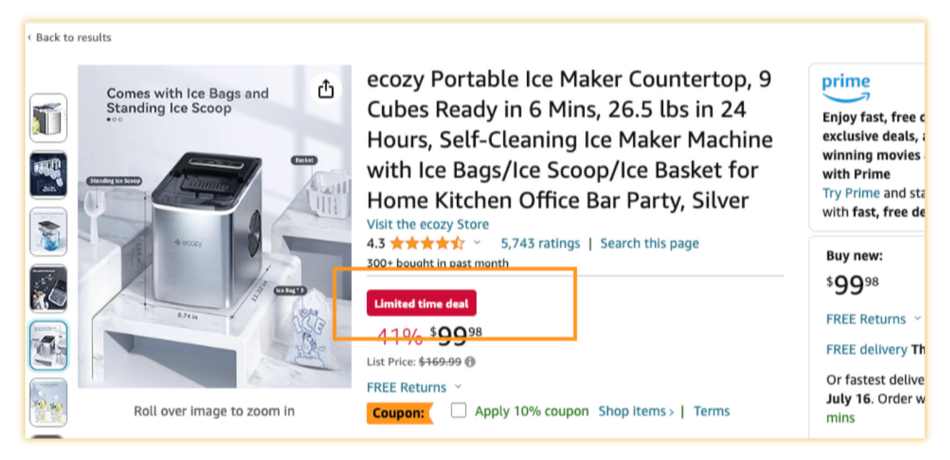
      Rainforest API now returns deal_badge when request type=deals to indicate the type of deal presented. On the Amazon page, the badge is currently the red text to the right of the % off.  Examples of this include “Limited Time Deal,” “With Prime,” and “With Prime early access.” View Docs.

      [NEW] Rainforest search results return a deal object

      Rainforest API returns a deal object with a type=search request. The object returns three possible results: link, text and badge_text. View docs.

      If you’re new here, check out Rainforest API.

      Ready to See What Traject Data Can Help You Do?


      We’re your premier partner in web scraping for eCommerce data. Get started with one of our APIs for free and see the data possibilities that you can start to collect.
      Search and eCommerce APIs: The Smarter Way to Shop Data for Marketers

      In today’s world, marketers need access to reliable, up-to-date data for their campaigns and strategies in order to remain competitive. Traditional methods of accessing data, such as subscription platforms, can take time and effort. There is a more innovative way to shop for data — search and eCommerce APIs. 

      By purchasing this kind of data directly from an API, marketers can benefit from quick and easy access to valuable data, while saving time and money in the process. This blog post will explore the advantages of shopping for search and eCommerce data via APIs.

      Benefits of Buying Search and eCommerce Data from an API

      Buying data from an API saves time and money

      As a marketer, you know the importance of data when it comes to creating effective campaigns and identifying insights about your target audience. But accessing and analyzing all the necessary data can be costly and time-consuming. Statista reports that a whopping 9,932 martech solutions were available to marketing professionals in 2022. 

      That’s a lot of solutions to sift through to find the right one for your business. And chances are, it’s still not going to have everything you need. That’s why, according to Martech Today, the average marketer uses 6.2 different marketing data platforms to collect and analyze information. That’s a lot of platforms to pay for, maintain, and make sense of.

      Buying data directly from an API is a more cost-effective solution. APIs provide an efficient and affordable way to access the data you need without having to pay for multiple platforms. How? APIs are the powerhouse behind all the marketing platforms you’re currently using for data and insights, such as SEMrush, Moz, IRi, NPD, Nielsen, etc. 

      With an API, you only pay for the data you need, without the overhead costs associated with maintaining a large data infrastructure (i.e. platform). Additionally, you can often choose from different pricing plans that allow you to pay for the amount or level of access you need — APIs often charge based on usage or volume, which can be more affordable than paying an ongoing subscription for a large data platform. 

      APIs are more accurate and timely

      Platforms have to be updated — and the data refreshed. APIs provide real-time data as you request it. And APIs are capable of delivering data at lightning-fast speeds, with many capable of providing updates within mere seconds or even milliseconds. This is particularly useful for tracking trends and dealing with a frequently changing market, as it allows you to stay ahead of the competition by accessing the latest data as soon as it becomes available.

      For example, let’s say you are running an eCommerce store and want to track the performance of your latest product launch. By obtaining data directly from an API, you can access real-time information about customer search behavior, purchase patterns, and competitor pricing. This allows you to quickly identify any issues or opportunities and make informed decisions about how to optimize your marketing and sales efforts.

      Further, because APIs are designed to be constantly updated and maintained, the data you obtain is more accurate and reliable — there is no backend manipulation happening to it. This means you don’t have to worry about spending time and resources analyzing and validating data through multiple sources.

      Timely and accurate data is critical to marketing success. Customer behavior, purchase patterns, and market trends change constantly. Using APIs to get real-time data, you can better optimize your marketing strategies to target the right audience at the right time, with the right message.

      Ready to See What Traject Data Can Help You Do?


      We’re your premier partner in web scraping for eCommerce and SERP data. Get started with one of our APIs for free and see the data possibilities that you can start to collect.
      Most APIs are built for flexibility and scalability

      With APIs, you can quickly access the information you need and customize it to fit your specific business needs. According to Mulesoft, 77% of businesses use APIs to improve their data analysis capabilities. That’s because APIs can be integrated with just about any dashboard or visualization tool you prefer, providing you with greater control and visibility over your data. And you can use multiple APIs to get a full picture across multiple markets, channels, or products. 

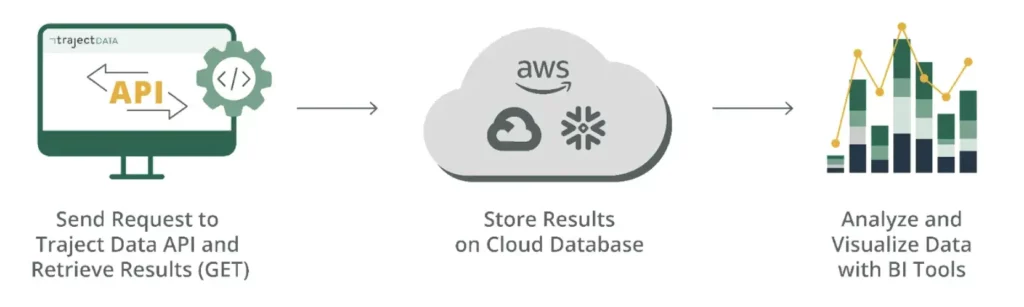
      How it works: 

      APIs are designed for automated data retrieval and to handle any spikes in demand, ensuring that your data delivery is always seamless and uninterrupted. This means you can access all the data you need, whenever you need it, without having to worry about scalability issues. 

      Get Started with a Search or eCommerce API Today

      In today’s fast-paced world, where trends and consumer behavior can change in a matter of hours, timely data is essential. Obtaining data directly from an API ensures that you have the most accurate and up-to-date information available — at a price your organization can afford.

      APIs are a powerful tool for marketers. By leveraging them for data and insights, you can gain a competitive advantage by accessing the most current and reliable information available, allowing your organization to make smarter, data-driven decisions that drive growth and success. 

      With APIs, you can leverage data insights to optimize your campaigns, increase conversions, and stay ahead of the competition. But not all APIs are created equal. Traject Data offers the largest suite of search and eCommerce APIs available. With our APIs, you get: 

      • A scalable flexible pricing model so you can purchase as little or as much data as you need, when you need it
      • Raw, robust, real-time data at the highest volume and granular enough to answer even your most specific questions 
      • Data in a variety of formats so that you can integrate it with any platform you choose and customize your analysis for unique insights

      Explore our APIs to get more data, for less.

      Traject Data is Your Premier Partner in Web Scraping


      Join thousands of satisfied users worldwide who trust Traject Data for all their eCommerce and SERP data needs. Whether you are a small business or a global enterprise, our entire team is committed to helping you achieve your goals and stay ahead in today's dynamic digital landscape. Unlock your organization's full potential with Traject Data. Get started today.

      Get started today